PRODUCTS
- Home
- Coupling
- Flexible couplings
- Shaft coupling
- Universal joints
- Support
CONTACT US
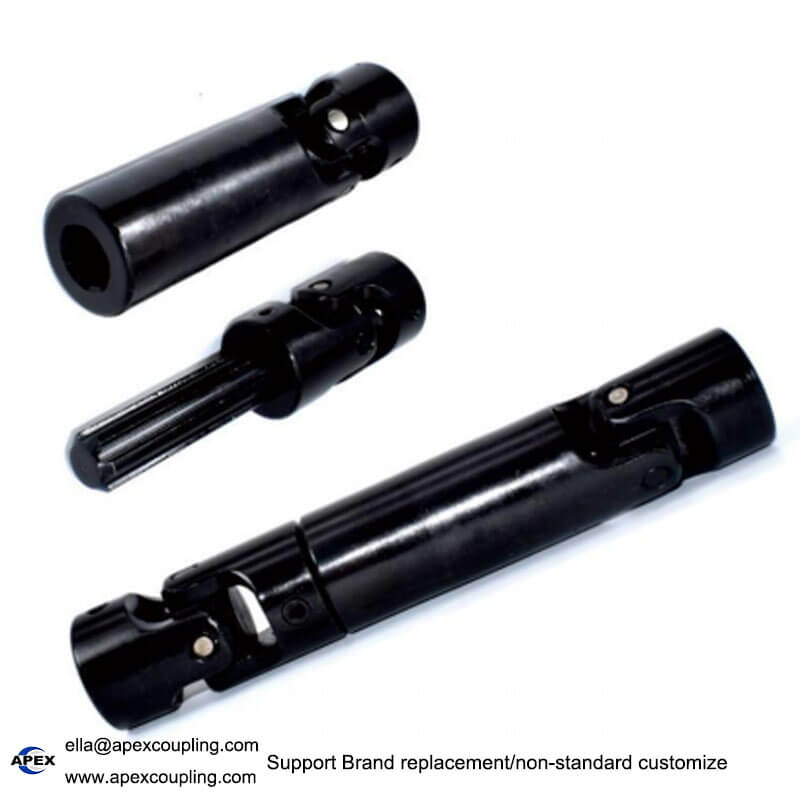
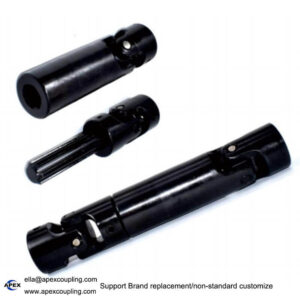
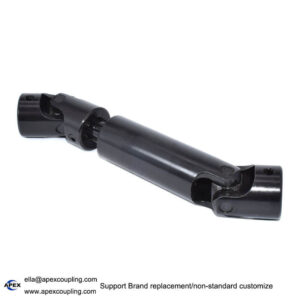
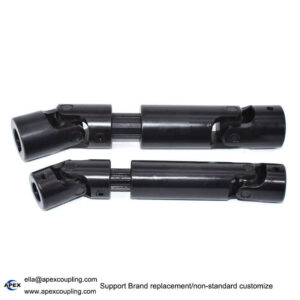
WSS Telescopic Cardan Universal Joint Shaft
Model Number
Check below, custom
WSS2
WSS3
WSS4
WSS5
WSS6
WSS7
WSS8
- Phone : +86 13431039760
- Wechat : +86 13431039760
- Whatsapp : +86 13431039760
- Email : ella@apexcoupling.com
Product Description
The WSS Telescopic Cardan Universal Joint Shaft is designed for industrial power transmission applications requiring angular movement and adjustable shaft length. Manufactured from high-quality 40Cr steel as a standard material, it is available with sliding-block or needle roller bearing configurations to suit different operating speed requirements.
With precision-finished joint components, customizable shaft lengths and multiple mounting options, this telescopic universal shaft is suitable for packaging machinery, woodworking equipment, multi-spindle drilling machines, metallurgical equipment and other specialized machinery. Custom designs and alternative materials are available upon request.
WSS Telescopic Cardan Universal Joint Shaft
Product Overview
The WSS Telescopic Cardan Universal Joint Shaft is designed to transmit rotary power between shafts operating at an angle while accommodating changes in shaft length. Its telescopic structure makes it suitable for machinery where the distance between connected components may vary during operation or installation.
The WSS series is available with different joint and bearing configurations to meet a range of industrial transmission requirements. Standard construction uses high-quality 40Cr steel, while alternative materials such as 304 or 316 stainless steel may be available for suitable applications. Selected upgraded configurations can also be manufactured using 42CrMo alloy steel; material availability should be confirmed for the required model.
Precision-finished joint components help reduce clearance and support smooth articulation. Shaft lengths, bore configurations, keyways and other mounting details can be customized according to drawings and operating conditions.
Key Features
Telescopic shaft design: Accommodates required axial length adjustment within the specified design range.
Angular power transmission: Connects shafts operating at an angle within the permitted articulation limits.
Precision-finished joints: Designed for controlled clearance and smooth movement.
Two bearing options: Sliding-block and needle roller bearing configurations are available.
Multiple speed configurations: Select the bearing type according to the required operating speed and load.
Durable steel construction: Standard 40Cr steel, with selected alternative materials available on request.
Customizable dimensions: Special shaft lengths, bore sizes and mounting configurations can be discussed.
Surface treatment options: Available finishes may include black oxide, nickel plating, chrome plating and other treatments, depending on the configuration.
Optional dust protection: A protective boot may be available to help keep contaminants away from the joint.
Technical Specifications
| Parameter | Specification |
|---|---|
| Product Series | WSS |
| Product Type | Telescopic Cardan Universal Joint Shaft |
| Standard Material | 40Cr steel |
| Optional Materials | 304 / 316 stainless steel or selected 42CrMo configurations, subject to confirmation |
| Bearing Options | Sliding-block type or needle roller bearing type |
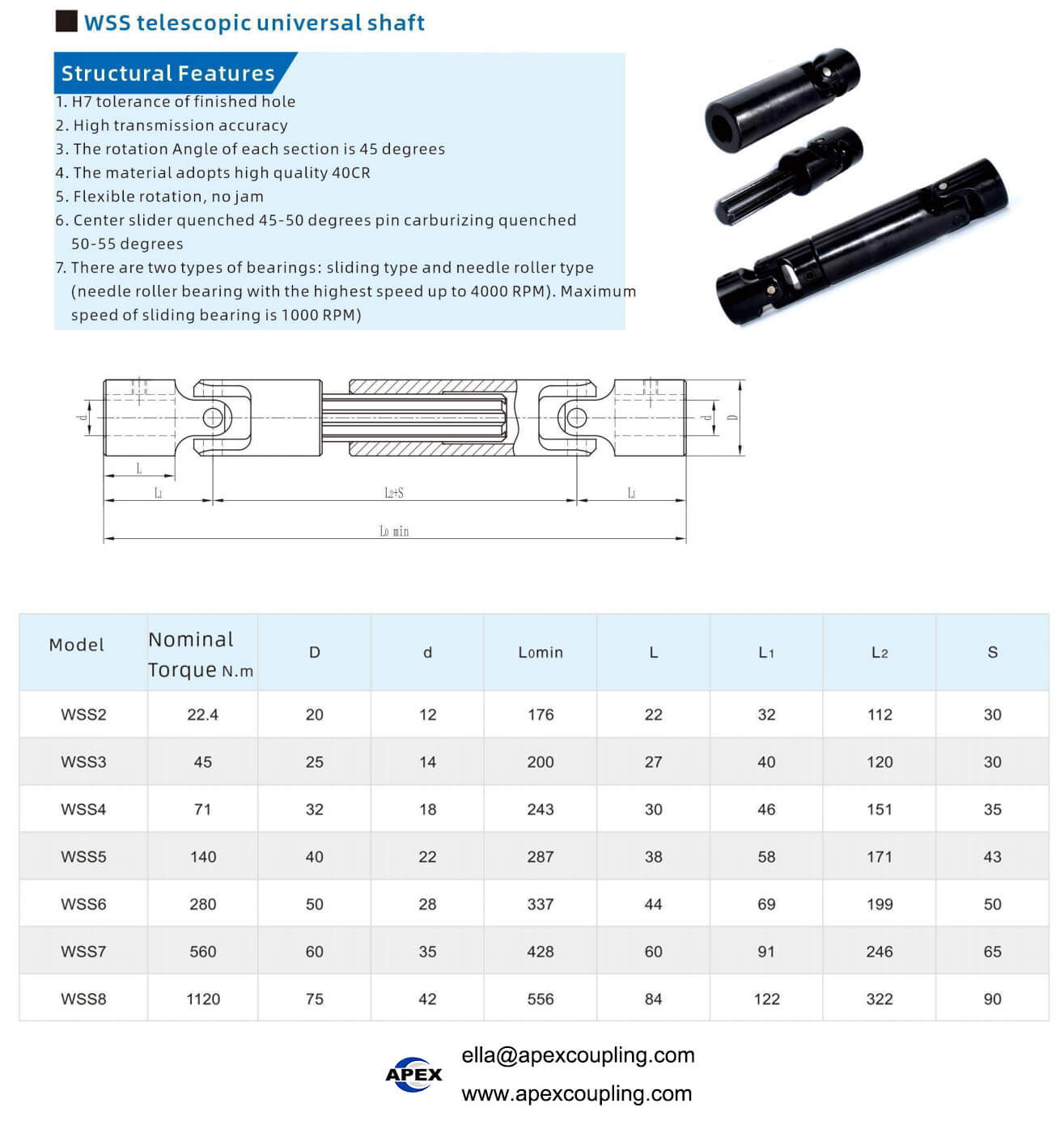
| Maximum Joint Angle | Up to 45° per joint section, according to the supplied product data |
| Recommended Working Angle | Within 30° per joint section |
| Sliding-Block Type Maximum Speed | Up to 1,000 RPM |
| Needle Roller Bearing Type Maximum Speed | Up to 4,000 RPM |
| Recommended Operating Speed | Supplier guidance recommends staying within approximately 50% of the applicable maximum speed; verify for the selected model |
| Bore Configuration | H7 finished bore available for specified quick-locking configurations |
| Mounting Options | Standard keyway, hexagonal bore or other options subject to configuration |
| Shaft Length | Custom lengths available |
| Surface Treatment | Natural finish, black oxide, nickel plating, chrome plating and other options subject to availability |
| Customization | Non-standard dimensions and mounting structures can be discussed |
Technical note: Maximum angle and speed are configuration-dependent. The stated 45° is the maximum articulation per joint section, not a recommendation for continuous operation at that angle. The recommended working angle is within 30° per section according to the supplied information. Actual limits depend on model, speed, torque, lubrication and operating conditions. Confirm the manufacturer’s drawing before final selection.
Bearing Options: Sliding Block vs. Needle Roller
Sliding-Block Type
The sliding-block configuration is intended for applications where the specified speed and load requirements can be met by the sliding joint structure. The supplied product data lists a maximum speed of up to 1,000 RPM for this configuration.
Needle Roller Bearing Type
The needle roller bearing configuration is intended for applications requiring higher rotational speeds within the rated operating limits. The supplied data lists a maximum speed of up to 4,000 RPM for selected needle roller configurations.
The maximum figures are not guaranteed operating speeds for every size. When selecting a bearing type, consider torque, duty cycle, lubrication, joint angle and the required service life.
How Does a Telescopic Cardan Universal Joint Shaft Work?
A Cardan universal joint transmits torque between two shafts whose centerlines intersect at an angle. The joint allows the connected shafts to rotate while accommodating angular misalignment within its design limits.
The telescopic section allows the effective shaft length to change within the specified stroke. This is useful when equipment geometry requires axial movement, installation adjustment or a changing distance between connected components.
The joint angle, telescopic travel, rotational speed and torque capacity must all remain within the selected model’s limits. For applications requiring a constant output speed, consider the operating characteristics of a single universal joint and whether a correctly phased double-joint arrangement is needed.
Typical Applications
The WSS telescopic universal shaft can be considered for:
Packaging machinery
Woodworking machinery
Multi-spindle drilling machines
Metallurgical equipment
General industrial machinery
Specialized mechanical transmission systems
Equipment requiring adjustable shaft length and angular power transmission
The correct shaft should be selected according to the machine’s operating speed, torque, angle, telescopic travel and installation space.
Material and Surface Treatment Options
The standard material listed for the WSS series is 40Cr steel. Depending on the design and application, alternative material options may include 304 or 316 stainless steel. Selected upgraded models may be available in 42CrMo alloy steel.
Surface treatment options may include natural finish, black oxide, nickel plating, chrome plating and other corrosion-protection treatments, subject to product availability and technical requirements.
Please specify the working environment, including moisture, dust, temperature and exposure to corrosive substances, so the appropriate material and finish can be reviewed.
Customization and OEM Manufacturing
Apex Coupling supports inquiries for non-standard universal joint shafts. Depending on feasibility, customization may include:
Overall shaft length and telescopic travel
Bore diameter and tolerance
Keyway or hexagonal bore
Sliding-block or needle roller bearing configuration
Material selection
Surface treatment
Optional dust protection
Special mounting dimensions based on customer drawings
For a quotation, please provide the shaft drawing or dimensions, required quantity, operating torque, speed, working angle, telescopic travel and application details.
How to Select the Right WSS Universal Joint Shaft
Confirm the shaft length and travel. Specify the installed length and the required telescopic movement.
Calculate the operating torque. Include normal running torque, starting torque and peak loads.
Check the working angle. Keep the operating angle within the model’s recommended limit.
Choose the bearing type. Compare the speed and load requirements against the selected sliding-block or needle roller configuration.
Specify the material. Confirm whether standard 40Cr steel or an alternative material is required.
Confirm the mounting connection. Specify the bore diameter, H7 tolerance where required, keyway, hexagonal bore or other interface.
Consider the environment. Select an appropriate surface treatment and determine whether a dust boot is needed.
Review the technical drawing. Verify dimensions, telescopic travel, lubrication requirements and allowable operating conditions before installation.
Request a Quote
Looking for a WSS telescopic Cardan universal joint shaft for your equipment? Send Apex Coupling your shaft dimensions, operating conditions and technical drawing for a configuration review.
OEM and ODM inquiries for special lengths, mounting interfaces, materials and surface treatments are welcome.
Email: ella@apexcoupling.com
WhatsApp: +86 13437856962
Contact our team to discuss your application, technical requirements and quotation.
Frequently Asked Questions
1. What is a telescopic Cardan universal joint shaft?
A telescopic Cardan universal joint shaft transmits rotary power between angled shafts while allowing the shaft length to change within a specified travel range. It is commonly used in industrial machinery where angular movement and axial adjustment are required.
2. What is the difference between sliding-block and needle roller universal joints?
They use different bearing structures and have different operating characteristics. According to the supplied WSS specifications, the sliding-block type is rated up to 1,000 RPM, while selected needle roller configurations can reach up to 4,000 RPM. Confirm the actual rating for the selected model.
3. What is the maximum working angle of the WSS universal joint?
The supplied specifications list a maximum articulation angle of 45° per joint section and recommend a working angle within 30° per section. The allowable angle should be verified against the model’s technical drawing and operating conditions.
4. What material is used for the WSS telescopic shaft?
The standard material is listed as 40Cr steel. Depending on the design, 304 or 316 stainless steel and selected 42CrMo alloy steel configurations may also be available.
5. Can the shaft length and bore be customized?
Yes. Custom shaft lengths, bore configurations, keyways and other mounting dimensions can be discussed. Provide a technical drawing or the required dimensions for review.
6. Is a dust boot available?
A protective dust boot may be available for selected configurations. It helps reduce the entry of dust and other contaminants into the joint area, but it should not be assumed to make the assembly fully sealed.
7. How should I choose the right WSS universal joint shaft?
Confirm the required torque, operating speed, joint angle, installed length, telescopic travel, bore dimensions, bearing type and working environment. These details help determine a suitable configuration.
For more type universal joint, pls visit:
WSS telescopic Cardan universal joint shaftNeedle roller bearing Cardan universal jointWSS universal joint shaft with telescopic sectionCustom Cardan universal joint shaft with keywayIndustrial telescopic universal shaft with protective dust boot
Product Show
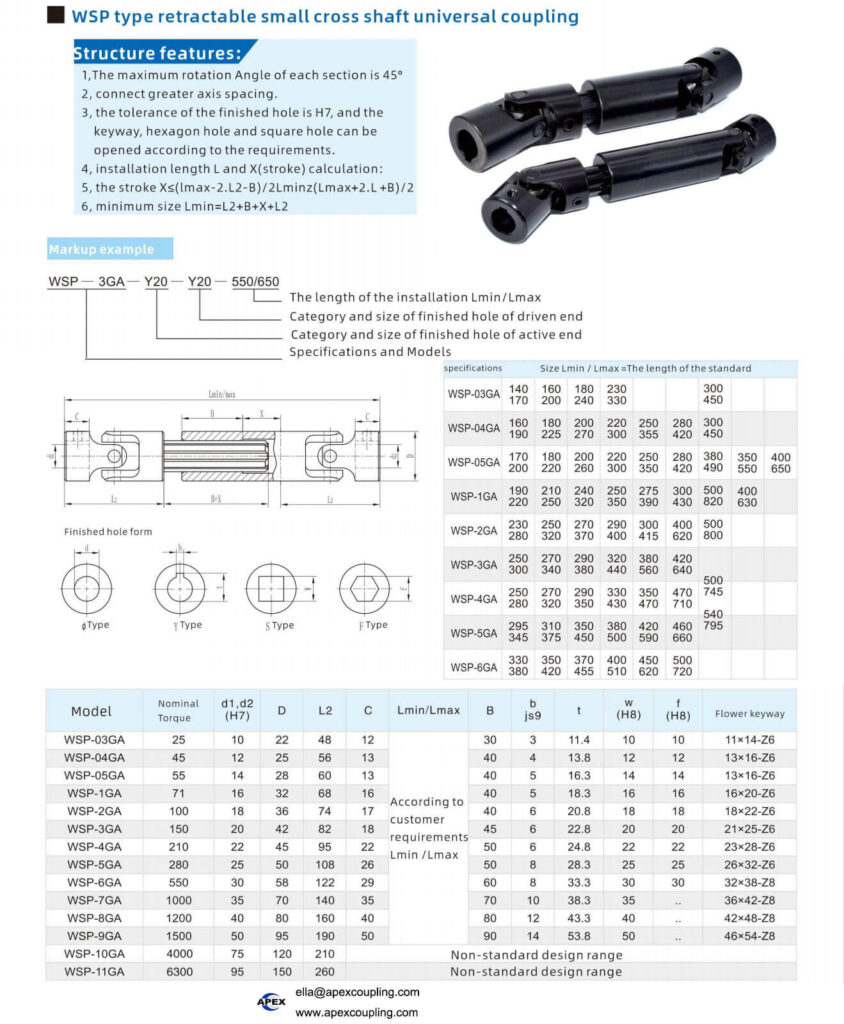
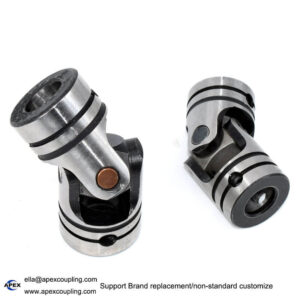
cardan universal joint