Telescopic Shaft Selection Guide for Industrial Machinery
Selecting a telescopic shaft requires more than matching the overall length. The assembly must fit the machine, provide sufficient axial travel and transmit the required torque at the specified speed and working angle.
Use the following checklist to prepare the technical details needed for product selection.
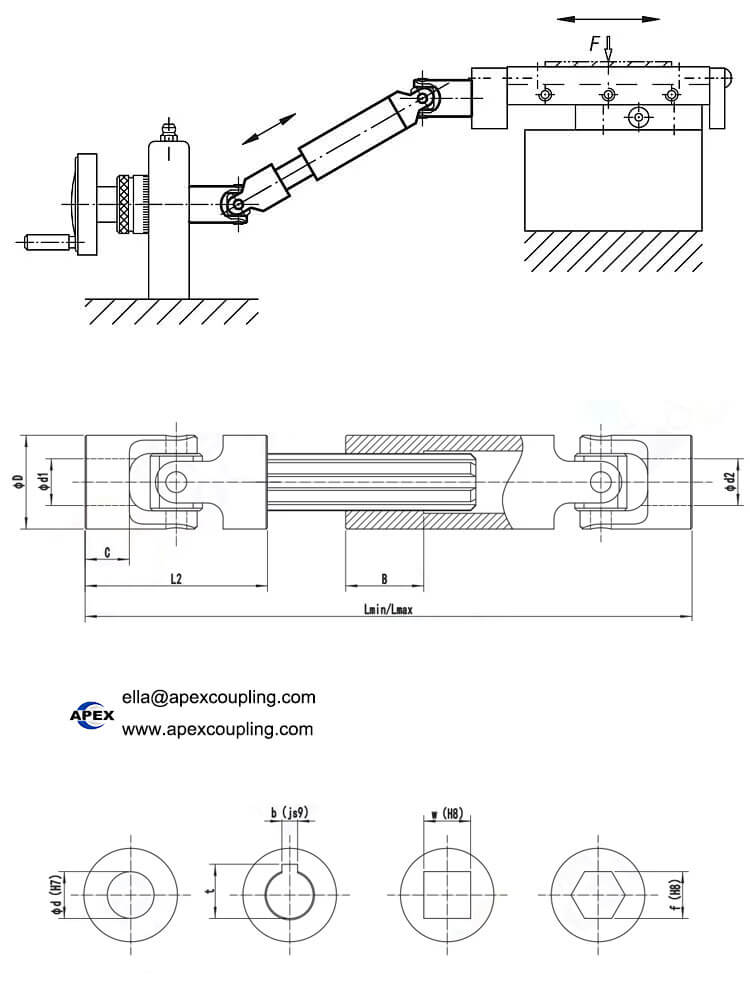
1. Define the Required Length
Identify the installed length and how it is measured. Depending on the design, the manufacturer’s stated length may refer to a particular assembly configuration.
If the shaft separation changes during operation, provide both the minimum and maximum required operating lengths.
Do not assume that a stated overall length represents the full telescopic travel.
2. Specify the Axial Travel
Calculate the difference between the minimum and maximum operating lengths. Then confirm the usable travel of the selected assembly.
Allow for installation tolerances and the movement required under actual operating conditions. The assembly should not routinely reach the end of its designed travel.
3. Measure the Shaft Connections
Record the input and output shaft diameters and specify any required keyway, spline or custom bore.
If the two ends use different dimensions, state each requirement separately. Provide a dimensioned drawing when the connection geometry is non-standard.
4. Calculate Torque Requirements
Identify continuous torque, peak loads, starting conditions, reversals and any impact loading.
Request the rated torque for the exact model. Do not assume that all sizes within a series have the same load capacity.
Where the operating load varies significantly, share the duty cycle with the manufacturer.
5. Confirm Rotational Speed
State the normal operating speed and any peak speed requirements. The suitable rating depends on the complete design, including dimensions, working angle, load and operating conditions.
Use model-specific manufacturer data rather than an unverified general maximum.
6. Determine the Working Angle
Measure the angle between the connected shaft centerlines under normal operating conditions.
Confirm the recommended continuous working angle and the maximum articulation limit separately. The allowable angle may depend on torque and rotational speed.
The CPSP product information lists 45° as an operating-angle value, but further confirmation is needed to determine whether this is a maximum or recommended continuous angle.
7. Review Material and Environment
The supplied CPSP specifications identify 42CrMo alloy steel. Confirm the material grade, heat treatment and any surface protection requirements.
For food and beverage machinery, assess the actual exposure to moisture and cleaning chemicals. Do not assume an alloy steel product is automatically suitable for direct food contact or washdown conditions.
8. Check Installation Space and Maintenance
Review surrounding components, mounting access, alignment and inspection requirements. Confirm that the assembly can move through its required travel without interference.
Use the manufacturer’s installation and maintenance instructions for the selected configuration.
9. Prepare a Complete Technical Inquiry
For accurate selection, provide:
Model or application description
Shaft diameters and connection types
Installed length
Minimum and maximum operating lengths
Required axial travel
Working angle
Torque and rotational speed
Environmental conditions
Quantity and delivery requirements
Dimensioned drawing, if available
CPSP Telescopic Shaft Options from Apex Coupling
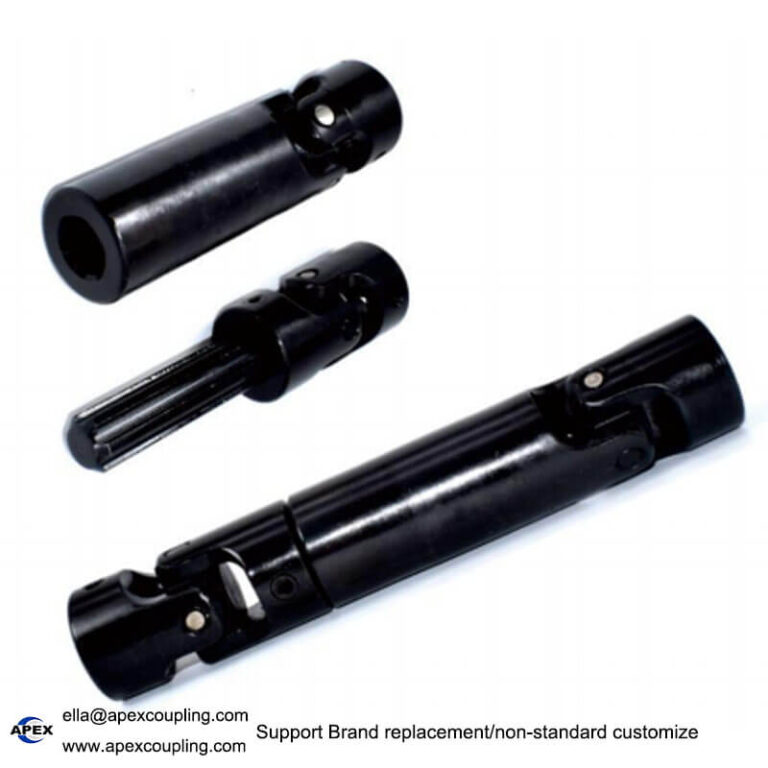
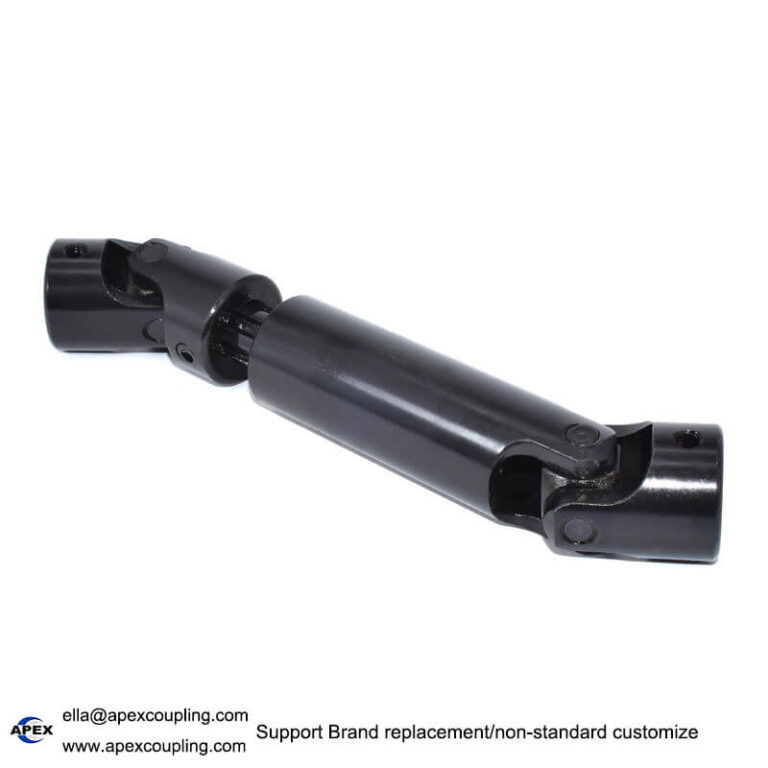
Apex Coupling’s CPSP series is listed with 42CrMo alloy steel construction, customizable shaft holes and OEM/ODM support. Several model numbers are provided, but dimensions and ratings should be confirmed individually.
Send your dimensional drawing and operating requirements to review the appropriate configuration.
Email: ella@apexcoupling.com
WhatsApp: +86 13437856962
Frequently Asked Questions
Is overall length the same as telescopic travel?
No. Overall length describes a specified assembly dimension, while telescopic travel describes the permitted axial movement. Confirm both values.
Can shaft-hole dimensions be customized?
The supplied specifications indicate customizable shaft holes. Confirm bore dimensions and connection details with the manufacturer.
Can I select a shaft using torque alone?
No. Length, axial travel, working angle, speed, shaft connections and environment also affect suitability.
What should I send for a quotation?
Provide a dimensioned drawing, operating conditions, required travel, shaft dimensions, quantity and any material requirements.
Inquiry now:
ella@apexcoupling.com
steel vs cast iron jaw coupling, rotex spider hardness guide, flexible coupling for motor, elastic coupling maintenance.