Universal Joint Selection Guide for Industrial Machinery Apex
Choosing a universal joint for industrial equipment requires a clear understanding of the shaft arrangement and operating conditions. A joint that fits the shaft diameter may still be unsuitable if its torque rating, speed limit or working angle does not meet the application requirements.
Use this guide to prepare the technical information needed for reliable product selection.
1. Measure Both Shaft Diameters
Record the diameter of each connected shaft. Determine whether both ends need the same bore or whether a different size is required at each end.
Confirm the mounting interface, including any keyway, set screw or special bore geometry. For precision installations, specify the required tolerance and verify it against the manufacturer’s drawing.
2. Establish the Required Length
Measure the available installation space and determine the required overall length. Consider the connected components, mounting access and clearance needed for the joint to articulate.
Do not rely on a model number alone to confirm the dimensions. Review the technical drawing and check how the manufacturer defines overall length.
3. Calculate the Operating Torque
Determine the continuous torque and consider additional loads caused by starting, acceleration, frequent reversal or impact.
Compare the calculated requirements with the rating for the exact model. Product-family ranges should not be treated as a universal rating for every size.
If the load changes significantly during operation, provide the complete duty cycle to the manufacturer.
4. Determine the Working Angle
Measure the angle between the connected shaft centerlines during operation.
Confirm both the recommended working angle and the maximum articulation angle. These values may differ, and allowable operation can depend on speed and load.
For arrangements with two joints, the angle at each joint and the relative joint phasing may affect motion characteristics.
5. Verify Rotational Speed
Identify the normal operating speed and any required peak speed. Check that the selected joint is rated for the intended duty cycle.
Speed suitability can depend on the joint construction, size, load, working angle, lubrication and installation. Do not select a model using an unverified general maximum-speed figure.
6. Select Material and Surface Finish
Choose a material and finish according to mechanical loads, temperature, corrosion exposure and maintenance requirements.
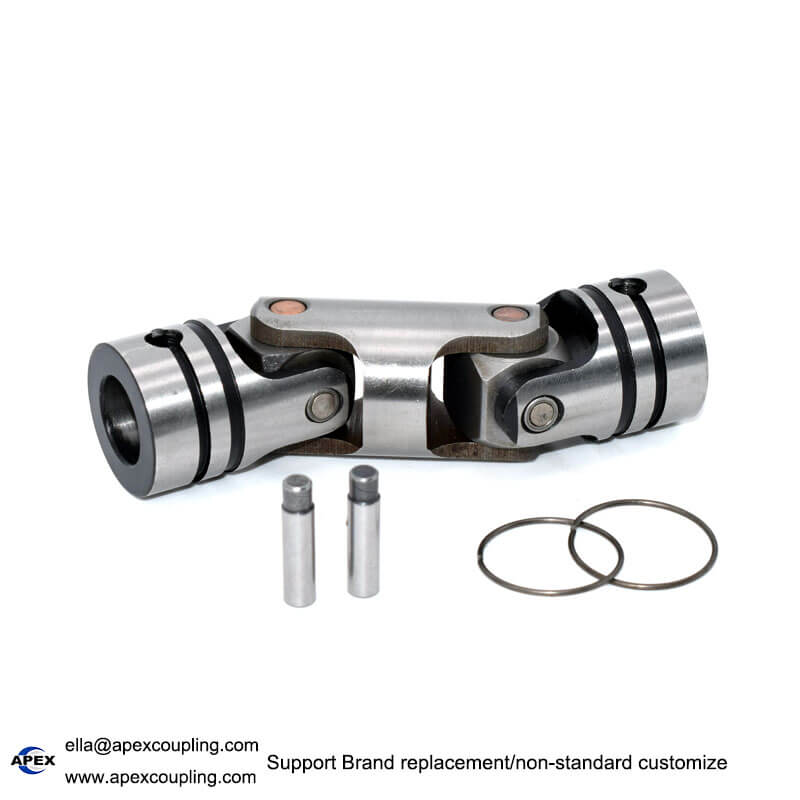
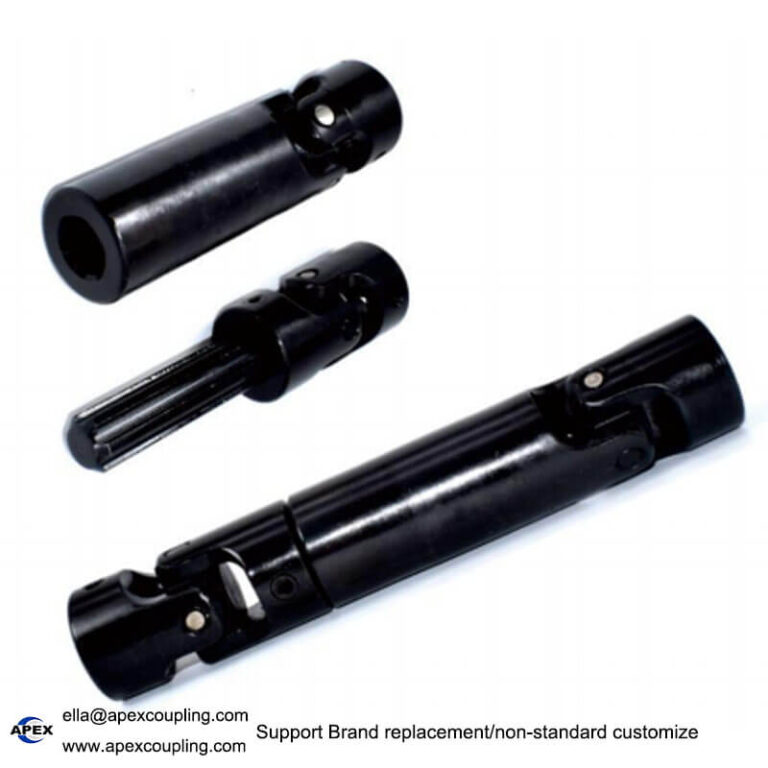
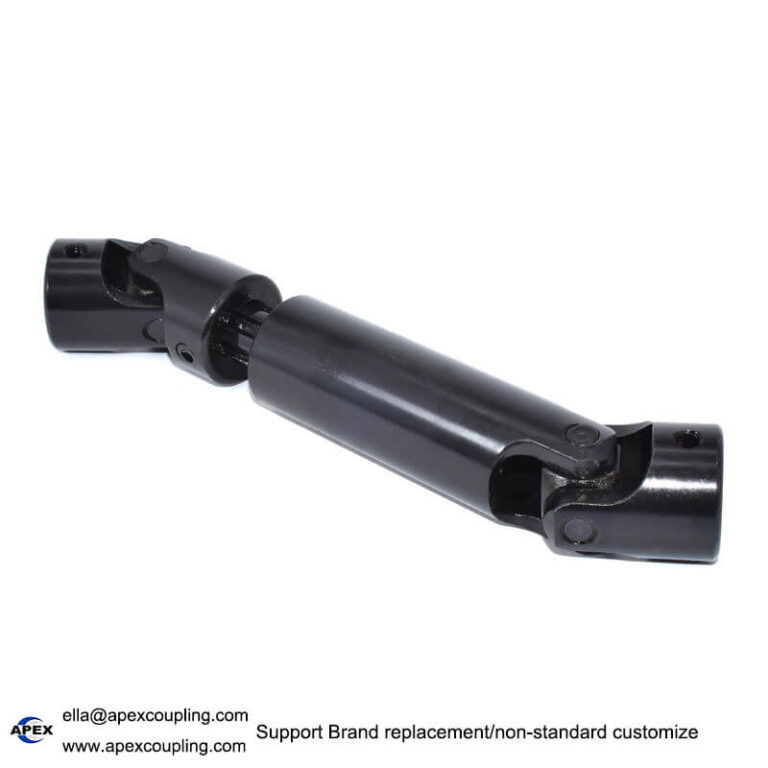
The Apex Coupling CScA/CScW series lists alloy steel as the standard material, with 304 stainless steel as a possible option subject to confirmation. The standard surface finish is blackened; nickel plating, zinc plating and polishing may be available for selected configurations.
Confirm the exact material grade and finish rather than assuming all combinations are available.
7. Review Installation and Maintenance
Check shaft alignment, mounting access, lubrication requirements and inspection intervals. The correct installation procedure depends on the joint design.
If the machine has limited space or special mounting constraints, provide a drawing showing the surrounding components and required clearances.
8. Prepare a Complete Inquiry
For efficient product selection, provide:
Shaft diameters and mounting details
Required overall length
Continuous and peak torque
Operating speed and duty cycle
Working angle
Material and surface finish requirements
Quantity and delivery requirements
Technical drawings, if available
Complete information helps the supplier review the application more accurately.
Discuss Your Application with Apex Coupling
Apex Coupling supplies the CScA/CScW fixed-pin series for selected industrial transmission applications. The supplied specifications identify alloy steel construction, a blackened finish and an optional 304 stainless steel material that requires confirmation.
To request a model recommendation or quotation, send your dimensions and operating conditions.
Email: ella@apexcoupling.com
WhatsApp: +86 13437856962
Frequently Asked Questions
Which specifications are most important?
Shaft dimensions, working angle, torque, speed and mounting requirements are essential. Material and environment should also be considered.
Can I choose a joint by shaft diameter alone?
No. The joint must also meet the torque, speed, angular and installation requirements.
Should the maximum angle be used continuously?
Only if the manufacturer confirms that it is permitted under the actual load and speed conditions.
Can non-standard dimensions be requested?
OEM/ODM inquiries can be reviewed. Availability depends on the design and technical feasibility.