Single vs Double Universal Joint – WS/WSD Selection Guide for Precision Drives
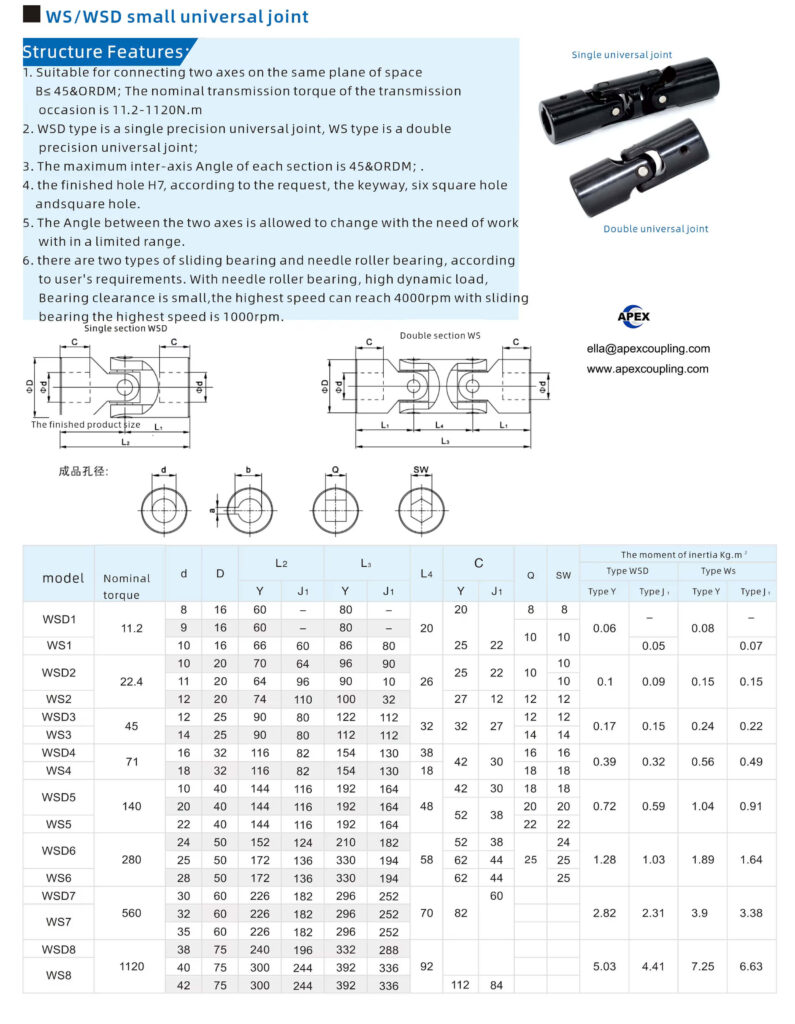
Universal joints (cardan joints) are essential for transmitting power between shafts that are not perfectly aligned. The WS/WSD series offers both single and double joint configurations, covering a torque range of 11.2 to 1120 N·m with angular capacity up to 45° per joint. Available in stainless steel, 42CrMo, or aluminum with sliding or needle bearings, this series provides maximum flexibility for a wide range of applications.
This guide helps you select the right configuration, material, bearing type, and bore option for your application.
1. Single Joint (WSD) vs Double Joint (WS) – Which One Do You Need?
| Feature | Single Joint (WSD) | Double Joint (WS) |
|---|---|---|
| Angular misalignment | ✅ Up to 45° | ✅ Up to 45° per joint |
| Parallel offset | ❌ No | ✅ Yes |
| Total articulation | Up to 45° | Up to 90° |
| Output speed fluctuation | Present (sinusoidal) | Reduced (near constant) |
| Length | Short | Longer |
| Smoothness at angle | Good | Excellent |
| Best for | Shafts intersect at an angle on the same plane | Shafts both angled and offset |
Rule of thumb for WS/WSD:
Use WSD (single joint) when shafts are on the same plane but angled.
Use WS (double joint) when shafts are both angled and offset – provides smoother motion.
2. Operating Angle – 45° Limit
The WS/WSD series allows up to 45° limit angle per joint. For continuous operation, we recommend ≤30° to ensure maximum bearing life.
⚠️ Operating at the absolute maximum angle (45°) increases wear. If your application requires constant high angle, consider reducing the angle or using a double joint configuration.
3. Bearing Selection – Sliding Bearing vs Needle Bearing
The WS/WSD series offers two bearing options:
| Parameter | Sliding Bearing | Needle Bearing |
|---|---|---|
| Max Speed | 1000 rpm | 4000 rpm |
| Dynamic Load Capacity | Good | High |
| Bearing Clearance | Moderate | Small |
| Shock Absorption | Excellent | Good |
| Friction | Higher | Lower |
| Maintenance | Requires periodic lubrication | Sealed, low maintenance |
| Best for | Low speed, high torque, shock loads | High speed, smooth rotation, precision |
Recommendation:
Choose sliding bearing for heavy-duty, low-speed applications with shock loads.
Choose needle bearing for high-speed applications (above 1000 rpm) where precision and low friction are priorities.
4. Material Selection – Stainless Steel vs 42CrMo vs Aluminum
| Material | Strength | Corrosion Resistance | Weight | Best For |
|---|---|---|---|---|
| Stainless Steel | High | Excellent | Medium | Food & beverage, chemical, marine, outdoor |
| 42CrMo Alloy Steel | Very High | Moderate | High | Heavy industrial, high torque, shock loads |
| Aluminum Alloy | Moderate | Good | Low | High speed, low inertia, precision applications |
Our recommendation:
Choose stainless steel for food processing, chemical, or outdoor applications.
Choose 42CrMo for heavy-duty industrial applications requiring maximum strength.
Choose aluminum for high-speed, low-inertia precision applications.
5. Bore Options – Keyway, Hexagon, Square, Plain
| Bore Type | Best For |
|---|---|
| Keyway | High torque, positive drive, industrial motors |
| Hexagon Hole | Quick disconnect, manual adjustment, agricultural equipment |
| Square Hole | Heavy-duty, anti-rotation, special machinery |
| Plain Hole | Simple shaft connections, general use |
We machine custom bores to your exact specifications – just provide your drawing.
6. Variable Operating Angle – A Key Feature
The WS/WSD series allows the angle between shafts to change within a limited range during operation. This is ideal for:
Applications where shaft alignment varies during operation
Machines with moving components (e.g., robotic arms)
Systems with thermal expansion or vibration
7. Applications Across Industries
| Industry | Application | Recommended Material |
|---|---|---|
| Food & Beverage | Processing equipment, conveyors | Stainless steel |
| Energy & Mining | Conveyors, feeders, crushers | 42CrMo |
| Building Material | Material handling | 42CrMo or Aluminum |
| Machinery Repair | Replacement parts | Any |
| Manufacturing | General power transmission | 42CrMo or Aluminum |
| Packaging | Wrapping machines, conveyors | Aluminum or 42CrMo |
8. Real‑World Example – Food Processing Line Upgrade
A food processing plant was using standard steel universal joints on their conveyors. The joints corroded from frequent washdowns, causing frequent failures and downtime.
They switched to Apex Coupling WSD single universal joints (stainless steel, needle bearing, H7 bore, keyway). Results:
Corrosion eliminated – stainless steel withstood washdown
Service life tripled – needle bearing provided high dynamic load capacity
Downtime reduced – reliable performance
Hygiene compliance – stainless steel meets food industry standards
9. Installation & Maintenance Tips
Check alignment – Keep angles ≤30° for continuous operation.
Lubricate regularly – Sliding bearing joints require periodic lubrication.
Needle bearing maintenance – Sealed, low maintenance – inspect periodically.
Check for wear – Inspect cross joint and bearings periodically.
Dynamic balancing – For speeds above 1000 rpm, ensure the joint is balanced.
10. Selection Checklist
Configuration: Single (WSD) or double (WS)
Material: Stainless steel, 42CrMo, or Aluminum
Bearing: Sliding (1000 rpm) or needle (4000 rpm)
Torque: 11.2–1120 N·m – select based on your requirement
Angle: Up to 45° – keep ≤30° for continuous use
Bore type: Keyway, hexagon, square, or plain
Bore tolerance: H7 for precision shaft fit
11. Conclusion
The WS/WSD small universal joint coupling from Apex Coupling offers the perfect combination of strength, flexibility, and precision for light to medium-duty industrial applications. With 11.2–1120 N·m torque capacity, 45° angular flexibility, H7 bore precision, three material options, and two bearing options, it is the ideal solution for food & beverage, energy & mining, building material, and general industrial drives.
👉 Need a universal joint for your application? Contact us with your configuration, torque, speed, material, and bore requirements.
Inquiry now:
ella@apexcoupling.com
single vs double universal joint
WS WSD selection guide
precision universal joint coupling
stainless steel universal joint
sliding bearing vs needle bearing
11.2-1120 N.m universal joint
H7 bore universal joint