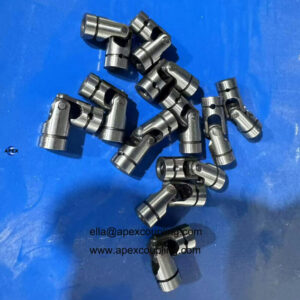
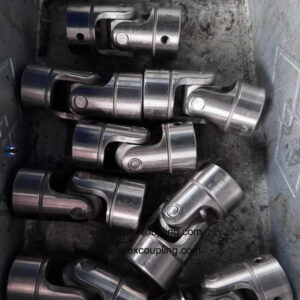
Introduction In a modern production facility, noise isn’t just a nuisance—it’s a sign of mechanical inefficiency. Excessive vibration and friction in universal joints can lead to premature wear and system failure. Our UNKW and CSKW series are specifically engineered to solve the “Noise vs. Torque” dilemma.
1. The Secret to Low-Noise Transmission The noise in a universal joint often comes from the “play” or clearance between the pin, bearing, and sleeve. By utilizing H7 precision machining, we eliminate unnecessary gaps. This tight fit ensures that torque is transferred smoothly, keeping noise levels at a minimum even during high-speed operation.
2. 42CrMo: The Foundation of Strength A quiet joint is useless if it can’t handle the load. By using 42CrMo alloy steel, we ensure the UNKW series can manage the high-torque demands of industrial robots and automated assembly lines. The material’s natural toughness helps dampen vibrations, further contributing to a quieter workspace.
3. Compensating for Complex Misalignments Many engineers face the challenge of radial and angular deviations. The UNKW/CSKW series provides a large angle compensation (up to 45°), allowing the joint to “absorb” installation errors that would otherwise cause grinding and loud mechanical stress.
4. Customization for Specialized Environments Do your machines operate in a cleanroom or a high-moisture environment? We offer 304 Stainless Steel versions and Nickel Plating options. These treatments don’t just prevent rust; they maintain the surface smoothness required for low-friction, low-noise performance over years of service.
Conclusion If your goal is a more reliable, quieter, and efficient machine, the UNKW/CSKW series is the precision component you’ve been looking for.
reduce coupling noise, high torque low noise joint, UNKW series benefits, precision automation parts, industrial transmission silent solutions.