Flexible Jaw Coupling Selection — Torque, Speed and Bore Size
Selecting a flexible jaw coupling requires a clear understanding of the connected equipment and its operating conditions. A coupling that fits the shaft diameter may still be unsuitable if its torque rating, speed limit or elastic element does not match the application.
Flexible jaw couplings use two hubs and an elastic spider to transmit torque between connected shafts. They are widely considered for industrial drive systems where a compact connection and some flexibility are required.
This guide explains the main parameters to check when selecting a flexible jaw coupling.
1. Start with the Application Requirements
Before comparing coupling models, gather the basic information about the drive system.
Identify the driving equipment, driven equipment, normal operating load, starting conditions, operating speed and available installation space.
Also determine whether the machine frequently starts and stops, reverses direction or experiences shock loads. These factors can affect the required coupling capacity and spider selection.
A clear application specification helps prevent selection based only on price or nominal bore diameter.
2. Calculate the Required Torque
Torque is one of the primary parameters used to size a flexible jaw coupling.
For a rotating system with known mechanical power and rotational speed, torque can be estimated using:
[
T=\frac{9550P}{n}
]
Where:
(T) is torque in N·m.
(P) is power in kW.
(n) is rotational speed in RPM.
This formula provides an estimate of torque under the stated power and speed conditions. The final coupling selection must also account for the equipment’s load characteristics and the manufacturer’s rating method.
For applications with shock loads, frequent reversing or heavy starting conditions, the required design capacity may be higher than the calculated normal operating torque.
3. Verify the Coupling’s Torque Rating
After estimating the required torque, compare it with the rated torque of the exact coupling size and spider configuration.
Do not assume that every size in a product series shares the same torque rating. Hub dimensions, spider material and design details can affect the permitted load.
For a reliable selection, confirm the rated torque and any applicable service factors with the supplier or technical documentation.
4. Check the Maximum Rotational Speed
The coupling must also be suitable for the required operating RPM.
Allowable speed can depend on coupling size, balance, hub construction, spider design, installation accuracy and operating conditions. A larger coupling does not necessarily have the same speed capability as a smaller one.
For high-speed applications, confirm the maximum permitted speed for the exact model and ensure that the coupling is installed according to the manufacturer’s instructions.
5. Match Both Shaft Bore Diameters
Bore diameter is a key purchasing parameter, but both shaft ends must be checked.
Record the driving-side and driven-side shaft diameters. If the shafts have different diameters, specify both sizes separately.
Also verify:
Required bore tolerance
Keyway dimensions
Shaft-end length
Hub fastening method
Overall coupling length
Available installation space
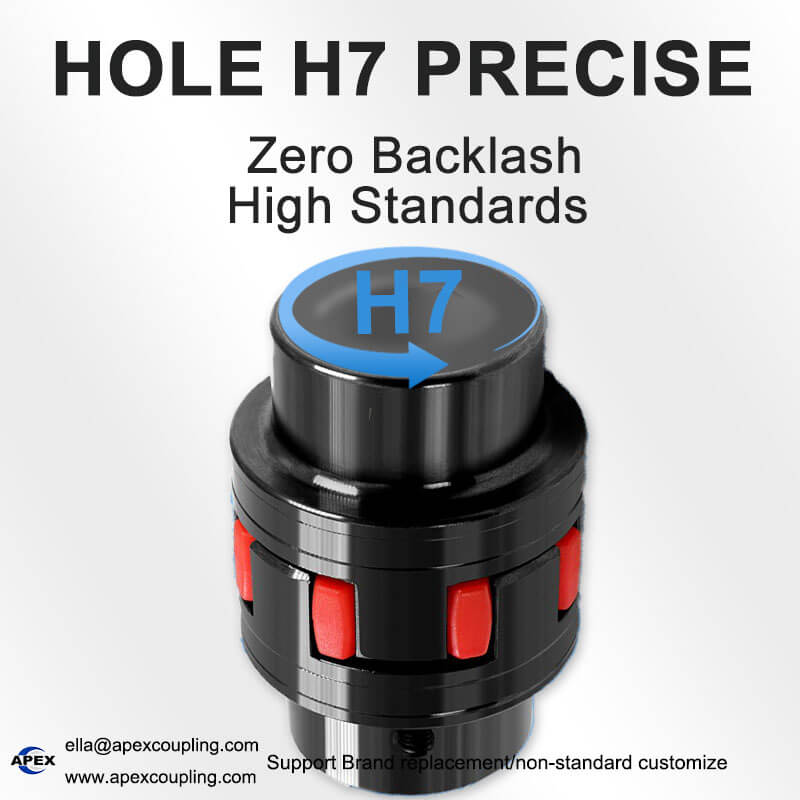
An H7 bore option may be available on selected models, but the exact tolerance and connection configuration should be confirmed for the specific coupling.
6. Select the Appropriate Spider Material
The elastic spider influences the coupling’s flexibility and load transmission characteristics.
Polyurethane spiders are used in many flexible jaw coupling designs. The correct material and hardness depend on torque, speed, temperature, environmental exposure and desired mechanical behavior.
When selecting a spider, confirm that it is compatible with the coupling hub geometry. A replacement element should not be selected based only on similar appearance or nominal size.
7. Evaluate Shaft Misalignment
Flexible jaw couplings can accommodate limited angular, radial and axial misalignment, depending on their design.
However, they should not be used as a substitute for correct shaft alignment. Excessive misalignment may increase spider wear and place additional loads on the coupling and connected machinery.
Measure the expected displacement and compare it with the manufacturer’s limits for the selected model. Follow the recommended installation procedure and verify alignment before operation.
8. Consider Temperature and Operating Environment
The spider material must be appropriate for the working environment.
Check the minimum and maximum operating temperatures, possible heat generated by the machine, and exposure to oil, chemicals, moisture or dust.
Material properties can vary between formulations, so use the verified temperature and chemical-resistance information for the specific spider rather than assuming all polyurethane elements perform identically.
9. Check Installation and Maintenance Requirements
A flexible jaw coupling should be installed according to the manufacturer’s instructions. Before assembly, inspect the hubs, shaft ends and elastic spider for damage or contamination.
During maintenance, check for unusual noise, vibration, spider deformation, cracks and excessive backlash. These symptoms may indicate wear, overload, misalignment or incorrect installation.
Replacing the spider without correcting the underlying problem may lead to repeated failures.
10. Flexible Jaw Coupling Selection Checklist
Use this checklist before requesting a quotation:
Required operating torque and any shock loads
Operating speed in RPM
Driving-side and driven-side bore diameters
Keyway and bore tolerance requirements
Coupling outside diameter and overall length
Expected shaft misalignment
Spider material and hardness
Operating temperature and environmental conditions
Installation space and maintenance access
Required quantity and customization details
Providing this information helps the manufacturer identify a suitable coupling more efficiently.
11. Star Elastic Couplings from Apex Coupling
Apex Coupling supplies flexible jaw coupling products for industrial power transmission applications. Available models, bore sizes and customization options depend on the selected series.
For assistance with selection, provide your operating torque, speed, shaft diameters and installation dimensions.
Visit our star elastic coupling product page to review the product information and submit your requirements.
Conclusion
Flexible jaw coupling selection should consider torque, rotational speed, shaft dimensions, spider material, misalignment and operating environment together.
By checking the technical requirements before ordering, buyers can reduce the risk of choosing an undersized or incompatible coupling and improve the reliability of the complete drive system.
Inquiry now:
ella@apexcoupling.com
steel vs cast iron jaw coupling, rotex spider hardness guide, flexible coupling for motor, elastic coupling maintenance.