Ball Hinge Universal Joint vs Cross Shaft – Which Design Is Right for Your Application?
Universal joints (cardan joints) are essential for transmitting power between shafts that are not perfectly aligned. Two common designs dominate the market: the traditional cross-shaft universal joint and the ball hinge (spherical) universal joint.
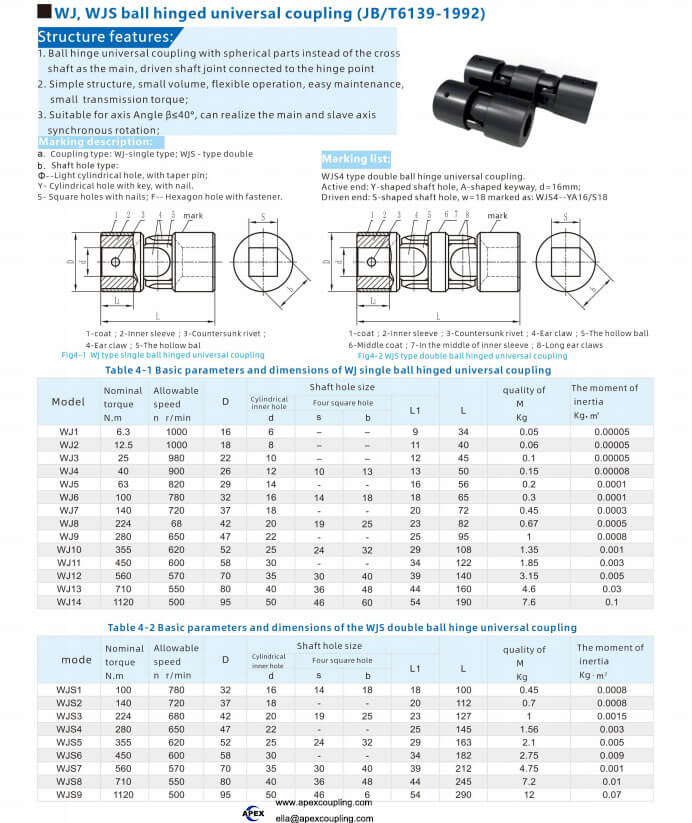
The WJ/WJS series from Apex Coupling represents the ball hinge design, offering distinct advantages for many industrial applications. This guide compares both designs and helps you select the right one for your needs.
1. What Is a Ball Hinge Universal Joint?
A ball hinge universal joint uses spherical components as the hinge point between the driving and driven shafts. Unlike cross-shaft designs, which use a four-point cross, the ball hinge uses a sphere-in-socket arrangement that provides smooth, low-friction operation.
The WJ/WJS series is manufactured to the JB/T6139-1992 standard and is available in:
WJ (single joint) – for angular misalignment only
WJS (double joint) – for angular and parallel misalignment
2. Ball Hinge vs Cross Shaft – Quick Comparison
| Feature | Ball Hinge (WJ/WJS) | Cross Shaft (Traditional) |
|---|---|---|
| Structure | Simple, compact | Complex, bulky |
| Operation | Smooth, flexible | Can be stiff at high angles |
| Maintenance | Easy | More complex |
| Torque capacity | Good for size | Higher for size |
| Angle capability | Up to 45° | Up to 45° |
| Synchronous rotation | Yes (WJ) | No (without double joint) |
| Constant velocity | With WJS double joint | With double joint |
| Cost | Economical | Higher |
| Weight | Lightweight | Heavier |
3. Advantages of the Ball Hinge Design
Simple Structure
The ball hinge design has fewer components than cross-shaft designs, reducing potential failure points and simplifying maintenance.
Smooth Operation
The spherical hinge provides smoother rotation, especially at higher angles, reducing vibration and stress on connected equipment.
Compact Size
Ball hinge couplings are smaller and lighter than cross-shaft designs for the same torque capacity, saving valuable space in machinery.
Synchronous Rotation
Unlike single cross-shaft joints, the WJ single ball hinge coupling can achieve synchronous rotation of the main and driven shafts.
Constant Velocity (WJS)
The WJS double joint can achieve constant velocity operation when properly phased – eliminating the speed fluctuations inherent in single cross-shaft joints.
4. When to Choose Ball Hinge (WJ/WJS)
Choose ball hinge universal joints when:
Space is limited – Compact design saves valuable real estate
Smooth operation is critical – Spherical hinge provides smooth, low-friction rotation
Maintenance is a concern – Simple design is easy to maintain
Synchronous rotation is required – WJ single joint provides synchronous rotation
Cost is a factor – Ball hinge designs are generally more economical
Constant velocity is needed – WJS double joint can provide constant velocity
Application is packaging, woodworking, or conveying – Common uses for WJ/WJS couplings
Choose cross-shaft universal joints when:
Extremely high torque is required
Heavy-duty applications demand maximum strength
Standard cross-shaft designs are already integrated into your equipment
5. Selecting the Right WJ/WJS Model
Step 1: Determine Single or Double Joint
WJ (single) – Angular misalignment only, constant angle, higher torque
WJS (double) – Angular and parallel misalignment, varying angle, constant velocity capability
Step 2: Calculate Torque Requirements
WJ series: 6.3–1120 N·m
WJS series: 100–1120 N·m
Step 3: Select Bore Type
Y – Keyway for high torque
Φ – Round hole with taper pin
S – Square hole
F – Hexagon hole
Step 4: Verify Speed and Angle
Speed: 500–1000 RPM (WJ), 500–780 RPM (WJS)
Angle: Up to 45° per joint
6. Real‑World Example – Woodworking Machinery Upgrade
A woodworking equipment manufacturer was experiencing premature wear and vibration with cross-shaft universal joints on multi-spindle drills. The joints operated at 30° angles and required frequent lubrication and replacement.
They switched to Apex Coupling WJ single ball hinge universal joints (42CrMo, H7 bore, keyway). Results:
Vibration reduced – ball hinge design provided smoother operation
Maintenance eliminated – no lubrication required
Service life extended – 42CrMo withstood demanding operation
Synchronous rotation – achieved precise drilling synchronization
7. Installation & Maintenance Tips
Check alignment – Keep angles within recommended limits for optimal life
For WJS double joints – Maintain equal angles on both joints for constant velocity
Align yokes – For WJS, ensure input and output yokes are in the same plane
Lubricate if required – Some applications may benefit from periodic lubrication
Inspect for wear – Check hinge points and bores periodically
Bore fit – Use H7 shaft tolerance for best concentricity
8. Selection Checklist
Configuration: WJ (single) or WJS (double)
Bore type: Y (keyway), Φ (round), S (square), or F (hexagon)
Bore size: 6–50 mm (WJ) or 16–50 mm (WJS)
Torque: 6.3–1120 N·m (WJ) or 100–1120 N·m (WJS)
Speed: 500–1000 RPM (WJ) or 500–780 RPM (WJS)
Angle: Up to 45° per joint
Material: 42CrMo or 304 stainless steel
Finish: Black oxide, polished, nickel, zinc, or chrome
9. Conclusion
The ball hinge universal joint (WJ/WJS) from Apex Coupling offers a compelling alternative to traditional cross-shaft designs – with simpler structure, smoother operation, compact size, and easier maintenance. With single or double joint options, 42CrMo construction, H7 bore precision, and multiple bore types, it is the ideal solution for packaging machinery, woodworking equipment, conveyors, and general automation.
👉 Need a ball hinge universal joint for your application? Contact us with your configuration, bore type, and torque requirements.
Inquiry now:
ella@apexcoupling.com
Ball hinge universal joint vs cross shaft
WJ WJS universal joint guide
Spherical universal joint selection
JB/T6139-1992 coupling guide
Single double universal joint comparison