FA Automation Universal Joint Selection Guide – UNCA/UNCW for Packaging & Woodworking Machinery
Universal joints (cardan joints) are essential for transmitting power between shafts that are not perfectly aligned. In factory automation, packaging machinery, woodworking equipment, and multi-spindle drills, the choice between a single joint (UNCA/CSCA) and a double joint (UNCW/CSCW) – as well as fastening type, material, and finish – can significantly impact performance, reliability, and maintenance costs.
This guide explains how to select the right FA automation standard universal joint for your application, using the UNCA/UNCW and CSCA/CSCW series as a practical example.
1. What Is an FA Automation Standard Universal Joint?
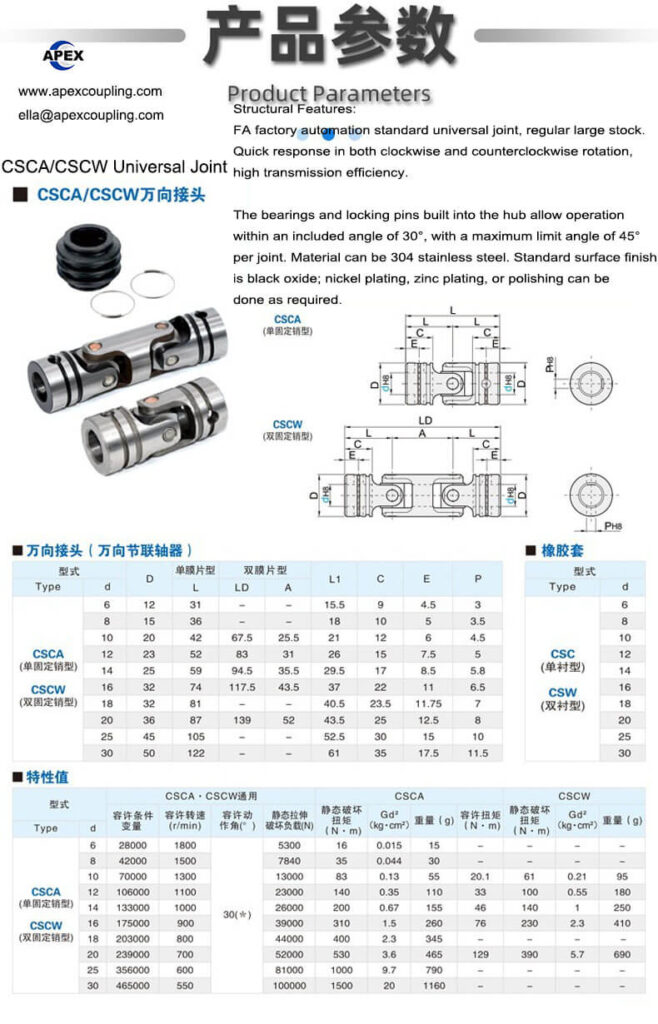
FA (Factory Automation) standard universal joints are manufactured to industry-standard dimensions with:
Large conventional stock – ready for immediate shipment
Rapid bidirectional response – identical clockwise and counterclockwise rotation
High transmission efficiency – minimal power loss
Built-in bearings and fixed pins – smooth operation up to 30°
Low noise & low backlash – precision fit for quiet operation
✅ The UNCA/UNCW series meets all FA automation standards – making it the ideal choice for automation, packaging, and material handling applications.
2. Single Joint (UNCA/CSCA) vs Double Joint (UNCW/CSCW) – Which One Do You Need?
| Feature | Single Joint (UNCA/CSCA) | Double Joint (UNCW/CSCW) |
|---|---|---|
| Angular misalignment | ✅ Up to 45° | ✅ Up to 45° per joint |
| Parallel offset | ❌ No | ✅ Yes |
| Total articulation | Up to 45° | Up to 90° |
| Length | Shorter | Longer |
| Weight | Lighter | Heavier |
| Best for | Shafts intersect at an angle on the same plane | Shafts both angled and offset |
Rule of thumb for FA automation:
Use single joint (UNCA/CSCA) for straight-line automation with slight angular misalignment.
Use double joint (UNCW/CSCW) for applications where shafts are both angled and offset – common in conveyors, packaging machinery, and multi-spindle drills.
💡 Double joint configurations provide smoother power transmission and reduced vibration when both angular and parallel misalignment are present.
3. Fastening Type – Pin vs Keyway
| Fastening Type | Series | Best For |
|---|---|---|
| Pin Type (固定銷型) | UNCA / UNCW | Standard FA automation, quick installation, set screw/pin fastening |
| Keyway Type (鍵槽型) | CSCA / CSCW | High torque, positive drive, secure connection |
✅ UNCA/UNCW series features pin/set screw fastening – ideal for standard FA automation applications. CSCA/CSCW series features keyway fastening – ideal for applications requiring secure, high-torque connections.
4. Bearing Selection – Pin/Block vs Needle Roller
The UNCA/UNCW series offers two bearing options:
| Parameter | Pin/Block (Sliding) Bearing | Needle Roller Bearing |
|---|---|---|
| Max Speed | 1000 RPM | 4000 RPM |
| Dynamic Load Capacity | Good | High |
| Friction | Higher | Lower |
| Maintenance | Requires periodic lubrication | Sealed, low maintenance |
| Best for | Low speed, high torque, shock loads | High speed, smooth rotation, precision |
Recommendation:
Choose pin/block bearing for heavy-duty, low-speed applications with shock loads.
Choose needle roller bearing for high-speed applications (above 1000 RPM) where precision and low friction are priorities.
⚠️ Note: It is recommended to use the coupling at ≤50% of the maximum rated speed for optimal service life.
5. Material Selection – 42CrMo Alloy Steel vs 304 Stainless Steel
| Material | 42CrMo Alloy Steel | 304 Stainless Steel |
|---|---|---|
| Strength | High – quenched & tempered | Moderate |
| Toughness & fatigue resistance | Excellent | Good |
| Wear resistance | High | Medium |
| Corrosion resistance | Moderate | Excellent |
| Cost | Lower | Higher |
| Best for | Industrial automation, heavy loads | Food processing, chemical, marine |
Our recommendation for FA automation:
Choose 42CrMo with black oxide for most factory automation and industrial applications.
Choose 304 stainless steel for food & beverage, chemical, or outdoor applications where corrosion resistance is critical.
6. Operating Angle – 30° Working vs 45° Limit
The UNCA/UNCW series is designed with built-in bearings and fixed pins for smooth operation up to 30° in continuous use. The absolute limit per joint is 45°.
| Angle Range | Recommendation |
|---|---|
| 0° – 30° | ✅ Ideal for continuous operation – maximum bearing life |
| 30° – 45° | ⚠️ Acceptable for short periods – reduced bearing life |
| >45° | ❌ Not recommended – can cause joint failure |
Practical tip: For most FA automation applications, try to keep operating angles below 30° for continuous operation to maximize service life.
7. Surface Finish Options – Protection & Appearance
| Finish | Corrosion Protection | Best For |
|---|---|---|
| Black Oxide (Standard) | Moderate | General industrial, FA automation |
| Polished (磨光) | Low (cosmetic) | Aesthetic applications |
| Nickel Plated | Good | Moderate corrosion environments |
| Zinc Plated | Good | Outdoor, moisture-prone applications |
| Chrome Plated | Good | Aesthetic or high-wear applications |
Recommendation:
Black oxide is sufficient for most FA automation applications.
Nickel or zinc plating for wet or humid conditions.
Polished or chrome plated for applications where appearance or smoothness is important.
8. Direct Misumi UNCA/UNCW Replacement
The UNCA/UNCW series is fully interchangeable with Misumi UNCA and UNCW couplings:
Same dimensions – drop-in replacement
Same performance – meets or exceeds OEM specifications
Better value – factory-direct pricing
✅ Upgrade without design changes – direct replacement for Misumi UNCA (single) and UNCW (double).
9. Applications Across Industries
| Industry | Application | Recommended Configuration |
|---|---|---|
| Packaging Machinery | Conveyors, wrapping machines | UNCA/CSCA or UNCW/CSCW |
| Woodworking | Multi-spindle drills, routers, saws | UNCA/CSCA |
| Multi-Spindle Drills | Precision drilling | UNCA/CSCA |
| Metallurgy | Rolling mills, casting lines | UNCW/CSCW |
| CNC Machines | Feed drives, positioning | UNCA/CSCA |
| Printing | Register control | UNCA/CSCA |
| Textile | Spinning, weaving | UNCA/CSCA |
10. Real‑World Example – Packaging Machinery Upgrade
A packaging machinery manufacturer was experiencing premature wear on standard universal joints used in their conveyor drives. The joints operated at 25° angles and 1500 RPM, causing frequent failures and downtime.
They switched to Apex Coupling UNCW/CSCW double universal joints (42CrMo, keyway type, needle roller bearing, H7 bore). Results:
Service life extended – needle roller bearing handled 1500 RPM smoothly
Angle capacity – 25° well within the 30° recommended range
Vibration reduced – H7 bore improved concentricity
Less downtime – fewer replacements during production
Direct replacement – no design changes required
11. Installation & Maintenance Tips
Check alignment – Keep operating angles ≤30° for continuous operation
Lubricate pin/block bearings – Regular lubrication extends service life
Needle roller bearings – Sealed, low maintenance – inspect periodically
Check for wear – Inspect cross shaft and bearings periodically
Dynamic balancing – For speeds above 1000 RPM, ensure the joint is balanced
Bore fit – Use H7 shaft tolerance for best concentricity
Speed recommendation – Use at ≤50% of maximum rated speed for optimal life
12. Selection Checklist
Configuration: UNCA/CSCA (single) or UNCW/CSCW (double)
Fastening type: Pin (UNCA/UNCW) or Keyway (CSCA/CSCW)
Bearing: Pin/block (1000 RPM) or Needle roller (4000 RPM)
Material: 42CrMo alloy steel (standard) or 304/316 stainless steel
Finish: Black oxide, polished, nickel, zinc, or chrome
Bore size: 10, 12, 14, 16, 20 mm – match your shaft diameter
Angle: ≤30° for continuous use (45° limit per joint)
Speed: ≤50% of max rated speed for optimal life
Misumi replacement: Direct UNCA/UNCW replacement – no design changes
13. Conclusion
The UNCA/UNCW and CSCA/CSCW precision miniature universal joint couplings from Apex Coupling offer the perfect combination of FA automation standard quality, 42CrMo strength, and configuration flexibility for packaging, woodworking, multi-spindle drill, and general automation applications. With single or double joint options, pin or keyway fastening, 304 stainless steel availability, multiple surface finishes, and direct Misumi UNCA/UNCW interchangeability, it is the ideal solution for demanding industrial environments.
👉 Need an FA automation universal joint for your application? Contact us with your configuration, fastening type, and bore requirements.
Inquiry now:
ella@apexcoupling.com
FA automation universal joint selection guide
UNCA UNCW selection guide
packaging machinery coupling
woodworking universal joint
multi-spindle drill coupling
Misumi UNCA replacement