What Is a Cardan Universal Joint? Types, Working Principles and Applications
What Is a Cardan Universal Joint? Types, Working Principles and Applications
A Cardan universal joint is a mechanical component that transmits rotational motion and torque between two shafts whose centerlines operate at an angle. It is widely used in industrial machinery and mechanical drive systems where a direct, rigid shaft connection is not practical.
Cardan universal joints are available in different configurations, materials and bearing designs. Selecting the right type requires an understanding of working angle, operating speed, torque, installation geometry and maintenance requirements.
What Is a Cardan Universal Joint?
A Cardan universal joint, also known as a universal joint or U-joint, connects rotating shafts that are not aligned on the same straight centerline.
The joint allows angular movement while transmitting torque from the driving shaft to the driven shaft. Depending on the design, it may be used as a standalone joint or incorporated into a longer shaft assembly.
Some universal joint shafts also include a telescopic section. This feature allows the effective shaft length to change within a specified range, which can be useful when equipment requires axial adjustment.
How Does a Cardan Universal Joint Work?
A typical Cardan joint uses a cross-shaped central component connected to joint yokes. The cross and bearing assemblies allow the connected yokes to articulate relative to each other as the shaft rotates.
Torque passes from the input shaft through the joint structure to the output shaft. The joint accommodates angular movement, but its kinematic behavior depends on the arrangement and operating angle.
A single Cardan joint operating at an angle does not generally produce perfectly uniform instantaneous output angular velocity, even when the input rotates at a constant speed. In some applications, a correctly phased pair of joints with suitable geometry can reduce this variation.
The exact result depends on the joint arrangement and shaft angles, so the transmission design should be evaluated for the intended application.
Common Types of Cardan Universal Joints
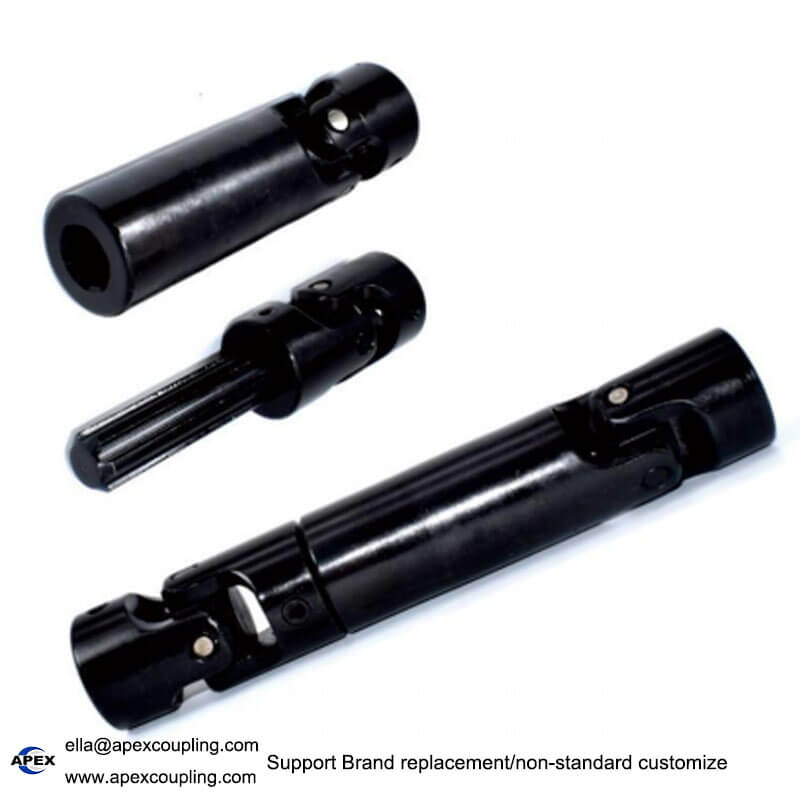
Standard Universal Joint
A standard universal joint accommodates angular misalignment between connected shafts. It is used in various mechanical transmission systems where the required angle and load fall within the design limits.
Telescopic Universal Joint Shaft
A telescopic universal shaft combines universal joints with an adjustable-length section. It accommodates angular movement and axial length changes, making it useful for equipment that requires installation adjustment or changing shaft distance.
The WSS series offered by Apex Coupling is an example of a telescopic universal shaft designed for industrial applications.
Sliding-Block Universal Joint
A sliding-block design uses sliding contact within the joint mechanism. Its suitability depends on the design’s rated speed, torque, lubrication and maintenance requirements.
Needle Roller Bearing Universal Joint
A needle roller bearing design uses rolling elements to support joint movement. Some configurations are suitable for higher operating speeds, provided the specified load, lubrication, alignment and speed limits are observed.
The bearing type should be selected according to the manufacturer’s model-specific performance data rather than by bearing type alone.
What Are the Main Applications of Cardan Universal Joints?
Cardan universal joints are used across a range of industrial and mechanical systems, including:
Packaging and processing machinery
Woodworking equipment
Drilling and machining systems
Metallurgical machinery
General mechanical power transmission
Specialized industrial equipment requiring angular shaft connections
A telescopic configuration may be particularly useful where the connected shafts also require axial length adjustment.
Key Factors When Selecting a Cardan Universal Joint
Torque Capacity
The joint must handle the operating torque and any relevant starting, reversing or shock loads. Consider the full duty cycle rather than only the normal running load.
Operating Speed
The allowable speed depends on the joint construction, bearing design, dimensions, lubrication, balance and operating angle. Confirm the rating for the exact model.
Working Angle
Determine the angle between the connected shafts and check it against the recommended operating limit. A maximum articulation angle should not automatically be treated as the recommended continuous working angle.
Shaft Length and Axial Movement
For telescopic models, specify the installed length and required travel. Confirm that the shaft remains correctly engaged throughout its operating range.
Material and Environment
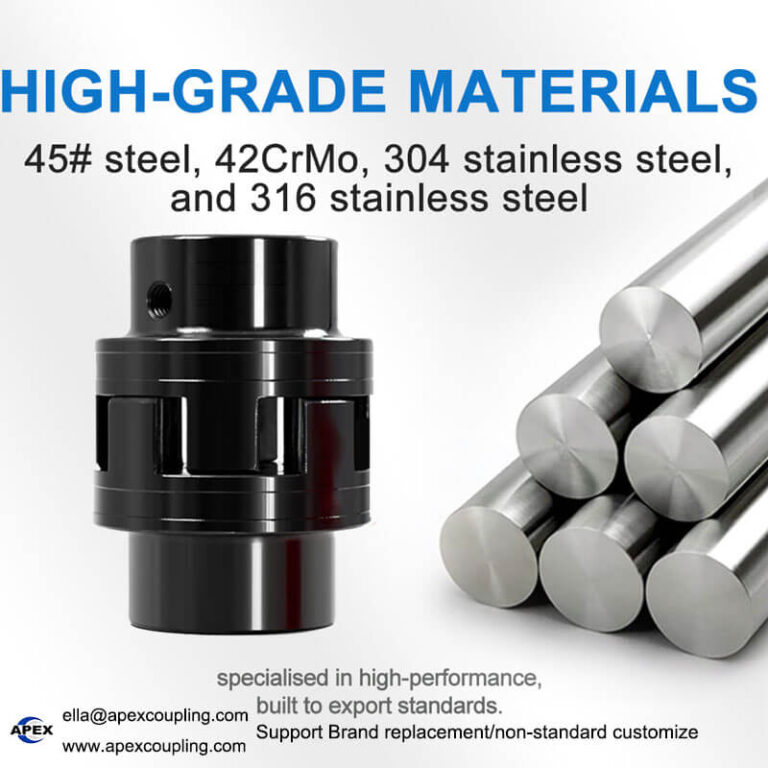
Material and surface treatment should be selected according to loading, temperature, moisture, contamination and corrosion exposure. Do not assume that every material or finish is available for every model.
Installation and Maintenance
Check shaft alignment, mounting dimensions, lubrication requirements and inspection intervals. Proper installation and maintenance can help reduce premature wear and unexpected downtime.
Cardan Universal Joint vs. Flexible Shaft Coupling
A Cardan universal joint is designed primarily to transmit torque between shafts operating at an angle. A flexible shaft coupling may use an elastomeric element, metal diaphragm, disc pack or another flexible structure to accommodate specified misalignment.
These components serve different mechanical purposes and are not automatically interchangeable.
For example, a diaphragm coupling may be suitable for precision motion control where torsional rigidity and backlash-free transmission are important. A Cardan universal joint may be more suitable where angular articulation is a central requirement.
The correct choice depends on the equipment geometry, operating conditions and required transmission characteristics.
Choosing a Cardan Universal Joint Manufacturer
When evaluating a supplier, consider the availability of technical drawings, model-specific ratings, material documentation, customization support and consistent quality control.
For non-standard applications, provide the manufacturer with the required dimensions, operating torque, speed, working angle, shaft travel and installation conditions.
A clear technical specification helps the supplier identify a suitable configuration and reduces the risk of ordering an incompatible component.
WSS Telescopic Cardan Universal Joint Shaft from Apex Coupling
Apex Coupling offers the WSS telescopic universal shaft for industrial transmission applications requiring angular movement and adjustable shaft length.
Depending on the selected configuration, the WSS series can be supplied with sliding-block or needle roller bearing designs, and selected shaft dimensions and mounting interfaces may be customized.
To discuss your application, share the required shaft length, telescopic travel, working angle, torque, operating speed and connection dimensions.
Contact Apex Coupling for product details and a quotation.
Email: ella@apexcoupling.com
WhatsApp: +86 13437856962
Frequently Asked Questions
Is a Cardan universal joint the same as a U-joint?
Cardan universal joint and U-joint are commonly used names for a universal joint that transmits torque between angled shafts. Specific designs may differ in construction and application.
Does a Cardan universal joint allow axial movement?
A standard joint does not necessarily provide telescopic movement. Axial length adjustment requires a telescopic shaft or a separate sliding section designed for that purpose.
Does a single Cardan joint maintain constant output speed?
Generally, no. At a non-zero operating angle, a single Cardan joint can produce instantaneous output-speed variation. A properly designed double-joint arrangement may reduce this variation.
How do I choose the right universal joint?
Check torque, operating speed, working angle, shaft dimensions, axial movement, bearing type, material and mounting requirements against the manufacturer’s specifications.
Can Cardan universal joint shafts be customized?
Selected models may be customized in shaft length, bore configuration, mounting details, material and surface treatment, subject to technical feasibility.