Tire Coupling Selection Guide – F-Type Martin Couplings for Heavy-Duty Applications
Tire couplings (also known as rubber element couplings or Martin-type couplings) are among the most versatile and reliable flexible couplings for heavy-duty industrial applications. With a simple two-flange and rubber tire design, they offer high elasticity, excellent shock absorption, and maintenance-free operation. This guide explains how tire couplings work, their key advantages, and how to select the right F-Type model for your application.
1. What Is a Tire Coupling?
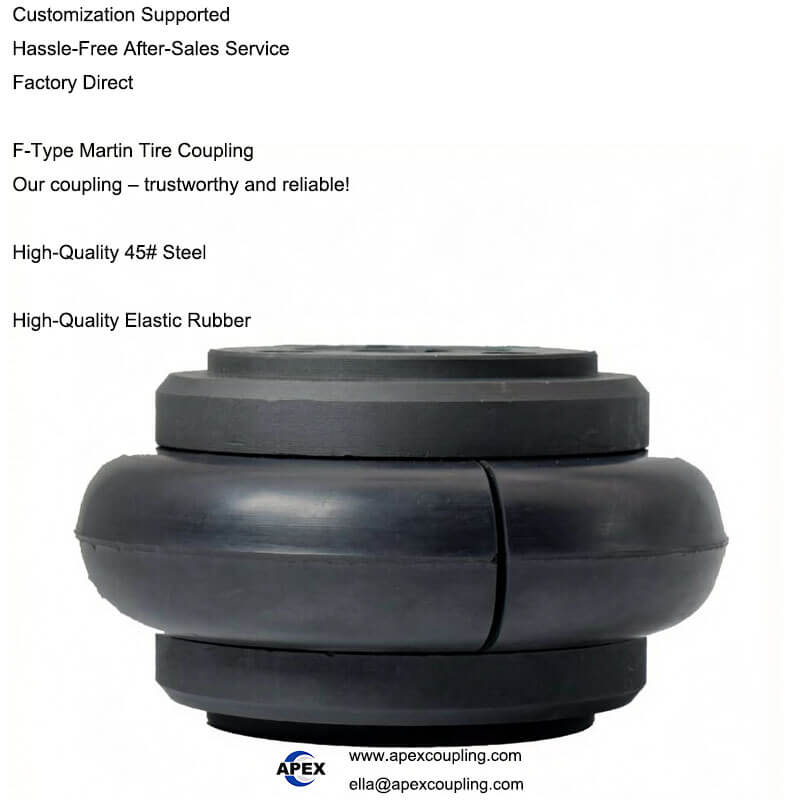
A tire coupling consists of:
Two flanged hubs – precision-machined from 45# steel
A high-elasticity rubber tire element – reinforced with embedded bolts
Torque is transmitted from the driving hub through the rubber tire to the driven hub. The tire element flexes to accommodate angular, parallel, and axial misalignment while absorbing shock and vibration.
💡 Tire couplings are designed for applications requiring high elasticity and excellent shock absorption in a maintenance-free package.
2. Key Advantages of Tire Couplings
| Advantage | Benefit |
|---|---|
| High-Elasticity Rubber Element | Exceptional shock absorption and vibration damping – protects connected equipment |
| Maintenance-Free | No lubrication required – reduces operating costs |
| Excellent Misalignment Compensation | Compensates angular (up to 4°), parallel (up to 6mm), and axial (up to 8mm) misalignment |
| Simple Installation | Easy to install and align – reduces downtime |
| Easy Tire Replacement | Tire replacement without axial movement of equipment |
| Visual Inspection | Tire condition can be inspected without disassembly |
| Cost-Effective | Economical solution for demanding applications |
| Anti-Static & Fire-Resistant Options | Optional tire elements available for hazardous environments |
3. F-Type vs Other Tire Coupling Types
The F-Type tire coupling features a flanged design where the rubber tire element is bolted directly to the hubs. Key characteristics include:
| Feature | F-Type | Other Types (e.g., B, H) |
|---|---|---|
| Hub Design | Flanged hubs with bolt holes | Taper lock or other mounting methods |
| Installation | Bolt-on tire element | Varies by type |
| Tire Replacement | Simple – remove bolts and replace tire | Varies by type |
| Misalignment Compensation | Excellent – up to 4° angular, 6mm parallel | Varies |
4. How to Select the Right F-Type Model
Step 1: Determine your torque requirement
Calculate the torque your application requires
Select a model with rated torque ≥ 1.5× your requirement
F-Type series covers 50–8000 N·m
Step 2: Match shaft diameters
Measure your shaft diameters
Select a model with a bore range that accommodates your shafts
Step 3: Check speed requirements
Verify the coupling’s maximum speed exceeds your operating speed
F-Type series: up to 5000 RPM (varies by model)
Step 4: Consider environmental factors
Temperature: F-Type operates -30°C to +60°C
Dust/moisture: Suitable for dusty and wet environments
Hazardous conditions: Anti-static and fire-resistant options available
Step 5: Evaluate misalignment
The F-Type coupling compensates for angular (4°), parallel (6mm), and axial (8mm) misalignment
Higher misalignment capacity than many other coupling types
5. Applications Where Tire Couplings Excel
| Industry | Application |
|---|---|
| Conveyors | Material handling, belt conveyors |
| Fans & Blowers | Ventilation systems |
| Pumps | Centrifugal, gear, diaphragm pumps |
| Compressors | Air and gas compressors |
| Mixers | Industrial mixing equipment |
| Mining | Crushers, feeders, conveyors |
| Metallurgy | Rolling mills, continuous casting |
| Chemical | Agitators, pumps, compressors |
| Food & Beverage | Processing equipment |
| Woodworking | Saws, routers, planers |
6. Installation & Maintenance Tips
Align shafts – Even with misalignment compensation, keep within recommended limits for optimal performance
Install hubs – Mount the flanged hubs on the driving and driven shafts
Install tire element – Bolt the rubber tire between the two hubs
Check bolt torque – Tighten bolts to the specified torque
No lubrication required – Tire coupling is maintenance-free
Visual inspection – Check tire condition periodically without disassembly
Replace tire – When worn, replace the tire element without axial movement of equipment
7. Real‑World Example – Mining Conveyor Upgrade
A mining company was experiencing frequent coupling failures on heavy-duty conveyors. The existing couplings required regular lubrication and failed prematurely due to shock loads and misalignment.
They switched to Apex Coupling F-Type tire couplings (45# steel, high-elasticity rubber element, maintenance-free). Results:
Service life extended – tire element withstood shock loads and misalignment
Maintenance eliminated – no lubrication required
Downtime reduced – tire replacement without moving equipment (1 hour vs. 4 hours)
Shock absorption improved – rubber element protected connected equipment
8. Selection Checklist
- □
Torque: 50–8000 N·m – select based on your requirement
- □
Shaft diameter: Match your shaft sizes – custom bores available
- □
Speed: Ensure model supports your operating speed
- □
Temperature: -30°C to +60°C – verify operating range
- □
Environment: Dusty, wet, or hazardous – consider anti-static/fire-resistant options
- □
Misalignment: Angular (4°), parallel (6mm), axial (8mm) – verify capacity
- □
Maintenance: Maintenance-free – no lubrication
- □
Application: Conveyors, fans, pumps, compressors, mining, metallurgy
9. Conclusion
The F-Type tire coupling from Apex Coupling offers the perfect combination of high elasticity, excellent shock absorption, and maintenance-free operation for demanding industrial applications. With 45# steel hubs, high-elasticity rubber tire element, 50–8000 N·m torque capacity, and easy tire replacement, it delivers reliable, long-lasting performance in conveyors, fans, pumps, compressors, mining, and general industry.
👉 Need a tire coupling for your application? Contact us with your model, bore, and torque requirements.
Inquiry now:
ella@apexcoupling.com
Tire coupling selection guide
F-type coupling guide
Martin tire coupling selection
Rubber element coupling guide
Maintenance-free coupling
Heavy-duty flexible coupling