How to Identify Jaw Coupling Size and Bore Dimensions
Identifying the correct jaw coupling size is important when installing new equipment or replacing an existing coupling. A model label can help, but dimensions and operating requirements should be checked before a replacement is ordered.
This guide covers the measurements and technical details buyers should prepare.
1. Measure the Outer Diameter
Measure the outside diameter of the coupling hub or assembled unit according to the supplier’s drawing.
Make sure you know which component the published dimension describes. The outside diameter of a hub may differ from the overall envelope of an assembled coupling.
2. Measure the Overall Length
Measure the length along the shaft axis. Check whether the dimension refers to one hub, the complete coupling or the assembly with its elastomer installed.
Installation space can be limited, so overall length and hub position may be important to the replacement decision.
3. Measure Both Shaft Bores
Measure the diameter of the driving shaft and the driven shaft separately. If the shafts are different sizes, the coupling may require two different bores.
Also record keyway dimensions, clamping screws or other fastening features. Bore diameter alone may not fully define the shaft connection.
4. Confirm the Coupling Design
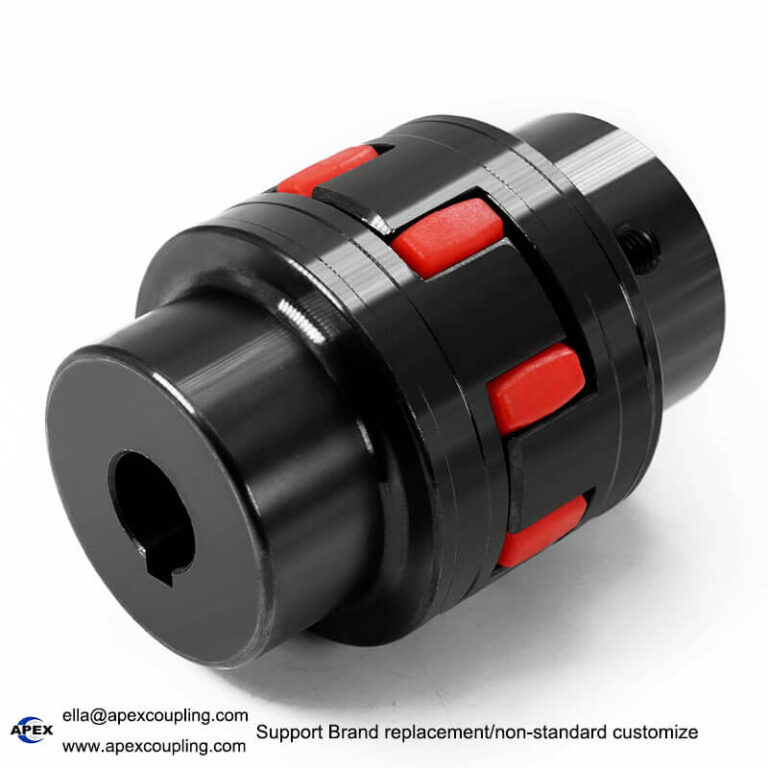
A jaw coupling generally consists of two hubs and an elastomeric spider. However, the hub geometry, spider shape and assembly arrangement can differ between product designs.
Confirm that the replacement is compatible with the existing components. Similar-looking products should not be assumed interchangeable without dimensional verification.
5. Check the Operating Requirements
Dimensions are only one part of coupling selection. Confirm:
Continuous and peak torque
Normal and maximum operating speed
Shaft alignment and permitted misalignment
Operating temperature
Environmental exposure
Installation and maintenance requirements
The supplier should verify that the selected coupling meets the application’s requirements.
Example: ROTEX-Compatible Size Range
The dimensional information supplied for Apex Coupling’s compatible range includes the following examples:
| Model Size | Listed Outer Diameter | Listed Length | Listed Bore Range |
|---|---|---|---|
| ROTEX 14 | 30 mm | 35 mm | 6–16 mm |
| ROTEX 19 | 40 mm | 66 mm | 6–25 mm |
| ROTEX 24 | 55 mm | 78 mm | 8–35 mm |
| ROTEX 28 | 65 mm | 90 mm | 10–42 mm |
| ROTEX 38 | 80 mm | 114 mm | 10–50 mm |
These values reproduce the supplied product data and should be confirmed against the drawing for the exact configuration before use.
Create a Useful Coupling Specification
When contacting a supplier, include the model marking, outer diameter, overall length, both shaft bores, mounting details and operating conditions.
If the original model is unknown, provide clear photographs and a dimensioned sketch. These details help the supplier assess the replacement requirements.
Request Coupling Selection Support from Apex Coupling
Apex Coupling offers ROTEX-compatible jaw coupling options and OEM/ODM support, subject to technical review.
Send the existing coupling dimensions and application details to discuss a suitable configuration.
Email: ella@apexcoupling.com
WhatsApp: +86 13437856962
Frequently Asked Questions
Is the model number enough to identify a replacement?
Not always. Verify the dimensions, bores, connection details and operating ratings.
Why do both shaft diameters matter?
The driving and driven shafts may have different diameters. Both must be compatible with the selected hub bores.
Can I use a coupling with a different overall length?
Only if it fits the available installation space and meets the machine’s alignment and connection requirements.
What if the existing coupling has no readable model number?
Measure the main dimensions, photograph the components and record the shaft sizes and operating conditions. A drawing is helpful when available.
Inquiry now:
ella@apexcoupling.com
steel vs cast iron jaw coupling, rotex spider hardness guide, flexible coupling for motor, elastic coupling maintenance.