Keyless vs. Keyed Shaft Connections: Engineering Mechanics of CSF-A3 Expansion Locking Assemblies
In high-load power transmission systems—such as heavy conveyors, mining crushers, gear drives, and automated steel processing lines—connecting a driving shaft to a mounted component (like a gear, sprocket, flywheel, or conveyor pulley) is a critical design choice. For decades, traditional woodruff keys, parallel keyways, and press fits were the standard choice. However, keyways cut into shafts create localized notch stress concentrations, reduce effective shaft diameter, and can develop fretting corrosion under reversing shock loads.
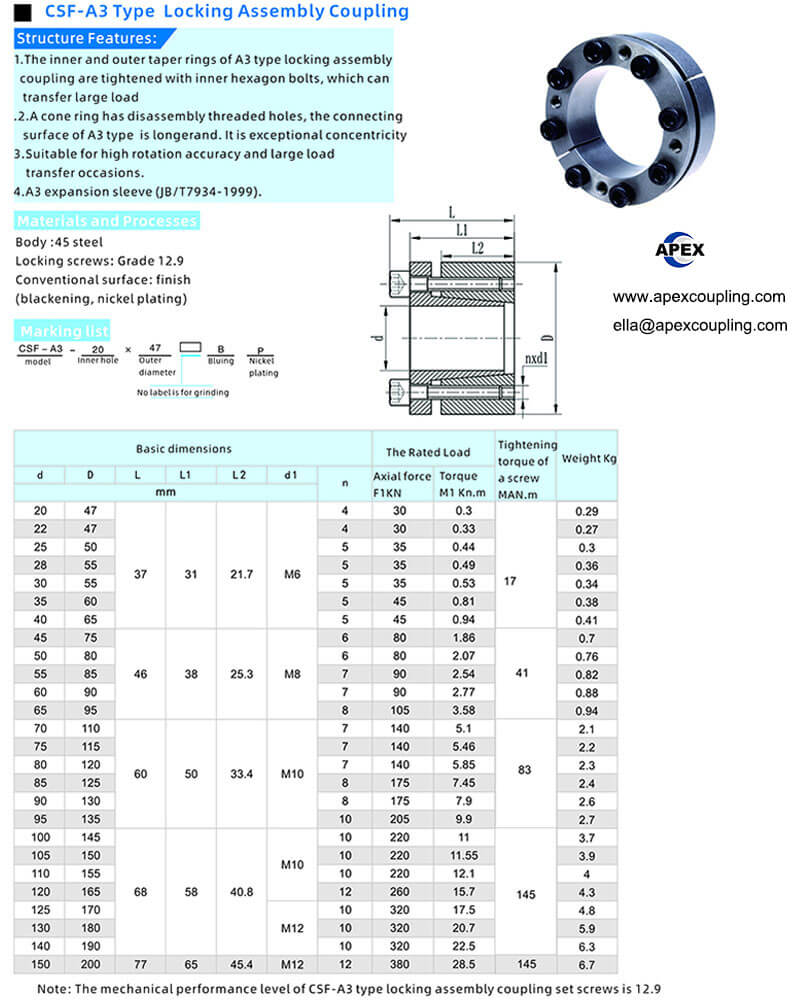
To solve these mechanical limitations, design engineers rely on keyless friction-locking elements like the CSF-A3 Type Locking Assembly Coupling (manufactured under standard JB/T7934-1999). This paper analyzes the pressure dynamics, torque transmission capabilities, and installation advantages of keyless taper expansion sleeves.
1. The Wedge-Action Pressure Mechanics of CSF-A3 Assemblies The working principle of the CSF-A3 expansion sleeve relies on inclined plane mechanics (tapered wedge action) to transform axial bolt tension into high radial locking pressure.
Symmetrical Radial Expansion: As the Grade 12.9 inner hexagon socket screws are torqued in a crosswise pattern, the outer taper ring is drawn axially over the inner cone ring.
High-Friction Interference Fit: This movement forces the split inner ring to clamp inward onto the shaft while the outer ring expands outward against the hub bore. This forms a continuous 360° mechanical friction interface without keyways.
2. Torque Transmission Capacity and Stress Distribution Keyway connections concentrate shear stress on a narrow key face, which can lead to micro-deformations and backlash during rotational reversals. In contrast, as shown in the engineering charts in image_ab4df5.png and image_ab4e13.png, the CSF-A3 sleeve distributes mechanical pressure evenly over an extended axial contact length (L1 up to 65mm):
High Load Support: Handles rated torques up to 28.5 Kn.m (28,500 N·m) and axial forces up to 380 kN on a 150mm shaft diameter.
Preserved Shaft Integrity: Because no keyways are machined into the shaft, engineers can specify smaller shaft diameters without sacrificing safety factors, reducing overall machinery weight and component costs.
3. Exceptional Concentricity and Easy Maintenance For high-speed or high-accuracy machinery, component runout can cause damaging vibrations across bearings and gearboxes. The CSF-A3 features a longer mating surface design that provides exceptional self-centering guidance and high rotational accuracy during installation.
Equally important is ease of maintenance. Conventional press fits or rusted keyways often require torch heating, hydraulic pullers, or destructive cutting to remove. The CSF-A3 cone ring includes integrated disassembly threaded holes. To release the unit, technicians simply remove the locking screws, insert them into the disassembly threads, and torque them to back the taper rings apart cleanly—saving time during routine maintenance.
4. Material Standards and Direct OEM Factory Customization Heavy-duty industrial applications require dependable metallurgy. The CSF-A3 body is precision-turned from high-grade 45# steel / S45C carbon steel and paired with Grade 12.9 high-tensile locking bolts. Optional surface treatments like blackening or nickel plating protect the assembly in humid or corrosive operating environments.
Operating out of our ISO-compliant production plant in Guangdong, China, Apexcoupling provides complete manufacturing support for the CSF-A3 series. With inner shaft diameters available from 20mm to 150mm (and custom sizing from 18mm to 200mm), we offer direct OEM, ODM, and OBM customization to meet your exact machinery specifications.
keyless locking assembly mechanics, CSF-A3 expansion sleeve guide, keyless shaft coupling calculations, JB/T7934-1999 locking device, taper sleeve torque transmission, friction locking element installation.
Inquiry now:
ella@apexcoupling.com
steel vs cast iron jaw coupling, rotex spider hardness guide, flexible coupling for motor, elastic coupling maintenance.