Double Diaphragm Coupling Selection Guide – Zero Backlash Couplings for Servo Motors & Encoders
Double diaphragm couplings (also known as double disc couplings) are essential components in precision motion control systems. With their zero backlash, high torsional rigidity, and superior misalignment compensation, they are the preferred choice for servo motors, encoders, stepper motors, and instrumentation applications.
This guide explains how double diaphragm couplings work, the advantages over single diaphragm designs, and how to select the right model for your application.
1. What Is a Double Diaphragm Coupling?
A double diaphragm coupling consists of:
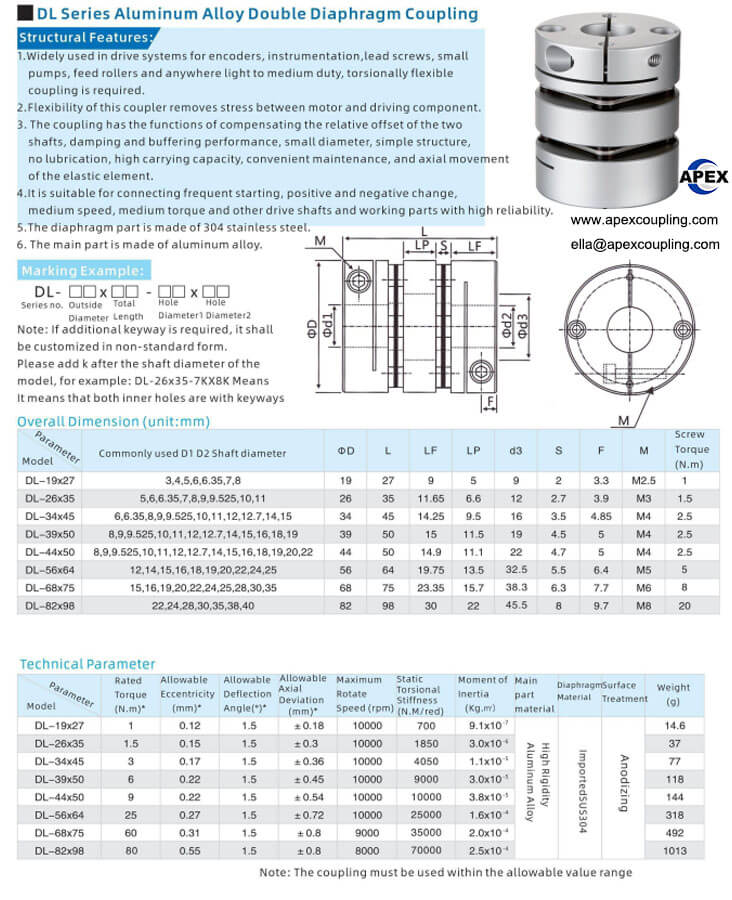
Two metal hubs – typically aluminum or steel
Two stainless steel diaphragms – connected by a center spacer
Clamping screw fastening – for secure shaft connection
Torque is transmitted through the diaphragms, which flex to accommodate angular, radial, and axial misalignment while maintaining high torsional rigidity and zero backlash. The double diaphragm design allows the two disc packs to bend in opposite directions, providing superior compensation for parallel misalignment.
💡 Double diaphragm couplings are widely used in drive systems for encoders, instrumentation, lead screws, small pumps, feed rollers, and anywhere a light to medium-duty, torsionally flexible coupling is required. They are particularly suited for applications with frequent starting, reversing, and high reliability requirements.
2. Double Diaphragm vs Single Diaphragm – Which One Do You Need?
| Feature | Double Diaphragm (DL Series) | Single Diaphragm |
|---|---|---|
| Radial (parallel) misalignment | ✅ Yes – superior compensation | ❌ Cannot accommodate |
| Angular misalignment | ✅ Yes – up to 1.5° | ✅ Yes – up to 1° |
| Axial misalignment | ✅ Yes – up to ±0.80mm | ✅ Yes – up to ±0.50mm |
| Torsional rigidity | High | Higher |
| Space requirement | Longer (center spacer required) | Compact – saves space |
| Best for | Applications requiring full misalignment compensation | Space-limited, well-aligned applications |
Selection guideline:
Choose double diaphragm when radial (parallel) misalignment must be accommodated.
Choose single diaphragm when space is limited, high torsional rigidity is required, and shafts are well-aligned with no significant parallel misalignment.
3. Key Advantages of Double Diaphragm Couplings
| Advantage | Benefit |
|---|---|
| Zero Backlash | No rotational clearance – precise positioning for encoders and servo motors |
| High Torsional Rigidity | Accurately controls shaft rotation – enables high-precision control for servo systems |
| Superior Misalignment Compensation | Accommodates angular, radial, and axial misalignment – reduces stress on bearings |
| Low Inertia | Lightweight design – ideal for high-speed operation up to 10000 RPM |
| Maintenance-Free | No lubrication required – reduces downtime |
| 304 Stainless Steel Diaphragm | Excellent fatigue resistance and corrosion resistance – long service life |
| Zero-Clearance Shaft Connection | Suitable for positive and negative rotation – identical clockwise and counterclockwise characteristics |
| Vibration Damping | Absorbs shock and vibration – protects sensitive equipment |
4. Materials – Why Aluminum + 304 Stainless Steel?
The DL series uses a combination of high-strength aluminum alloy for the hubs and 304 stainless steel for the diaphragms:
| Component | Material | Benefits |
|---|---|---|
| Hubs | Aluminum alloy | Lightweight, low inertia, corrosion-resistant, anodized finish |
| Diaphragms | 304 stainless steel | Excellent fatigue resistance, corrosion resistance, long service life |
5. Applications Where Double Diaphragm Couplings Excel
| Industry | Application | Why Double Diaphragm? |
|---|---|---|
| Servo Motors | High-precision motion control | Zero backlash, high rigidity, low inertia |
| Encoders & Resolvers | Position feedback systems | Zero backlash, accurate signal transmission |
| Stepper Motors | Precision positioning | Zero backlash, low inertia |
| Lead Screws | Linear motion systems | Zero backlash, precise positioning |
| Instrumentation | Precision measuring instruments | Zero backlash, reliability |
| Small Pumps | Light-duty pump drives | Maintenance-free, low inertia |
| Feed Rollers | Material handling | Low inertia, misalignment compensation |
6. How to Select the Right Double Diaphragm Coupling
Step 1: Determine Your Torque Requirement
Calculate the torque your application requires.
Select a coupling with adequate torque capacity.
DL series covers 1–80 N·m.
Step 2: Determine Single or Double Diaphragm
Double diaphragm (DL): For applications requiring radial misalignment compensation.
Single diaphragm: For well-aligned shafts, high rigidity, compact spaces.
Step 3: Match Shaft Diameters
Measure your shaft diameters.
Select a model with a bore range that accommodates your shafts.
H7 bore tolerance is recommended for precision fit.
Step 4: Consider Space Constraints
Measure available space for the coupling (outer diameter and length).
DL series offers compact sizes from 19mm OD.
Step 5: Evaluate Misalignment
Determine the expected angular, radial, and axial misalignment.
DL series accommodates angular (1.5°), radial (0.12-0.55mm), and axial misalignment.
Step 6: Consider Speed Requirements
Verify the coupling’s maximum speed exceeds your operating speed.
DL series offers speeds up to 10000 RPM.
Step 7: Consider Keyway Requirements
For applications requiring keyways, add “K” to the model number.
Example: DL-26×35-7K×8K – both bores with keyways.
7. Real‑World Example – Servo Motor Upgrade
A machine builder was experiencing position errors on a servo-driven system due to backlash in their existing coupling. The coupling also could not accommodate the radial misalignment caused by thermal expansion.
They switched to Apex Coupling DL series double diaphragm coupling (aluminum hubs, 304 stainless steel double diaphragm, zero backlash). Results:
Position errors eliminated – zero backlash
Misalignment accommodated – double diaphragm compensated for radial, angular, and axial deviations
Maintenance eliminated – no lubrication required
Accuracy improved – H7 precision bore
Service life extended – 304 stainless steel diaphragms provided excellent fatigue resistance
8. Installation & Maintenance Tips
Clean shafts – Remove oil, grease, and debris before installation.
Check alignment – Even with misalignment compensation, keep within recommended limits.
Tighten clamping screws evenly – Use a torque wrench in a star pattern.
No lubrication required – Coupling is maintenance-free.
Periodic inspection – Check for wear, cracks, or deformation in the diaphragms.
Keep clean – Remove dust and debris to prevent premature wear.
Keyway option – For keyway applications, ensure proper key fit.
9. Selection Checklist
- □
Type: DL – double diaphragm coupling
- □
Structure: Double diaphragm – for applications requiring radial misalignment compensation
- □
Material: Aluminum hubs + 304 stainless steel diaphragms
- □
Backlash: Zero backlash – precision applications
- □
Bore: H7 tolerance – match your shaft diameters
- □
Keyway: Add “K” if required (e.g., DL-26×35-7K×8K)
- □
Fastening: Clamping screw – secure, even clamping force
- □
Misalignment: Angular (1.5°), radial, axial – verify capacity
- □
Speed: Up to 10000 RPM – match your motor speed
- □
Torque: 1–80 N·m – ensure it exceeds your requirement
- □
Maintenance: Maintenance-free – no lubrication
- □
Application: Servo motors, encoders, stepper motors, lead screws, instrumentation
10. Conclusion
The DL series aluminum double diaphragm coupling from Apex Coupling offers the perfect combination of zero backlash, high torsional rigidity, superior misalignment compensation, and maintenance-free operation for precision motion control applications. With aluminum alloy construction, 304 stainless steel double diaphragm, clamping screw fastening, and H7 bore precision, it is the ideal solution for servo motors, encoders, stepper motors, lead screws, instrumentation, and light to medium-duty drive systems.
👉 Need a double diaphragm coupling for your precision application? Contact us with your model, bore, and torque requirements.
Inquiry now:
ella@apexcoupling.com
Double diaphragm coupling selection guide
Diaphragm coupling guide
Zero backlash coupling selection
Servo motor coupling
Encoder coupling guide
Aluminum flexible coupling
DL series coupling guide
304 stainless steel diaphragm