Ball Fork Universal Joint Selection Guide – QC Series for Packaging & Woodworking Machinery
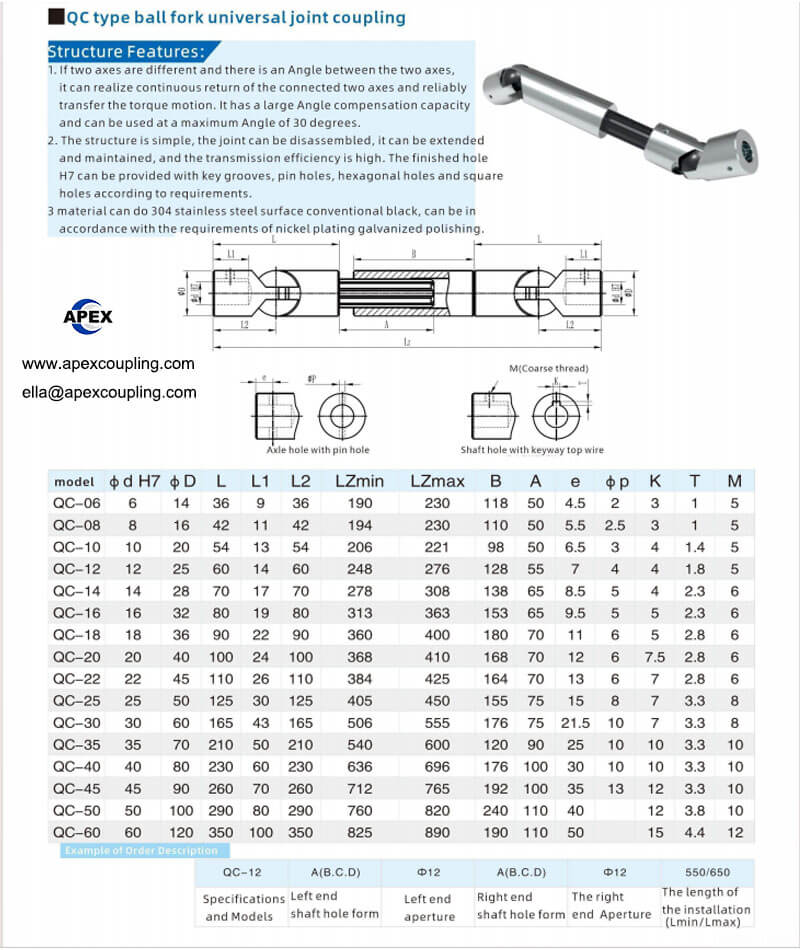
Ball fork universal joints (also known as ball and socket joints) are essential for transmitting power between shafts with both angular misalignment and variable axial spacing. The QC series from Apex Coupling offers a versatile solution with a telescopic spline shaft and detachable joints, covering bore sizes from 6 to 60 mm with working angles up to 30°.
This guide explains how ball fork universal joints work, their key advantages, and how to select the right model for your application.
1. What Is a Ball Fork Universal Joint?
A ball fork universal joint consists of:
Two yokes (forks) – precision-machined from 40Cr alloy steel
A ball fork (ball and socket) joint – allows smooth, continuous rotation with angular misalignment
A telescopic spline shaft – allows axial length adjustment
Detachable joints – for easy maintenance and component replacement
The ball fork design provides smooth, continuous rotation even when the two shafts are at an angle, making it ideal for applications where shaft alignment is difficult to maintain.
💡 Ball fork universal joints are widely used in packaging machinery, woodworking equipment, multi-spindle drills, and general automation where both angular misalignment and variable shaft spacing are present.
2. Key Advantages of Ball Fork Universal Joints
| Advantage | Benefit |
|---|---|
| Ball Fork Design | Smooth, continuous rotation with angular misalignment – reliable torque transmission |
| Telescopic Spline Shaft | Allows axial length adjustment without disassembly – accommodates variable shaft spacing |
| 30° Working Angle | Large angular compensation – accommodates significant misalignment |
| Detachable Joints | Easy maintenance and component replacement – reduces downtime |
| Compact & Reliable | Simple structure, compact design, high transmission efficiency |
| Maintenance-Friendly | Joints can be disassembled for inspection and replacement |
3. Ball Fork vs Cross Shaft – Which One Do You Need?
| Feature | Ball Fork (QC Series) | Cross Shaft (Traditional) |
|---|---|---|
| Rotation smoothness | Smoother – continuous rotation | Can be jerky at high angles |
| Angular capacity | Up to 30° working / 45° limit | Up to 45° |
| Telescopic design | ✅ Yes – standard | Optional |
| Detachable joints | ✅ Yes – easy maintenance | More complex |
| Structure | Simpler, more compact | More complex |
| Best for | Automation, packaging, woodworking | Heavy-duty, high-torque applications |
4. Applications Where Ball Fork Universal Joints Excel
| Industry | Application | Why QC? |
|---|---|---|
| Packaging Machinery | Conveyors, wrapping machines | Smooth rotation, variable spacing |
| Woodworking | Multi-spindle drills, routers | Telescopic adjustment, detachable joints |
| Multi-Spindle Drills | Precision drilling | Angular misalignment, easy maintenance |
| Metallurgy | Rolling mills, casting lines | High torque, telescopic compensation |
| Printing | Register control | Smooth rotation, precision |
| Glass Machinery | Glass processing | Reliable, low maintenance |
| Food & Beverage | Processing equipment | Stainless steel option available |
5. How to Select the Right QC Model
Step 1: Determine Your Torque Requirement
Calculate the torque your application requires.
QC series covers bore sizes from 6 to 60 mm.
Step 2: Determine Working Angle
Measure the expected angular misalignment.
QC series: 30° working angle (45° limit).
Step 3: Determine Length and Travel
Measure the minimum and maximum shaft spacing.
Select a model with LZmin and LZmax that accommodate your requirements.
Step 4: Select Bearing Type
Plain bearing: Up to 1000 RPM, higher torque, requires lubrication.
Needle roller bearing: Up to 4000 RPM, lower friction, maintenance-free.
Step 5: Select Bore Type
Standard: H7 round bore.
Keyway: Add “K” after bore size.
Hexagon, square, or pin hole available on request.
Step 6: Consider Material and Finish
Standard: 40Cr alloy steel with black oxide.
Optional: 304/316 stainless steel for corrosion resistance.
Optional finishes: polished, chrome, nickel, sandblasted.
6. Installation & Maintenance Tips
Check alignment – Keep operating angles ≤30° for continuous operation.
Lubricate bearings – Regular lubrication extends service life (plain bearings).
Needle bearings – Sealed, low maintenance – inspect periodically.
Detachable joints – Take advantage of detachable design for easy maintenance.
Check for wear – Inspect ball fork, spline shaft, and bearings periodically.
Bore fit – Use H7 shaft tolerance for best concentricity.
Speed recommendation – Use at ≤50% of maximum rated speed for optimal life.
7. Real‑World Example – Packaging Line Upgrade
A packaging machinery manufacturer was experiencing premature wear on standard universal joints used in their conveyor drives. The joints operated at 25° angles and 1500 RPM, causing frequent failures and downtime.
They switched to Apex Coupling QC ball fork universal joints (40Cr, needle bearing, telescopic, detachable joints). Results:
Service life extended – needle bearing handled 1500 RPM smoothly
Telescopic adjustment – accommodated variable shaft spacing
Angle capacity – 25° well within the 30° recommended range
Maintenance simplified – detachable joints allowed quick component replacement
Less downtime – fewer replacements during production
8. Selection Checklist
- □
Model: QC-06 to QC-60 – select based on bore size and torque requirements
- □
Bearing type: Plain (1000 RPM) or Needle (4000 RPM)
- □
Material: 40Cr alloy steel (standard) or 304/316 stainless steel
- □
Finish: Black oxide, polished, chrome, nickel, or sandblasted
- □
Bore: H7 tolerance – match your shaft diameters
- □
Bore option: Keyway (K), hexagon, square, or pin hole
- □
Length: Specify LZmin and LZmax
- □
Angle: ≤30° for continuous use (45° limit per joint)
- □
Speed: ≤50% of max rated speed for optimal life
9. Conclusion
The QC ball fork universal joint coupling from Apex Coupling offers the perfect combination of smooth rotation, angular misalignment compensation, telescopic adjustment, and easy maintenance for demanding industrial applications. With 40Cr construction, ball fork design, 30° working angle, detachable joints, and OEM customization, it is the ideal solution for packaging machinery, woodworking equipment, multi-spindle drills, and general automation.
👉 Need a ball fork universal joint for your application? Contact us with your configuration, bore, and length requirements.
Inquiry now:
ella@apexcoupling.com
Ball fork universal joint selection guide
QC universal joint guide
Telescopic universal joint selection
Packaging machinery coupling
Multi-spindle drill coupling
Detachable universal joint