Slit Coupling Selection Guide – Zero Backlash Aluminum Couplings for Stepper Motors & Encoders
Slit couplings (also known as parallel line couplings, helical beam couplings, or flexible beam couplings) are essential components in precision motion control systems. With their unique slit cut design, they provide zero backlash, low inertia, and excellent misalignment compensation – making them the ideal choice for stepper motors, servo motors, encoders, resolvers, and 3D printers.
This guide explains how slit couplings work, their key advantages, and how to select the right model for your application.
1. What Is a Slit Coupling?
A slit coupling is a one-piece flexible coupling with a series of parallel slit cuts machined into a cylindrical metal body. These cuts create a flexible “spring-like” section that allows the coupling to:
Transmit torque while accommodating misalignment
Absorb vibration and shock loads
Provide zero backlash operation
Maintain constant velocity torque transmission
Offer high torsional stiffness with low inertia
💡 The slit design allows the coupling to flex and compensate for misalignment, providing a balance of torque, misalignment, and torsional stiffness capabilities.
2. Key Advantages of Slit Couplings
| Advantage | Benefit |
|---|---|
| Zero Backlash | No rotational clearance – precise positioning for encoders and servo motors |
| High Misalignment Tolerance | Accommodates angular, radial, and axial misalignment |
| Low Inertia | Lightweight design – ideal for high-speed operation and quick starts/stops |
| Vibration Damping | Absorbs shock and vibration – protects sensitive equipment |
| Maintenance-Free | No lubrication required – reduces downtime |
| One-Piece Construction | No moving parts – high reliability and long service life |
| Corrosion Resistance | Aluminum construction with anodized finish – suitable for various environments |
| High Speed Capability | Capable of speeds up to 70,000 RPM |
3. Slit Coupling vs Spiral Coupling – Key Differences
| Feature | Slit Coupling (Parallel Line) | Spiral Coupling (Helical) |
|---|---|---|
| Cut Design | Parallel, intermittent slits | Continuous spiral cut |
| Torque Rigidity | Higher – better torque capability | Lower – more flexible |
| Speed Capability | Higher – can handle higher speeds | Lower – limited by spiral design |
| Misalignment Compensation | Good – angular, radial, axial | Excellent – angular, radial, axial |
| Best for | High-speed, high-torque applications | Applications requiring maximum flexibility |
4. Applications Where Slit Couplings Excel
Slit couplings are widely used in various industries due to their flexibility and precision:
| Industry | Application | Why Slit Coupling? |
|---|---|---|
| Stepper Motors | Precision positioning | Zero backlash, low inertia |
| Servo Motors | Motion control | Zero backlash, high speed |
| Encoders & Resolvers | Position feedback systems | Zero backlash, accurate signal transmission |
| 3D Printers | Z-axis coupling, filament drive | Low inertia, misalignment compensation |
| CNC Machines | Small CNC, engraving machines | Precision, zero backlash |
| Medical Devices | Precision equipment | Smooth operation, reliability |
| Robotics | Small robot joints | Flexibility, precision |
| Automation | Pick-and-place systems | Low inertia, zero backlash |
5. How to Select the Right Slit Coupling
Step 1: Determine Your Torque Requirement
Calculate the torque your application requires.
Select a coupling with adequate torque capacity.
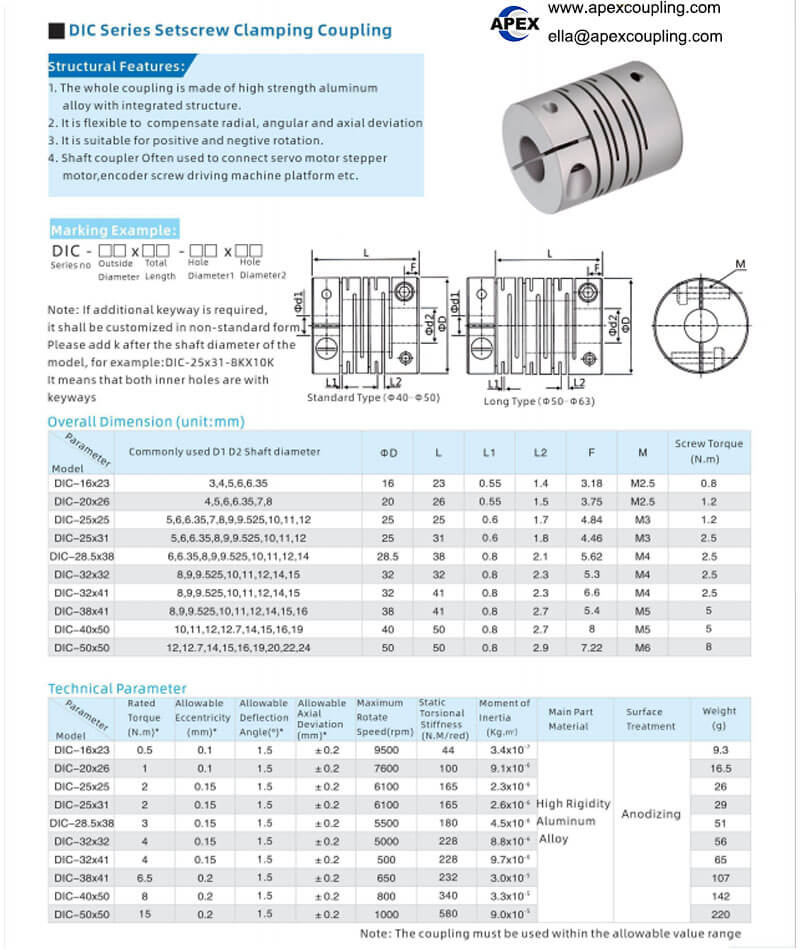
DIC series covers 0.5–15 N·m.
Step 2: Match Shaft Diameters
Measure your shaft diameters.
Select a model with a bore range that accommodates your shafts.
H7 bore tolerance is recommended for precision fit.
Step 3: Consider Space Constraints
Measure available space for the coupling (outer diameter and length).
Slit couplings are available in compact sizes for space-constrained applications.
Step 4: Evaluate Misalignment
Determine the expected angular, radial, and axial misalignment.
Slit couplings can accommodate angular, radial, and axial misalignment.
Step 5: Consider Environmental Factors
Temperature: Aluminum couplings operate in a wide temperature range.
Corrosion: Anodized aluminum offers good corrosion resistance.
Chemical exposure: Consider material compatibility.
Step 6: Select Fastening Method
Clamping screw: Provides even clamping force, no shaft damage.
Set screw: Simple and cost-effective.
6. Material Selection – Why 7075 Aluminum?
The DIC series uses 7075-T6 high-strength aluminum alloy:
| Feature | Benefit |
|---|---|
| Lightweight | Reduces inertia – enables high-speed operation |
| High Strength | Aerospace-grade alloy – durable and reliable |
| Corrosion Resistance | Naturally resists corrosion – long service life |
| Anodizable | Enhanced surface protection and aesthetics |
7. Installation & Maintenance Tips
Clean shafts – Remove oil, grease, and debris before installation.
Check alignment – Even with misalignment compensation, keep within recommended limits.
Tighten clamping screws evenly – Use a torque wrench in a star pattern.
No lubrication required – Coupling is maintenance-free.
Periodic inspection – Check for wear, cracks, or deformation in the slit cuts.
Keep clean – Remove dust and debris to prevent premature wear.
8. Real‑World Example – 3D Printer Upgrade
A 3D printer manufacturer was experiencing Z-axis positioning errors due to backlash in their existing coupling. The coupling also transmitted vibration to the print head, causing surface quality issues.
They switched to Apex Coupling DIC aluminum slit coupling (7075 aluminum, zero backlash, clamping type). Results:
Position errors eliminated – zero backlash
Print quality improved – vibration damping
Maintenance eliminated – no lubrication required
Accuracy improved – H7 precision bore
9. Selection Checklist
- □
Type: DIC – aluminum slit (parallel line) coupling
- □
Material: 7075 aluminum – lightweight, high strength
- □
Backlash: Zero backlash – precision applications
- □
Bore: H7 tolerance – match your shaft diameters
- □
Fastening: Clamping screw – secure, even clamping force
- □
Misalignment: Angular, radial, axial – verify capacity
- □
Maintenance: Maintenance-free – no lubrication
- □
Application: Stepper motors, servo motors, encoders, 3D printers
10. Conclusion
The DIC aluminum slit coupling from Apex Coupling offers the perfect combination of zero backlash, low inertia, and excellent misalignment compensation for precision motion control applications. With 7075 aluminum construction, slit (parallel line) design, clamping screw fastening, and maintenance-free operation, it is the ideal solution for stepper motors, servo motors, encoders, 3D printers, and CNC machines.
👉 Need a slit coupling for your precision application? Contact us with your bore size and requirements.
Inquiry now:
ella@apexcoupling.com
Slit coupling selection guide
Parallel line coupling guide
Zero backlash coupling selection
Stepper motor coupling guide
Encoder coupling guide
Aluminum flexible coupling
Clamping coupling guide