Double Flange Jaw Coupling Selection Guide – ML2 for Printing & Machine Tools
Double flange jaw couplings (LMS type) are a robust and reliable solution for demanding industrial applications. With their bolted flange design, high torque capacity, and maintenance-free operation, they are an excellent choice for printing machinery, machine tools, conveyors, and general industrial equipment. This guide explains how to select the right ML2 double flange coupling for your application.
1. What Is a Double Flange Jaw Coupling?
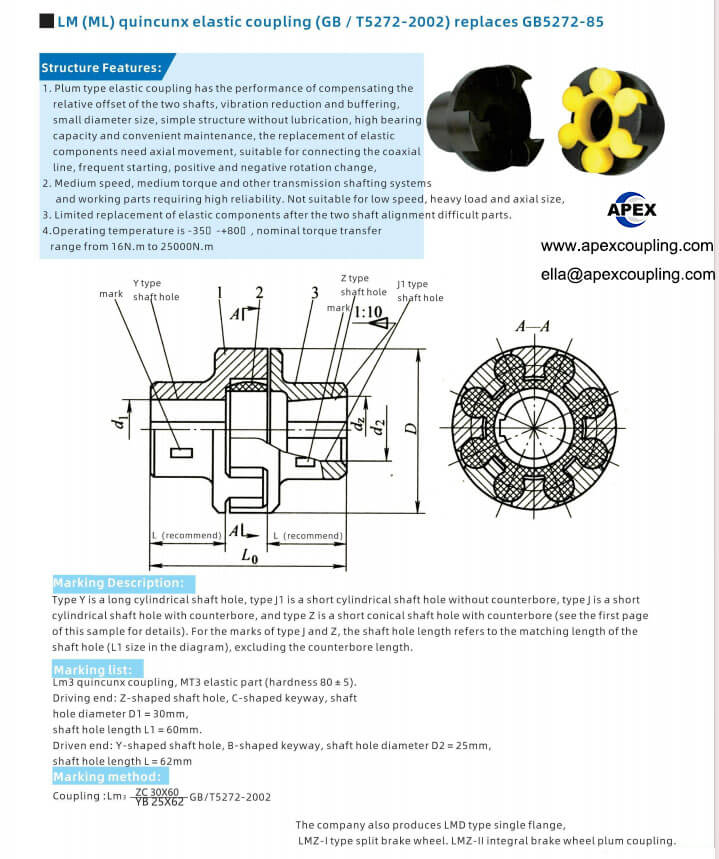
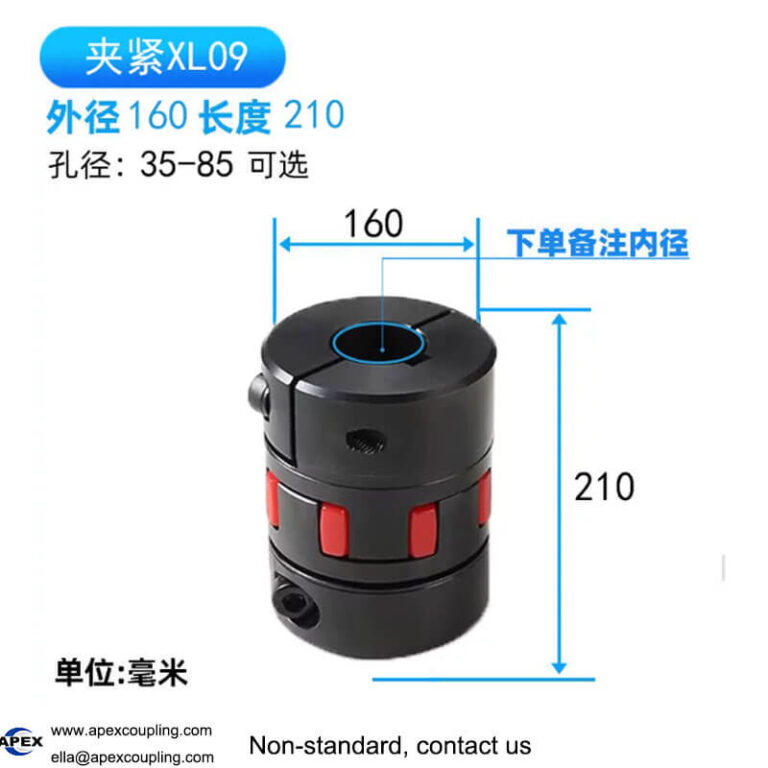
A double flange jaw coupling (LMS type) consists of:
Two 45# steel hubs with convex jaws
A polyurethane spider that fits between the jaws
Flanges bolted to the hubs for a secure connection
The spider transmits torque while absorbing shock, dampening vibration, and compensating for misalignment. The double flange design provides a secure, rigid connection ideal for demanding applications. This coupling is standardized under GB/T5272-2002, which defines five structural forms: LM (basic), LMD (single flange), LMS (double flange), LMZ-I, and LMZ-II .
💡 The LMS (double flange) type is the preferred choice when a secure, bolted flange connection is required.
2. Key Advantages of Double Flange Jaw Couplings
| Advantage | Benefit |
|---|---|
| Double Flange Design | Secure, rigid connection – ideal for demanding applications |
| Maintenance-Free | No lubrication required – reduces operating costs |
| High Torque Capacity | Handles heavy loads – up to 2000 N·m (ML2) |
| Vibration Damping | Polyurethane spider absorbs shock and vibration |
| Misalignment Compensation | Compensates angular, radial, and axial misalignment |
| Frequent Start/Stop Capability | Ideal for reversing and high-cycle applications |
| Wide Temperature Range | -35°C to +80°C – suitable for diverse environments |
| Standardized Design | Interchangeable with other LMS type couplings |
3. How to Select the Right ML2 Model
Step 1: Determine Your Torque Requirement
Calculate the torque your application requires.
Select a model with rated torque ≥ 1.5× your requirement.
ML2 offers 2000 N·m rated torque (max 8200 N·m).
Step 2: Match Shaft Diameters
Measure your shaft diameters.
ML2 supports a 30mm bore (custom bores available).
The GB/T5272-2002 standard covers shaft hole diameters from 12mm to 160mm .
Step 3: Check Speed Requirements
Verify the coupling’s maximum speed exceeds your operating speed.
ML2 offers 5000 RPM maximum speed.
Step 4: Consider Environmental Factors
Temperature: ML2 operates -35°C to +80°C .
Dust/moisture: Suitable for dusty and wet environments.
Step 5: Evaluate Misalignment
The ML2 coupling compensates for angular, radial, and axial misalignment .
This reduces stress on bearings and seals, extending equipment life.
4. Applications Where Double Flange Jaw Couplings Excel
| Industry | Application | Why ML2? |
|---|---|---|
| Printing | Register control, high-speed operation | High speed, precision, maintenance-free |
| Machine Tools | CNC, lathes, milling machines | High torque, reliability, frequent reversing |
| Conveyors | Material handling | Shock absorption, misalignment compensation |
| Pumps | Centrifugal, gear pumps | No lubrication, vibration damping |
| Fans & Blowers | Ventilation systems | High speed, maintenance-free |
| Mining | Crushers, feeders | High torque, durability |
| Metallurgy | Rolling mills | High torque, shock absorption |
5. Real‑World Example – Printing Press Upgrade
A printing press manufacturer was experiencing premature wear and vibration on their existing couplings. The couplings required regular lubrication and failed prematurely due to shock loads and misalignment.
They switched to Apex Coupling ML2 double flange jaw couplings (45# steel, polyurethane spider, 2000 N·m). Results:
Service life extended – polyurethane spider withstood shock loads
Maintenance eliminated – no lubrication required
Vibration reduced – spider absorbed vibration and shock
Downtime reduced – reliable, long-lasting performance
6. Installation & Maintenance Tips
Align shafts – Even with misalignment compensation, keep within recommended limits.
Install hubs – Mount the hubs on the driving and driven shafts.
Install spider – Place the polyurethane spider between the hubs.
Install flanges – Bolt the flanges securely to the hubs .
Check bolt torque – Tighten bolts to the specified torque.
No lubrication required – Coupling is maintenance-free .
Visual inspection – Check spider condition periodically.
Replace spider – When worn, replace the spider (requires axial movement) .
7. Selection Checklist
- □
Type: LMS (double flange) – secure bolted connection
- □
Model: ML2 – 2000 N·m, 5000 RPM
- □
Material: 45# steel – high strength, durable
- □
Bore: H7 – match your shaft diameter (custom available)
- □
Spider: Polyurethane – maintenance-free, vibration damping
- □
Temperature: -35°C to +80°C – verify operating range
- □
Application: Printing, machine tools, conveyors, pumps, fans
- □
Standard: GB/T5272-2002 – quality assured
8. Conclusion
The ML2 double flange jaw coupling from Apex Coupling offers the perfect combination of secure flange mounting, high torque capacity, and maintenance-free operation for demanding industrial applications. With 45# steel hubs, a polyurethane spider, 2000 N·m torque capacity, and GB/T5272-2002 compliance, it delivers reliable, long-lasting performance in printing machinery, machine tools, conveyors, and general industry.
👉 Need a double flange jaw coupling for your application? Contact us with your bore, torque, and speed requirements.
Inquiry now:
ella@apexcoupling.com
Double flange jaw coupling selection guide
ML2 coupling guide
LMS coupling selection
Quincunx elastic coupling guide
Plum blossom coupling guide
Printing machinery coupling
GB/T5272-2002 coupling guide