

CONTACT US
INQUIRY US
Apex Coupling, Our Core Expertise: Customization and Quality.
Your One-Stop Custom Coupling Manufacturer
Introduction In industrial drive systems, flexible jaw couplings rely on an internal elastomeric spider element to transfer torque while isolating vibration between driving and driven shafts. Over extended operational cycles, the constant compressive stress and environmental exposure cause the elastomeric insert to wear, making timely replacement essential to avoid metal-to-metal contact between coupling hubs.
Understanding the dimensional specifications and material properties of standard L-Series Elastic Rubber Coupling Spiders allows maintenance teams to select the exact replacement element for reduced downtime and extended machinery life.
1. Elastomeric Disc Structure and Damping Mechanics The L-series coupling spider features a central ring or flat disc structure with extending lugs or cushion pads.
Compressive Energy Absorption: As motor torque is applied, the metallic jaws of the coupling hub compress the elastic rubber or polyurethane teeth. This elastomeric compression absorbs sudden peak torque spikes and dampens harmonic vibrations.
Misalignment Compensation: The resilience of the elastic material accommodates minor angular deflections and axial float without transmitting excess stress to motor bearings.
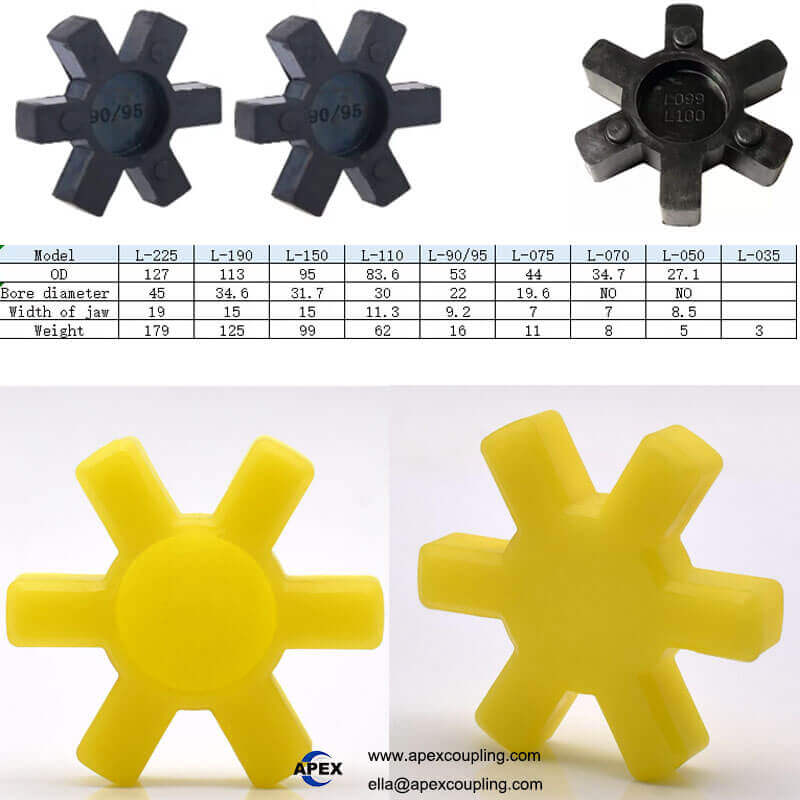
2. Dimensional Selection Parameters for L-Series Spiders Selecting the correct L-series insert requires matching key physical dimensions to your coupling hub profile. As shown in image_1c22ff.png, the L-series offers standardized sizing across light to heavy duty ratings:
Light-Duty (L-035 to L-070): Outer diameters from 27.1 mm to 34.7 mm, ideal for small electric motors and fractional horsepower drives.
Medium-Duty (L-075 to L-110): Outer diameters from 44 mm to 83.6 mm, featuring jaw widths from 7 mm to 11.3 mm for general machinery and pumps.
Heavy-Duty (L-150 to L-225): Outer diameters from 95 mm to 127 mm, supporting bore openings up to 45 mm for heavy industrial gearboxes and automotive manufacturing lines.
3. Polyurethane vs. NBR Rubber Material Selection Choosing between NBR rubber and Polyurethane (PU) depends on the operating environment:
NBR Rubber: Excellent flexibility, economical, and provides high dampening capability in standard temperature environments.
Polyurethane (PU): Higher abrasion resistance, superior resistance to oils and chemicals, and greater load-bearing capacity for high-torque applications.
4. Direct Factory Sourcing and Custom OEM Support Apexcoupling provides a complete inventory of L-series elastomeric inserts along with customized manufacturing tracks. Supported by ISO-compliant quality standards, our Guangdong facility handles custom Shore hardness requirements, special polymer blending, and private-label packaging through our OEM, ODM, and OBM programs.
Inquiry now:
ella@apexcoupling.com
L series coupling spider guide, rubber jaw coupling insert sizing, L-075 L-095 spider dimension table, polyurethane coupling disc replacement, vibration damping coupling element.
Apex Coupling, Our Core Expertise: Customization and Quality.
Your One-Stop Custom Coupling Manufacturer