Elastomer Selection for Curved Jaw Couplings: Why Hytrel GS Spiders Outperform Standard Polyurethane in High-Heat & Oil Environments
Introduction Flexible curved jaw couplings are among the most widely used elastomeric couplings in general machinery, motor drives, and hydraulic power units. While the metallic hubs transfer rotational energy, the elastomeric element—commonly called a spider insert—serves as the critical cushion that absorbs shock loads, dampens torsional resonance, and compensates for minor shaft misalignments.
However, standard polyurethane (PU) spiders often degrade prematurely when exposed to ambient heat exceeding 80°C or when splashed with synthetic hydraulic oil. To solve this degradation issue, drive designers utilize Hytrel GS Series Flexible Spider Inserts. This article breaks down the physical properties of Hytrel elastomeric elements, details dimensional standards matching ROTEX couplings, and provides engineering guidelines for thermal and oil-heavy applications.
1. Hytrel Thermoplastic Elastomer vs. Standard Polyurethane Selecting the correct spider material dictates the operational lifespan of your coupling assembly:
Thermal Endurance: Standard PU elements tend to soften or become brittle when operating in enclosed machinery spaces above 80°C–100°C. Imported Hytrel GS inserts maintain structural elasticity and compressive strength at continuous temperatures up to 200°C.
Chemical & Oil Resistance: Hydraulic pumps, gearboxes, and metalworking tools constantly mist couplings with oils and solvents. Hytrel exhibits low swell and resistance to oil degradation compared to conventional rubbers.
2. Curved Jaw Geometry and Load Distribution The curved tooth design of the GS series (matching ROTEX profiles) is engineered for progressive torsional stiffness:
Concave-Convex Contact: Under load, the convex elastomer teeth press against the curved jaws of the metallic hub, distributing compressive force evenly across the tooth surface.
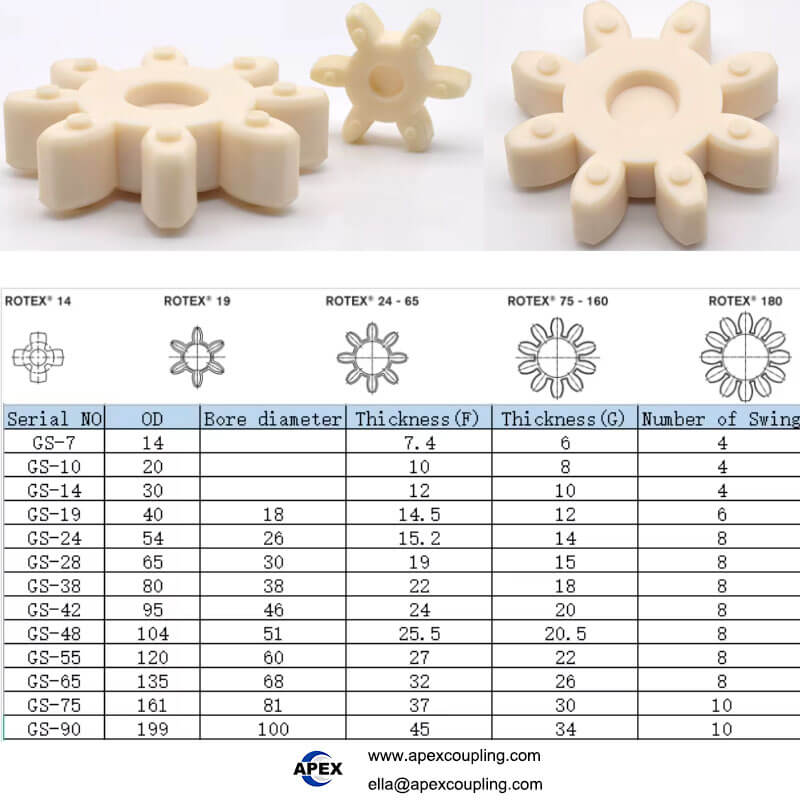
Variable Tooth Configurations: Depending on the torque requirements and size, GS inserts feature 4 teeth (GS-7 to GS-14), 6 teeth (GS-19), 8 teeth (GS-24 to GS-65), or 10 teeth (GS-75 to GS-90) to maximize load distribution.
3. Dimensional Standardizing & ROTEX Interchangeability Replacing worn elements in existing plant machinery requires exact dimensional matching. Apexcoupling GS inserts strictly conform to global ROTEX sizes, eliminating the need to replace complete coupling assemblies:
GS-19 (OD 40mm, Thickness 14.5mm): Fits ROTEX 19 hubs.
GS-24 (OD 54mm, Thickness 15.2mm): Fits ROTEX 24 hubs.
GS-28 (OD 65mm, Thickness 19mm): Fits ROTEX 28 hubs.
GS-38 through GS-90 (OD 80mm up to 199mm): Heavy industrial power transmission.
4. Manufacturing Quality and Custom Factory Support Certified under ISO 9001, RoHS, and Bureau Veritas (BV) standards, Apexcoupling manufactures jaw coupling spider inserts under strict quality controls. In addition to standard Hytrel and PU formulations, our facility supplies complete flexible couplings across GR, MT, NM, FCL, HRC, and L/J model ranges. Equipment manufacturers can leverage our OEM/ODM/OBM tracks for custom hardness ratings (92 Shore A, 98 Shore A, or 64 Shore D), special color coding, or branded packaging directly from our production hub in Guangdong, China.
Inquiry now:
ella@apexcoupling.com
Hytrel spider insert mechanics, GS type curved jaw coupling element, ROTEX spider replacement guide, oil resistant coupling elastomer, high temperature flexible insert 200C, polyurethane vs hytrel jaw spider.