L Type Elastic Coupling Selection Guide – Lovejoy Replacement for Pumps, Compressors & Wave Soldering Machines
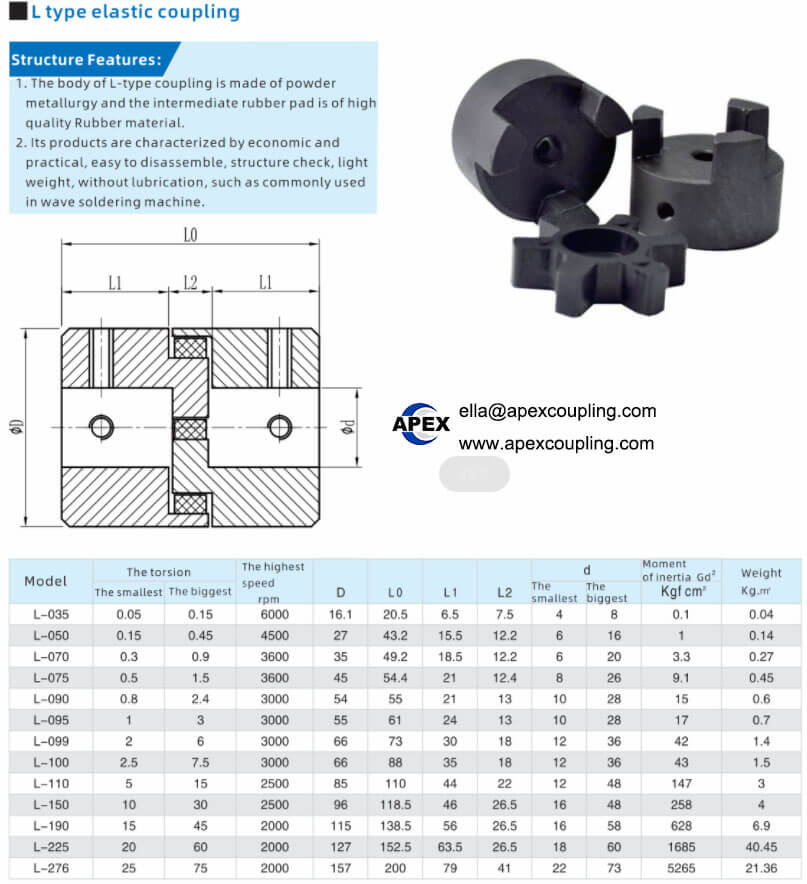
L Type elastic couplings (also known as L-type jaw couplings, spider couplings, or Lovejoy L-series) are among the most economical and widely used flexible couplings in industrial power transmission. With a simple three-piece design – two hubs and one elastomeric spider – they offer reliable torque transmission, shock absorption, and misalignment compensation at a competitive price point.
This guide explains how L Type elastic couplings work, their key advantages, and how to select the right model for your application – including wave soldering machines, pumps, compressors, and conveyors.
1. What Is an L Type Elastic Coupling?
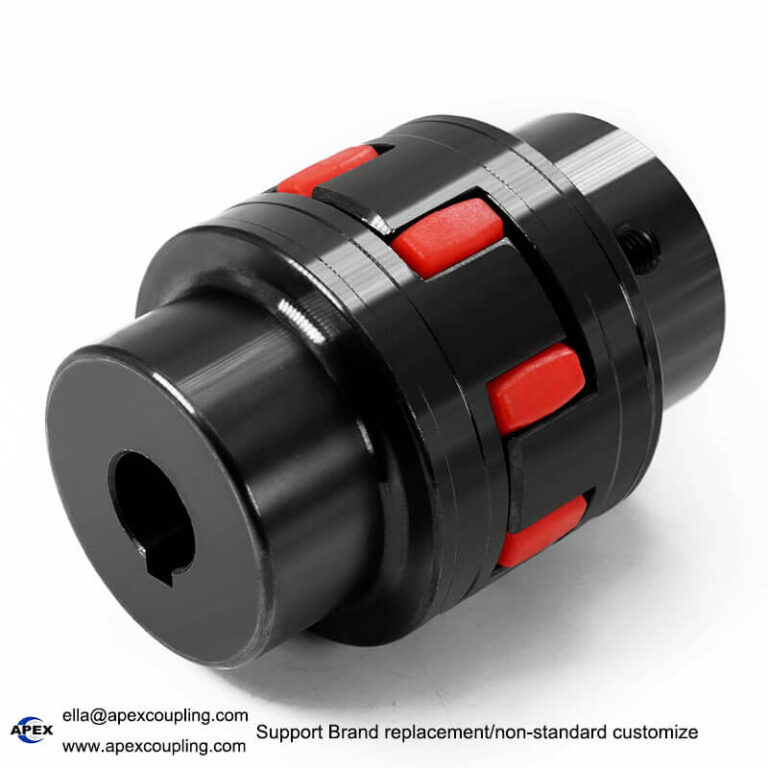
An L Type elastic coupling consists of:
Two powder metallurgy hubs – sintered iron construction for L035-L150 sizes
One elastomeric spider – NBR (Nitrile Butadiene Rubber) as standard
The spider sits between the jaws of the two hubs, transmitting torque while absorbing shock, dampening vibration, and compensating for angular and parallel misalignment.
Key characteristics:
Economical and practical – simple construction
Easy to disassemble – quick inspection and maintenance
Lightweight – powder metallurgy construction
No lubrication required – maintenance-free
Fail-safe – continues to function if spider fails
2. Why Choose L Type Elastic Couplings?
| Advantage | Benefit |
|---|---|
| Cost-Effective | Economical three-piece design – lower purchase and maintenance costs |
| Oil & Harsh Condition Resistant | Withstands oil, dirt, sand, moisture, and grease |
| Fail-Safe Design | Continues to function if spider fails – minimizes downtime |
| No Lubrication | Maintenance-free – reduces operating costs |
| Misalignment Compensation | Accommodates angular (1°) and parallel (0.015″) misalignment |
| Vibration Damping | Absorbs shock and vibration – protects sensitive equipment |
| Easy Maintenance | Simple inspection and spider replacement |
3. Lovejoy Compatibility – L070 to L150
Our L Type Elastic Coupling is dimensionally interchangeable with Lovejoy L-series couplings from L070 to L150:
| Size | Max Bore (mm) | Torque (N·m) | Max Speed (RPM) |
|---|---|---|---|
| L070 | 19 | 4.9 | 13,000 |
| L075 | 22 | 10.2 | 10,000 |
| L090 | 25 | 16.3 | 9,000 |
| L095 | 28 | 21.9 | 9,000 |
| L099 | 30 | 35.9 | 7,000 |
| L100 | 35 | 47.1 | 7,000 |
| L110 | 42 | 89.5 | 5,000 |
| L150 | 48 | 140 | 5,000 |
✅ Drop-in replacement – no design changes required. Same dimensions, superior value.
4. Spider Material Selection – Choose the Right Insert
The spider is the heart of the L Type coupling. Different materials offer different performance characteristics:
| Spider Material | Torque | Temperature Range | Best For |
|---|---|---|---|
| SOX (NBR) Rubber (Standard) | Baseline | -40°C to 100°C | General purpose, oil-resistant, good damping |
| Urethane | 1.5x NBR | -34°C to 90°C | Higher torque, good oil/chemical resistance |
| Hytrel® | 3x NBR | -29°C to 110°C | High torque, high temperature, excellent oil/chemical resistance |
| Bronze | 3x NBR | Extreme | Low speed (≤250 RPM), high torque, harsh environments |
✅ NBR (Nitrile Butadiene Rubber) is the standard spider material – offering excellent oil resistance, resilience similar to natural rubber, and effective operation in -40°C to 100°C.
5. Key Selection Criteria
When selecting an L Type elastic coupling, consider these factors:
Step 1: Determine your torque requirement
Calculate the torque your application requires
Select a model with rated torque ≥ 1.5× your requirement
L070: 4.9 N·m → L150: 140 N·m
Step 2: Match shaft diameters
Measure your shaft diameters
Select a model with adequate bore capacity
Step 3: Consider operating conditions
Temperature: NBR operates in -40°C to 100°C
Chemical exposure: NBR is oil-resistant
Speed: Ensure max speed exceeds your operating speed
Step 4: Evaluate misalignment requirements
Angular up to 1°
Parallel up to 0.015″
6. Applications Where L Type Elastic Couplings Excel
| Industry | Application | Why L Type? |
|---|---|---|
| Electronics Manufacturing | Wave soldering machines | Economical, maintenance-free |
| Pumps | Hydraulic, centrifugal, screw pumps | Oil resistance, vibration damping |
| Compressors | Piston and screw compressors | Fail-safe, reliable |
| Conveyors | Belt and screw conveyors | Easy maintenance, misalignment compensation |
| Fans & Blowers | Ventilation systems | High speed capability, lightweight |
| Machine Tools | Grinding, woodworking machinery | Vibration damping, precision |
| Construction | Excavators, cement mixers | Harsh condition resistant |
7. Installation & Maintenance Tips
Clean shafts and bores – Remove oil, grease, and debris
Check alignment – Even with misalignment compensation, keep within recommended limits (≤1° angular, ≤0.015″ parallel)
Install spider correctly – Ensure proper fit between the two hubs
Tighten set screws evenly – Use a torque wrench to specification
No lubrication required – NBR spider is self-lubricating
Inspect spider periodically – Replace if cracked, worn, or deformed
Fail-safe backup – If spider fails, schedule prompt replacement
8. Real‑World Example – Wave Soldering Machine Upgrade
A wave soldering machine manufacturer was using more expensive couplings that required frequent maintenance. The couplings were also susceptible to oil degradation from the soldering process.
They switched to Apex Coupling L Type elastic couplings (powder metallurgy hubs, NBR spider). Results:
Cost reduced – economical powder metallurgy construction
Maintenance eliminated – no lubrication required
Oil degradation eliminated – NBR spider resisted oil exposure
Downtime reduced – fail-safe design and easy maintenance
Performance maintained – vibration damping and misalignment compensation
9. Selection Checklist
Size: L070 to L150 – match your torque requirement
Bore size: Match your shaft diameters – custom available
Spider material: NBR (standard), Urethane, Hytrel®, or Bronze
Speed: Ensure max speed exceeds operating speed
Temperature: NBR operates in -40°C to 100°C
Environment: NBR for oil, dirt, sand, moisture, and grease resistance
Application: Wave soldering, pumps, compressors, conveyors, fans
10. Conclusion
The L Type elastic coupling from Apex Coupling offers the perfect combination of economical pricing, reliable performance, and harsh condition resistance for a wide range of industrial applications. With powder metallurgy hubs, NBR rubber spider, Lovejoy L070-L150 compatibility, and maintenance-free operation, it is the ideal choice for wave soldering machines, pumps, compressors, conveyors, and general industrial machinery.
👉 Need an L Type elastic coupling for your application? Contact us with your size, bore, and spider material requirements.
Inquiry now:
ella@apexcoupling.com
L type elastic coupling selection guide
Lovejoy L series replacement guide
wave soldering machine coupling
NBR rubber coupling guide
jaw coupling selection
oil resistant coupling for harsh conditions