Diaphragm Coupling Selection Guide – Single vs Double for Servo & Stepper Motors
Diaphragm couplings are among the most precision-engineered flexible couplings available for high-performance motion control applications. With zero backlash, high torsional stiffness, and low inertia, they are the preferred choice for servo motors, stepper motors, and ball screw drives.
This guide explains the differences between single and double diaphragm couplings, helps you select the right configuration, and covers the key specifications you need to consider.
1. What Is a Diaphragm Coupling?
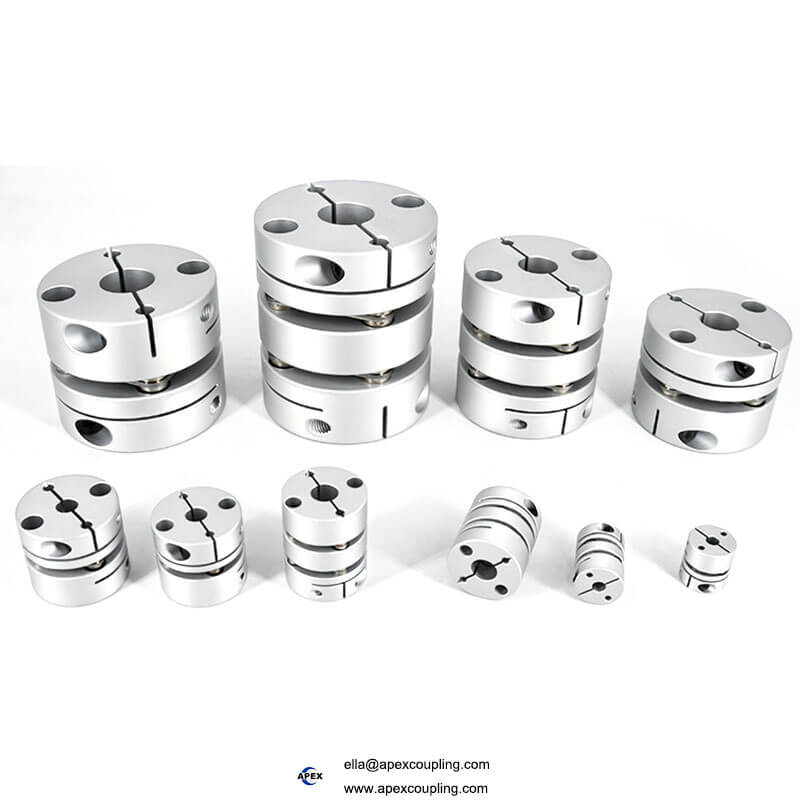
A diaphragm coupling is a metal flexible coupling that uses one or more stainless steel diaphragms to transmit torque while compensating for misalignment. It relies on the elastic deformation of the diaphragm to accommodate angular, radial (eccentricity), and axial deviations between connected shafts.
Key characteristics include:
Zero backlash – No rotational clearance
High torsional stiffness – Maintains system rigidity
Low moment of inertia – Fast dynamic response
Maintenance-free – No lubrication required
High transmission efficiency – Up to 99.86%
2. Single Diaphragm vs Double Diaphragm – Key Differences
| Feature | Single Diaphragm | Double Diaphragm |
|---|---|---|
| Eccentricity compensation | ❌ Not allowed (structural limitation) | ✅ Yes – bends in different directions simultaneously |
| Angular misalignment | ✅ Yes | ✅ Yes |
| Axial deviation | ✅ Yes | ✅ Yes |
| Torsional rigidity | Higher | Moderate |
| Space requirement | Compact – saves space | Longer (intermediate spacer required) |
| Best for | Space-constrained, high-rigidity applications | Applications requiring eccentricity compensation |
Why single diaphragm cannot compensate for eccentricity:
The single diaphragm coupling requires complex bending of the diaphragm. Due to structural limitations, it is not suitable for eccentricity (parallel misalignment).
Why double diaphragm can compensate for eccentricity:
The double diaphragm coupling has two diaphragm packs connected by an intermediate spacer. It can bend in different directions simultaneously to compensate for eccentricity.
3. Why Material Selection Matters
7075-T6 Aluminum Hubs
Aircraft-grade aluminum alloy
High strength-to-weight ratio – reduces inertia
Excellent fatigue resistance – long service life
Low moment of inertia – enables high-speed operation
304 Stainless Steel Diaphragm
Corrosion-resistant – withstands harsh environments
Oxidation-resistant – non-rusting
High fatigue strength – millions of cycles without failure
Acid and alkali resistant
4. Why Zero Backlash Matters for Servo & Stepper Motors
In precision motion control systems, backlash is the enemy:
Servo motors – Backlash causes positioning errors and poor settling times
Stepper motors – Backlash results in lost steps and inaccurate positioning
Ball screw drives – Backlash creates lost motion and reduces accuracy
A zero backlash diaphragm coupling ensures that every motor rotation translates directly to load movement – no lost motion.
5. Key Specifications to Consider
When selecting a diaphragm coupling, evaluate these parameters:
| Parameter | What to Look For |
|---|---|
| Torque | Coupling rated torque ≥ 1.5× motor torque |
| Speed | Match or exceed motor maximum speed |
| Bore size | Must match shaft diameters – H7 tolerance recommended |
| Misalignment | Angular, radial (eccentricity), and axial capacity |
| Inertia | Low inertia for high-speed applications |
| Backlash | Zero backlash for precision positioning |
| Material | 7075 aluminum + 304 stainless steel for durability |
6. Installation & Alignment Tips
Proper installation is critical for diaphragm coupling performance and longevity:
Clean shaft and bore – Remove oil, grease, and debris
Check alignment – Use a dial indicator to measure runout
For flanges <250mm, runout should not exceed 0.05mm
For flanges >250mm, runout should not exceed 0.08mm
Single diaphragm caution – Does not allow eccentricity – position carefully
Tighten screws evenly – Use a torque wrench in a star pattern
No lubrication required – Diaphragm coupling is maintenance-free
Set misalignment below 1/3 of allowable value – Extends service life
7. Applications Where Diaphragm Couplings Excel
| Industry | Application | Why Diaphragm Coupling? |
|---|---|---|
| Servo Motors | Precision positioning | Zero backlash, high rigidity |
| Stepper Motors | Motion control | No lost steps, low inertia |
| Ball Screws | Linear motion | Smooth operation, no reaction force |
| CNC Machines | Spindles, feed axes | High speed, precision |
| Encoders | Position feedback | Zero backlash, accuracy |
| Robotics | Joint drives | Precise, repeatable motion |
| Semiconductor | Wafer handling | High precision, clean room compatible |
8. Real‑World Example – CNC Machine Upgrade
A CNC machine manufacturer was experiencing positioning errors on a high-speed machining center. The existing coupling had measurable backlash, causing poor surface finish and scrapped parts.
They switched to Apex Coupling double diaphragm coupling (7075 aluminum hubs, 304 stainless steel diaphragm, zero backlash, H7 bore). Results:
Positioning accuracy improved – backlash eliminated
Surface finish enhanced – consistent machining quality
Maintenance eliminated – no lubrication required
Service life extended – 304 stainless steel diaphragm withstood millions of cycles
Higher speeds achieved – low inertia enabled faster acceleration
9. Selection Checklist
Configuration: Single (compact, high rigidity) or Double (eccentricity compensation)
Material: 7075-T6 aluminum + 304 stainless steel diaphragm
Backlash: Zero backlash for servo/stepper motors
Bore tolerance: H7 for precision shaft fit
Torque: 10000 N·m – select based on your requirement
Speed: 9000 RPM – match your motor speed
Screws: 12.9 grade for secure fastening
Surface: Anodized for corrosion resistance
10. Conclusion
The single/double diaphragm coupling from Apex Coupling offers the perfect combination of zero backlash, high torsional stiffness, and low inertia for precision servo and stepper motor applications. With 7075-T6 aluminum hubs, 304 stainless steel diaphragms, H7 bore precision, and 12.9 grade screws, it delivers reliable, long-lasting performance in demanding industrial environments.
👉 Need a diaphragm coupling for your servo or stepper motor? Contact us with your configuration, torque, speed, and bore requirements.
Inquiry now:
ella@apexcoupling.com
diaphragm coupling selection guide
single vs double diaphragm coupling
servo motor coupling selection
zero backlash coupling guide
7075 aluminum coupling
diaphragm coupling for ball screw