WJ vs WJS Universal Joint Coupling Article Title
When selecting a universal joint coupling for industrial machinery, engineers need to consider shaft angle, coupling structure, bore size, torque, installation space, and operating speed.
The WJ and WJS series are both ball-joint universal couplings designed for flexible shaft transmission. The main difference is their joint configuration: WJ uses a single ball-joint structure, while WJS uses a double ball-joint structure.
Both designs can be customized according to the requirements of different machinery and transmission systems.
What Is a Ball-Joint Universal Coupling?
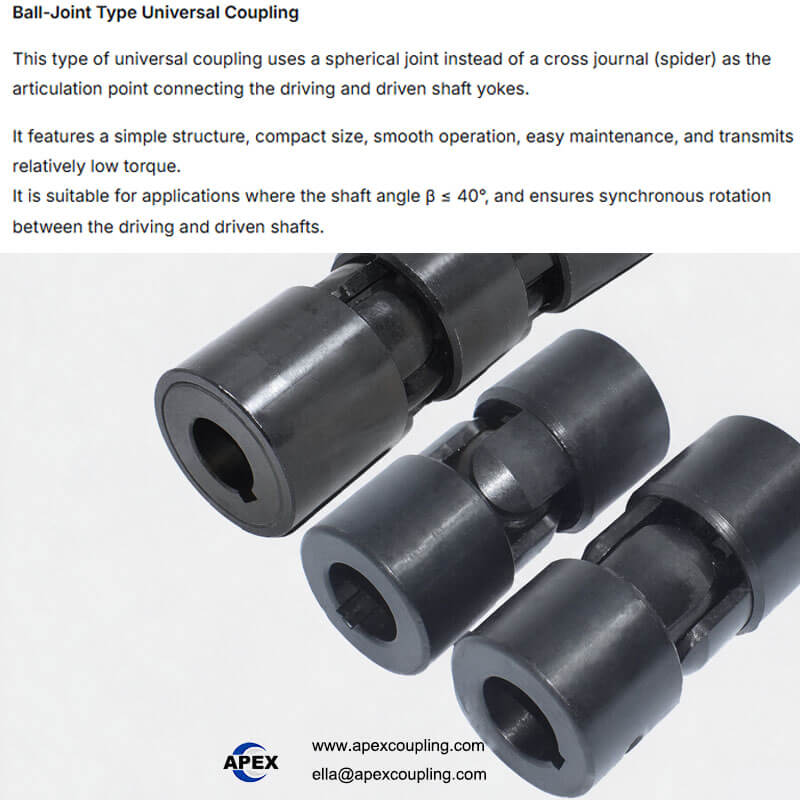
A ball-joint universal coupling uses a spherical component as the articulated connection between the driving and driven shafts.
Unlike a conventional cross-type universal joint, the ball-joint structure provides a compact design while allowing angular movement between connected shafts.
The WJ/WJS series is designed for applications with a shaft angle of up to 40 degrees, depending on the operating conditions and specific configuration.
These characteristics make the coupling suitable for compact industrial machinery where flexible shaft transmission is required.
What Is a WJ Universal Joint?
The WJ universal joint is the single ball-joint configuration.
It is suitable for machinery where a compact universal coupling is required to connect two shafts while allowing angular movement.
Typical advantages include:
- Single-joint structure
- Compact size
- Flexible operation
- Precision machining
- H7 bore option
- Low backlash
- Custom dimensions
- OEM manufacturing
The WJ configuration can be a good choice when the transmission system requires a simple single-joint arrangement.
What Is a WJS Universal Joint?
The WJS universal joint uses a double ball-joint structure.
The additional joint provides greater flexibility in shaft arrangement and can be useful in transmission systems where a double-joint configuration is required.
Typical WJS applications include:
- CNC machinery
- Automation equipment
- Packaging machinery
- Printing machinery
- Photovoltaic equipment
- Semiconductor machinery
- Special industrial transmission systems
The final WJS configuration should be selected according to shaft angle, available installation space, torque, speed, and shaft dimensions.
WJ vs WJS: Main Differences
| Feature | WJ | WJS |
|---|---|---|
| Joint Structure | Single ball joint | Double ball joint |
| Design | Compact | More flexible joint arrangement |
| Shaft Transmission | Angular transmission | Angular transmission |
| Maximum Shaft Angle | Up to 40°* | Up to 40°* |
| Bore | Custom | Custom |
| H7 Precision | Available | Available |
| Material | 42CrMo available | 42CrMo available |
| OEM | Supported | Supported |
| Typical Application | Compact machinery | Flexible transmission systems |
*Actual allowable operating angle should be confirmed according to the selected model and application conditions.
Why Is H7 Bore Accuracy Important?
Bore accuracy is an important consideration when selecting a precision universal joint coupling.
An H7 bore provides a controlled dimensional tolerance for shaft fitting and can help improve the accuracy and stability of the mechanical connection.
For machinery requiring precise shaft positioning, the bore should be selected according to the shaft diameter, fit requirements, keyway dimensions, and operating conditions.
Apexcoupling can provide customized bore dimensions and H7 precision according to customer requirements.
Why Use 42CrMo Alloy Steel?
42CrMo alloy steel is commonly selected for mechanical components that require high strength and good wear resistance.
For WJ/WJS universal joint couplings, appropriate material selection helps the coupling withstand mechanical loads and repeated transmission.
However, material selection should always be based on the actual application, torque, speed, environment, and required service life.
What Industries Use Ball-Joint Universal Couplings?
A ball joint universal coupling can be used in various industrial applications.
CNC Machinery
CNC equipment often requires precise mechanical transmission and controlled shaft movement.
Packaging Machinery
The compact design can be useful in automated packaging systems where installation space is limited.
Photovoltaic Equipment
Precision universal couplings can be used in mechanical transmission systems within photovoltaic manufacturing equipment.
Semiconductor Equipment
Compact and precision-machined coupling components can be suitable for selected semiconductor production machinery.
Printing Machinery
Universal couplings can provide flexible shaft transmission between mechanical components in printing systems.
Woodworking Machinery
WJ/WJS couplings can also be customized for mechanical transmission systems in woodworking equipment.
How to Choose the Right WJ/WJS Universal Joint Coupling
Before ordering a universal joint coupling, provide the manufacturer with the following information:
1. Shaft Diameter
Measure the shaft diameter accurately and specify the required bore size.
2. Shaft Angle
Determine the maximum working angle between the two shafts.
3. Torque
Provide the required or actual operating torque.
4. Rotational Speed
Specify the operating RPM of the transmission system.
5. Installation Space
Measure the available coupling length and outer diameter.
6. Connection Method
Specify whether you need a keyway, pin connection, set screw, or another connection method.
7. Operating Environment
Temperature, humidity, dust, chemicals, and other environmental factors may affect material and surface-treatment selection.
Custom WJ/WJS Universal Joint Couplings from Apexcoupling
Apexcoupling manufactures WJ/WJS ball-joint universal joint couplings for industrial machinery and customized transmission applications.
We support custom:
- Bore diameter
- Outer diameter
- Length
- Shaft connection
- Keyway
- Material
- Surface treatment
- Single or double joint configuration
- Non-standard dimensions
For a custom quotation, send your drawing, shaft dimensions, required torque, speed, and application information.
Our engineers can help select a suitable WJ or WJS universal joint coupling for your transmission system.
Related product: Precision WJ/WJS Ball-Joint Universal Joint Coupling
Conclusion
The WJ and WJS series are both precision ball-joint universal couplings, but they are designed with different joint configurations.
The WJ universal joint uses a single ball-joint structure and is suitable for compact transmission systems. The WJS universal joint uses a double ball-joint structure and can provide a more flexible transmission arrangement.
For the correct selection, engineers should consider bore size, shaft angle, torque, speed, installation space, material, and connection method rather than selecting a coupling based only on size.
If you need a customized WJ or WJS universal joint coupling, Apexcoupling can manufacture the coupling according to your drawings and technical requirements.
Inquiry now:
ella@apexcoupling.com
- WJ universal joint
- WJS universal joint
- ball joint universal coupling
- precision universal joint coupling
- single joint universal coupling
- double joint universal coupling
- custom universal joint coupling
- universal joint coupling manufacturer