Single vs Double Cross-Axis Universal Joint – Selection Guide for WX/WXD Series
Single vs Double Cross-Axis Universal Joint – Selection Guide for WX/WXD Series
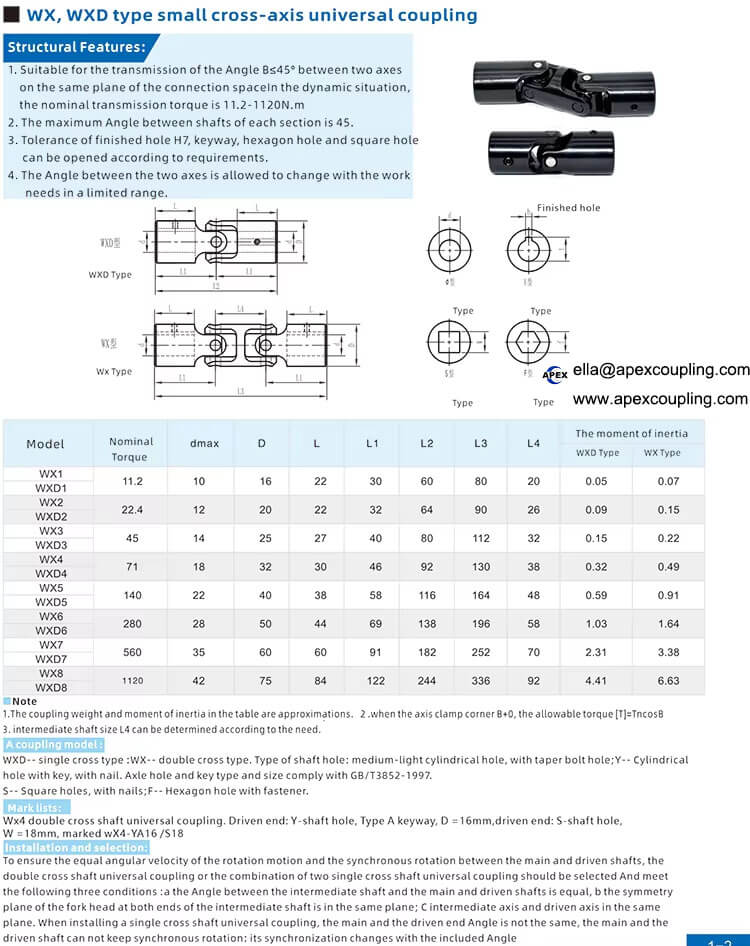
Cross-axis universal joints (cardan joints) are essential for transmitting power between shafts that are not perfectly aligned. The WX/WXD series offers both single and double joint configurations, covering a torque range of 11.2 to 1120 N·m with angular capacity up to 45° per joint. This guide helps you select the right configuration, material, bore type, and speed rating for your application.
1. Single Joint (WXD) vs Double Joint (WX) – Which One Do You Need?
| Feature | Single Joint (WXD) | Double Joint (WX) |
|---|---|---|
| Angular misalignment | ✅ Up to 45° | ✅ Up to 45° per joint |
| Parallel offset | ❌ No | ✅ Yes |
| Total articulation | Up to 45° | Up to 90° |
| Output speed fluctuation | Present (sinusoidal) | Reduced (near constant) |
| Length | Short | Longer |
| Smoothness at angle | Good | Excellent |
| Best for | Shafts intersect at an angle on the same plane | Shafts both angled and offset |
Rule of thumb for WX/WXD:
Use WXD (single joint) when shafts are on the same plane but angled.
Use WX (double joint) when shafts are both angled and offset – provides smoother motion.
💡 Double joint configurations reduce output speed fluctuation and provide smoother power transmission when both angular and parallel misalignment are present.
2. Operating Angle – 30° Working vs 45° Limit
The WX/WXD series is designed with built-in bearings and fixed pins for smooth operation up to 30° in continuous use. The absolute limit per joint is 45°.
| Angle Range | Recommendation |
|---|---|
| 0° – 30° | ✅ Ideal for continuous operation – maximum bearing life |
| 30° – 45° | ⚠️ Acceptable for short periods – reduced bearing life |
| >45° | ❌ Not recommended – can cause joint failure |
Practical tip: For most industrial applications, try to keep operating angles below 30° for continuous operation to maximize service life.
3. Speed Selection – Pin/Block vs Needle Bearing
The WX/WXD series offers two bearing options for different speed requirements:
| Parameter | Pin/Block Design | Needle Bearing Design |
|---|---|---|
| Max Speed | 1000 rpm | 4000 rpm |
| Load capacity | Good | Higher |
| Friction | Moderate | Low |
| Best for | Low-speed, high-torque applications | High-speed, smooth rotation |
Recommendation:
Choose pin/block for low-speed, heavy-duty applications.
Choose needle bearing for high-speed applications (above 1000 rpm).
4. Material Selection: 42CrMo Alloy Steel vs 304 Stainless Steel
| Material | 42CrMo Alloy Steel | 304 Stainless Steel |
|---|---|---|
| Strength | Very high (heat treated) | Moderate |
| Toughness & fatigue resistance | Excellent | Good |
| Wear resistance | High | Medium |
| Corrosion resistance | Low (needs coating) | Excellent |
| Cost | Lower | Higher |
| Best for | Standard industrial applications | Food processing, wet conditions, chemical exposure |
Our recommendation:
Choose 42CrMo with black oxide for most industrial applications.
Choose 304 stainless steel for food-contact, corrosive, or washdown environments.
5. Bore Options – Keyway, Hexagon, Square, Plain
Standard universal joints come with round bores. But many applications require non-standard connections:
| Bore Type | Best For |
|---|---|
| Keyway | High torque, positive drive, industrial motors |
| Hexagon Hole | Quick disconnect, manual adjustment, agricultural equipment |
| Square Hole | Heavy-duty, anti-rotation, special machinery |
| Plain Hole | Simple shaft connections, general use |
We machine custom bores to your exact specifications – just provide your drawing.
6. Surface Finish Options – Protection & Appearance
| Finish | Appearance | Corrosion Protection | Best For |
|---|---|---|---|
| Black Oxide (Standard) | Black, matte | Moderate | General industrial use |
| Nickel Plated | Silver, shiny | Good | Moderate corrosion environments |
| Galvanized | Silver, slightly blue | Good | Outdoor, moisture-prone applications |
| Polished | Bright, reflective | Low (cosmetic) | Aesthetic or low-corrosion applications |
7. JB/T5901-1991 Standard – What It Means
The WX/WXD series is manufactured to JB/T5901-1991, the Chinese national standard for small cross-axis universal joints. This ensures:
Consistent quality – standardized dimensions and tolerances
Interchangeability – compatible with other JB/T5901-1991 compliant products
Reliable performance – tested and proven design
8. Applications Across Industries
| Industry | Application |
|---|---|
| Packaging Machinery | Conveyors, wrapping machines, carton sealers |
| Woodworking | Multi-spindle drills, routers, saws |
| Metallurgy | Rolling mills, continuous casting lines |
| Printing | Presses, finishing equipment |
| Food & Beverage | Processing equipment (with 304SS option) |
| Construction | Light to medium-duty drives |
| Energy & Mining | Conveyors, feeders, crushers |
| Advertising | Rotating displays, signage |
9. Real-World Example – Packaging Line Upgrade
A packaging machinery manufacturer was experiencing vibration and premature wear on standard universal joints operating at 28° angle and 800 rpm. They switched to Apex Coupling WXD single joints (42CrMo, needle bearing, H7 bore, keyway). Results:
Service life extended – needle bearing handled 800 rpm smoothly
Vibration reduced – H7 bore improved concentricity
Less downtime – fewer replacements during production
Angle capacity – 28° well within the 30° recommended range
10. Installation & Maintenance Tips
Check angle – Keep operating angles ≤30° for continuous operation.
Lubricate regularly – Proper lubrication extends bearing and cross joint life.
Inspect for wear – Check cross joint and bearings periodically.
Dynamic balancing – For speeds above 1000 rpm, ensure the joint is balanced.
Torque fasteners – Ensure all screws and pins are properly tightened.
11. Conclusion
The WX/WXD small cross-axis universal joint coupling from Apex Coupling offers the perfect combination of strength, flexibility, and precision for light to medium-duty industrial applications. With 11.2–1120 N·m torque capacity, 45° angular flexibility, H7 bore precision, and multiple material, bore, and finish options, it is the ideal solution for packaging, woodworking, metallurgy, and general industrial drives.
👉 Need a cross-axis universal joint for your machinery? Contact us with your configuration, torque, speed, and bore requirements.
Inquiry now:
ella@apexcoupling.com
cross-axis universal joint guide
single vs double universal joint
WX WXD selection guide
small universal joint coupling
11.2-1120 N.m universal joint
H7 bore universal joint