Single, Double or Telescopic Universal Joint – Which Configuration Do You Need?
Single, Double or Telescopic Universal Joint – Which Configuration Do You Need?
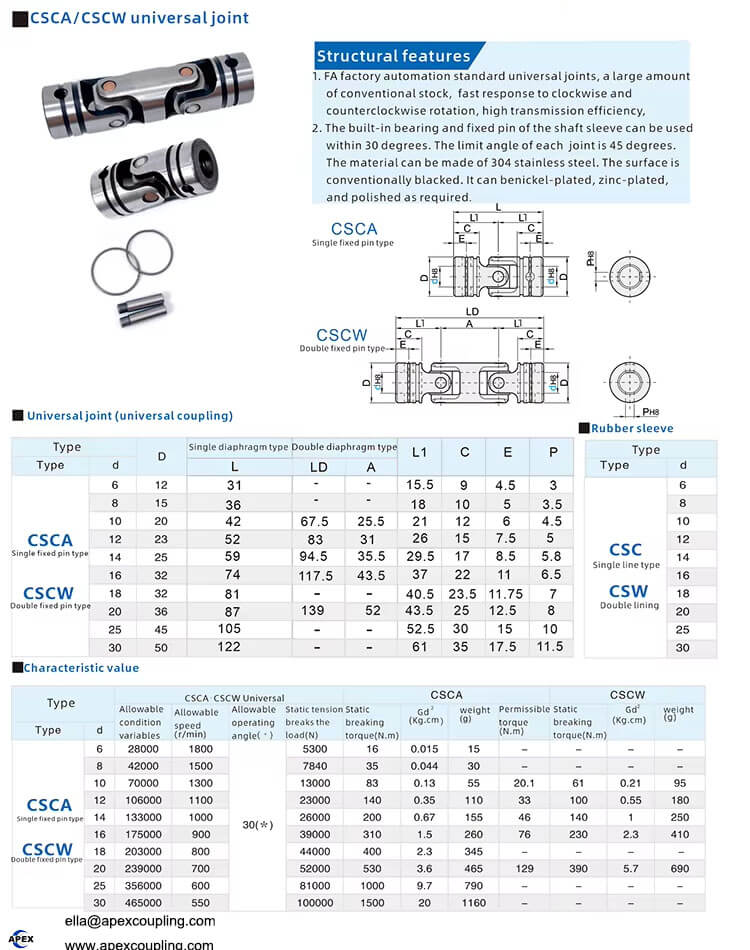
Universal joint couplings (cardan shafts) are essential for transmitting power between non‑collinear shafts. But with single, double, and telescopic configurations available, choosing the right one can be confusing. This guide explains the differences, helps you select the right design, and covers material choices – 42CrMo vs SUS304 stainless steel – for your industrial application.
1. Quick Comparison: Single vs Double vs Telescopic
| Feature | Single Joint | Double Joint | Telescopic |
|---|---|---|---|
| Angular misalignment | ✅ Up to 45° | ✅ Up to 45° per joint | ✅ Up to 45° |
| Parallel offset | ❌ No | ✅ Yes | ✅ Yes (with double joint) |
| Axial length adjustment | ❌ No | ❌ No | ✅ Yes (spline) |
| Output speed fluctuation | Present | Reduced | Reduced |
| Length | Short | Medium | Variable |
| Complexity | Simple | Moderate | Moderate |
| Best for | Shafts intersect at an angle | Shafts offset + angled | Variable shaft spacing, thermal expansion |
Rule of thumb:
Use single joint when shafts are on the same plane but angled.
Use double joint when shafts are both angled and offset.
Use telescopic when the distance between shafts changes (thermal expansion, easy installation/removal).
2. Why Choose a Telescopic Universal Joint?
Telescopic universal joints are used when two shafts that need connecting are positioned too far apart for a standard universal joint. Key benefits:
Length adjustment – Accommodates thermal expansion or variable spacing
Easy installation – Can be installed or removed without moving heavy equipment
Versatility – Combines angular misalignment compensation with axial displacement
Typical applications: rolling mills, paper machinery, construction equipment, and agricultural machinery.
3. Material Selection: 42CrMo vs SUS304 Stainless Steel
| Material | 42CrMo Alloy Steel | SUS304 Stainless Steel |
|---|---|---|
| Strength | Very high (heat treated) | Moderate |
| Toughness & fatigue resistance | Excellent | Good |
| Wear resistance | High | Medium |
| Corrosion resistance | Low (needs coating) | Excellent |
| Cost | Lower | Higher |
| Best for | Heavy industry, high torque, shock loads | Food processing, medical, marine, clean rooms |
Our recommendation:
Choose 42CrMo for most industrial applications where strength and durability are priorities.
Choose SUS304 stainless steel when moisture, chemicals, or hygiene standards are critical.
4. Operating Angle – 45° vs 90°
Standard single universal joints operate up to 45°. Double joint configurations can achieve up to 90° total articulation.
⚠️ For continuous operation, we recommend keeping the angle below the maximum to extend bearing and cross shaft life.
5. Custom Bore Options – Keyway, Hexagon, Square
Standard universal joints come with round bores. But many applications require non‑standard connections:
| Bore Type | Best For |
|---|---|
| Keyway | High torque, positive drive, industrial motors |
| Hexagon | Quick disconnect, manual adjustment, agricultural equipment |
| Square | Heavy‑duty, anti‑rotation, special machinery |
We machine custom bores to your exact specifications – just provide your drawing.
6. Real‑World Example – Food Processing Conveyor Upgrade
A food processing plant used standard steel universal joints on their conveyors. Frequent issues:
Corrosion from washdown procedures
Bearing failures due to angular misalignment
Downtime for replacement
They switched to Apex Coupling SUS304 stainless steel telescopic universal joints (double joint, custom bores). Results:
Corrosion eliminated – stainless steel withstands washdown
Service life tripled – 304 stainless + proper material choice
Easier installation – telescopic design allowed quick removal for cleaning
Angle capacity – accommodated misalignment without failure
7. Installation & Maintenance Tips
Check alignment – Even with flexible joints, keep angles ≤45° for continuous operation.
Lubricate regularly – Proper lubrication extends cross shaft and bearing life.
Inspect telescopic splines – For telescopic versions, check for wear and clean regularly.
Dynamic balancing – For speeds above 1000 rpm, ensure the joint is balanced.
Torque fasteners – Ensure all pins and screws are properly tightened.
8. When to Choose a Cardan Universal Joint Over Other Couplings
| Application | Recommended |
|---|---|
| Large angular misalignment (>5°) | ✅ Universal joint |
| Variable shaft spacing | ✅ Telescopic universal joint |
| Corrosive environment | ✅ SUS304 stainless steel universal joint |
| High torque, heavy duty | ✅ 42CrMo universal joint |
| Absolute zero backlash (servo) | ❌ Consider rigid or disc coupling |
| Very high speed (>6000 rpm) | ❌ Consider disc coupling |
9. Conclusion
The stainless steel cardan cross shaft universal joint coupling from Apex Coupling offers unmatched flexibility with single, double, and telescopic configurations. With 42CrMo for heavy‑duty strength or SUS304 for corrosion resistance, torque capacity from 4.5 to 1500 N·m, and operating angles up to 90°, it is the ideal solution for a wide range of industrial applications.
Inquiry now:
ella@apexcoupling.com
single vs double universal joint
telescopic universal joint guide
cardan shaft selection
stainless steel universal joint
42CrMo vs SUS304 coupling
universal joint configuration guide