Pin Type Universal Joint vs Cross Bearing – Which Design Is Right for You?
Pin Type Universal Joint vs Cross Bearing – Which Design Is Right for Your Application?
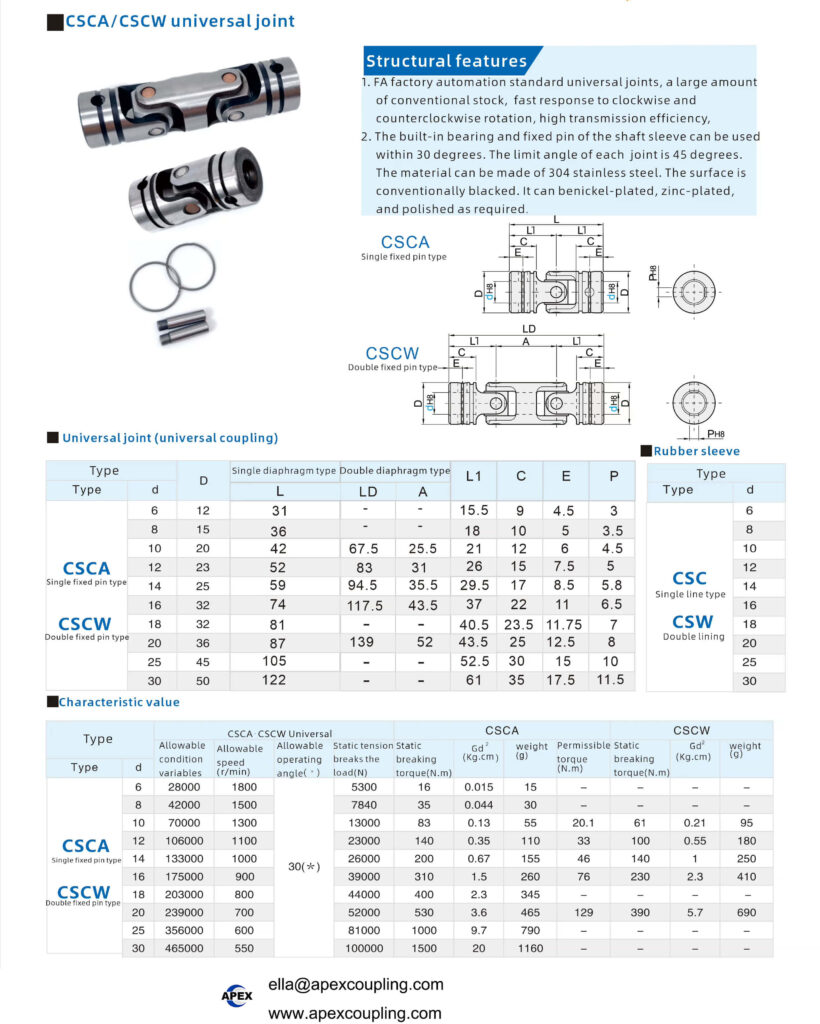
Universal joints (U‑joints) are essential for transmitting torque between non‑collinear shafts. Two common designs are fixed pin type (pin and block) and cross bearing type. This guide compares both, explains the advantages of 42CrMo alloy steel, and helps you choose the right configuration – single or double joint – for your stepper motor, servo motor, or general industrial application.
1. Quick Comparison: Pin Type vs Cross Bearing Universal Joint
| Feature | Fixed Pin Type (Pin & Block) | Cross Bearing Type |
|---|---|---|
| Design | Block with fixed pins forming the cross | Separate cross shaft with needle/roller bearings |
| Complexity | Simple, fewer parts | More complex, more components |
| Maintenance | Easy – pin replacement | Moderate – bearing lubrication/replacement |
| Cost | Lower | Higher |
| Speed Capacity | Moderate (up to 4000 rpm) | Higher (up to 6000+ rpm) |
| Torque Capacity | Light to medium (4.5–280 N·m) | Medium to heavy (higher ranges) |
| Backlash | Low | Very low |
| Best for | General industrial, servo/stepper motors, light automation | Heavy industry, high speed, high torque |
2. Why Choose Fixed Pin Type?
The fixed pin (pin and block) design is a tried‑and‑true solution for many industrial applications. Its advantages include:
Simplicity – Fewer moving parts means less that can fail.
Cost‑effectiveness – Lower manufacturing cost compared to cross bearing designs.
Easy Maintenance – Pins can be replaced quickly without special tools.
Reliability – Proven design used in countless applications worldwide.
✅ For applications with moderate torque (4.5–280 N·m) and speed (up to 4000 rpm), the pin type is often the most practical choice.
3. The 42CrMo Advantage
Both pin type and cross bearing universal joints benefit from high‑quality materials. 42CrMo alloy steel is a chromium‑molybdenum steel that, after quenching and tempering, offers:
High tensile strength – Handles torque without deformation
Excellent fatigue resistance – Withstands millions of reverse cycles
High impact toughness – Resists shock loads without cracking
Good wear resistance – Long service life even under friction
This makes 42CrMo the material of choice for durable, long‑lasting universal joints.
4. Single Joint vs Double Joint – Which One Do You Need?
| Feature | Single Joint | Double Joint |
|---|---|---|
| Angular misalignment | ✅ Up to 45° | ✅ Up to 45° per joint |
| Parallel offset | ❌ No | ✅ Yes |
| Output speed fluctuation | Present (sinusoidal) | Reduced (near constant) |
| Length | Short | Longer |
| Best for | Shafts intersect at an angle | Shafts offset + angled |
Rule of thumb:
Use single joint when shafts are on the same plane but angled (e.g., motor to gearbox).
Use double joint when shafts are both angled and offset (e.g., conveyor with lateral shift).
5. Applications for Fixed Pin Universal Joints
Fixed pin universal joints are widely used in:
Stepper & Servo Motor Drives – Precision motion control, low backlash
CNC Machines – Spindle and feed drives
3D Printers & Robotics – Compact, reliable connections
Encoders & Instrumentation – Low‑inertia, precise coupling
Packaging & Printing – Smooth, high‑speed operation
Food & Beverage – With appropriate material options
General Industry – Pumps, conveyors, mixers
6. Installation & Maintenance Tips
Check alignment – Even though universal joints accommodate misalignment, keep angles ≤30° for continuous operation to maximize life.
Lubricate pins – Regular lubrication reduces wear and extends service life.
Inspect pins periodically – Replace worn or damaged pins promptly.
Dynamic balancing – For speeds above 1000 rpm, ensure the joint is balanced.
Torque fasteners – Ensure all fixing pins and screws are properly tightened.
7. Real‑World Example – Servo Motor Drive Upgrade
A CNC machine manufacturer was experiencing positioning errors due to backlash in their existing universal joints. They switched to Apex Coupling fixed pin type universal joints (42CrMo, single joint, custom bore). Results:
Backlash reduced by 80% – improved positioning accuracy
Service life doubled – 42CrMo heat‑treated material
Cost reduced – simpler pin design vs. cross bearing
Easy maintenance – pin replacement took minutes
8. Conclusion
The fixed pin type universal joint offers a simple, reliable, and cost‑effective solution for light to medium‑duty applications. With 42CrMo alloy steel construction, it delivers excellent strength, fatigue resistance, and durability. Whether you need a single joint for angular misalignment or a double joint for offset + angle, Apex Coupling can deliver factory‑direct with OEM/ODM customization.
👉 Need a precision universal joint for your servo or stepper motor? Contact us with your torque, speed, and shaft sizes.
Inquiry now:
ella@apexcoupling.com
pin type universal joint vs cross bearing
fixed pin universal joint guide
universal joint for servo motor
42CrMo universal joint selection
single double universal joint comparison