KTR ROTEX T‑PUR vs Standard Polyurethane Spider
KTR ROTEX T‑PUR vs Standard Polyurethane Spider – Complete Technical Selection Guide
Introduction
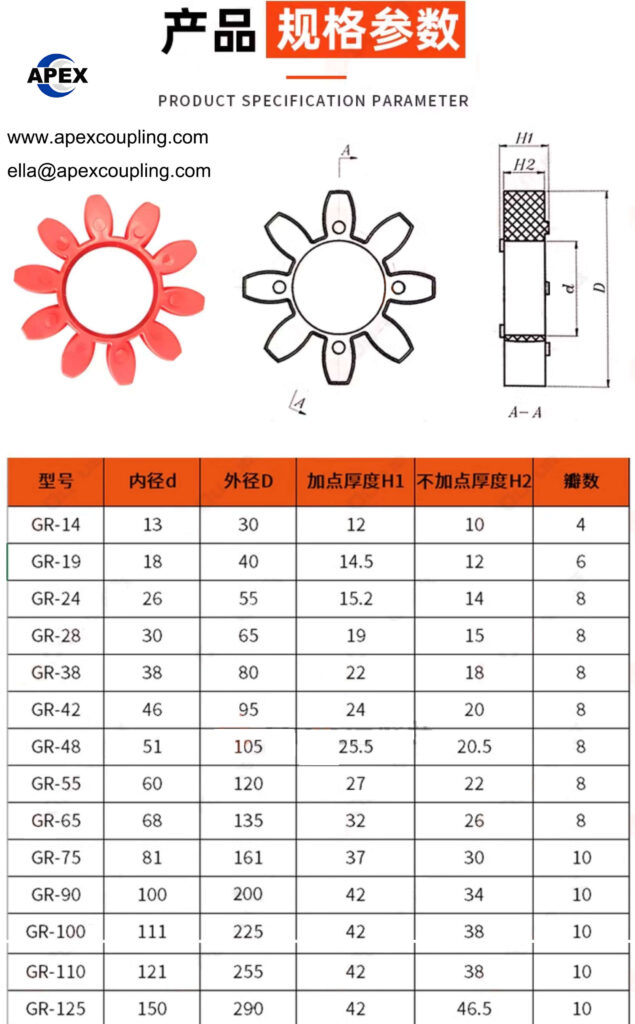
When selecting a replacement spider for your KTR ROTEX jaw coupling or any industrial elastomer coupling, the material choice directly impacts reliability, maintenance costs, and equipment uptime. Two polyurethane-based materials dominate the market: the upgraded T‑PUR® and conventional standard polyurethane (PUR) . Understanding their true differences—particularly in temperature resistance—helps engineers make informed procurement decisions.
This guide presents KTR‘s official technical specifications alongside industry-standard parameters, helping you select the optimal coupling spider for your specific application conditions.
📌 Note on Temperature Data: Temperature ratings for polyurethane elastomers can vary across manufacturers. KTR‘s original T‑PUR is rated -50°C to +120°C, while standard polyurethane elastomers are generally rated -30°C to +90°C as per KTR‘s original specifications. Some suppliers offer extended ranges such as -40°C to +100°C. Always check the original coupling manufacturer‘s manual for correct specifications and consider your actual operating conditions when selecting replacement parts.
What Is T‑PUR?
T‑PUR is KTR‘s improved polyurethane formulation, introduced in 2011 after three years of development. It serves as the new standard spider material for ROTEX jaw couplings from size 14 to size 90, and double‑tooth segments for sizes 100–180.
Unlike special high‑cost materials that sacrifice damping performance, T‑PUR enhances fatigue strength and temperature resistance while preserving all positive polyurethane characteristics—damping, wear resistance, oil resistance, and ozone resistance.
What Is Standard Polyurethane (PUR)?
Standard polyurethane remains the conventional elastomer for jaw coupling spiders. According to KTR‘s official specifications, standard spiders operate within a temperature range of -30°C to +90°C (continuous). Standard PUR spiders are available in multiple hardness grades, typically identified by color: yellow (92 Shore A), red (98 Shore A), or natural white with green tooth markings (64 Shore D).
Wider Temperature Variants Note: Many third‑party manufacturers offer standard polyurethane spiders rated from -40°C to +100°C. These extended‑range elastomers are available from various global suppliers, offering greater flexibility for moderate industrial applications.
Key Performance Comparison
| Parameter | T‑PUR® (Upgraded – KTR Official) | Standard PUR (KTR Official) | Standard PUR (Extended Range – Third‑Party) |
|---|---|---|---|
| Continuous temperature range | -50°C to +120°C | -30°C to +90°C | -40°C to +100°C |
| Peak temperature (short‑term) | Up to +150°C | Up to +120°C | Up to +120°C |
| Temperature resistance improvement | ~35% wider range vs KTR standard | — | — |
| Fatigue strength | Significantly improved | Standard | Enhanced (varies) |
| Service life | Considerably longer under extreme conditions | Standard | Improved |
| Price | At standard price, comparable to conventional PUR | Standard | Similar |
| Best suited for | Harsh, variable, high‑temperature, or reversing applications | General industrial use (mild conditions) | Moderate conditions requiring wider temperature tolerance |
Hardness Grades – Color Identification
T‑PUR and standard PUR use distinct color codes to identify Shore hardness levels. This visual system simplifies quick identification during maintenance and sourcing.
| Shore Hardness | T‑PUR Color (KTR) | Standard PUR Color |
|---|---|---|
| 92 Shore A (flexible, good damping, most common) | Orange | Yellow |
| 98 Shore A (medium, higher torque capacity) | Purple | Red |
| 64 Shore D (hard, minimal damping, highest torque) | Pale green | Natural white (green tooth marks) |
Lower Shore A hardness provides better vibration damping; higher Shore D allows higher torque transmission but reduces damping capacity.
When to Choose T‑PUR
T‑PUR is the preferred choice for demanding applications where standard polyurethane may fail prematurely:
1. High ambient temperatures above 90°C. If your equipment operates above 90°C continuously, T‑PUR‘s 120°C continuous rating provides a substantial safety margin.
2. Variable speed drives with frequent speed changes. Dynamic loads accelerate wear on standard PUR. T‑PUR‘s enhanced fatigue strength delivers longer service life.
3. Reversing operations with frequent start‑stop or direction changes. T‑PUR‘s superior dynamic properties excel in these demanding conditions.
4. Low‑temperature environments. For outdoor or refrigerated equipment operating at -40°C or lower, T‑PUR remains flexible down to -50°C.
5. Extended maintenance intervals. When reducing downtime is critical, T‑PUR‘s longer service life minimizes replacement frequency and lowers total cost of ownership.
When to Choose Standard Polyurethane
Standard PUR remains a valid option in specific scenarios:
1. Mild operating conditions. When temperatures consistently stay within -30°C to +90°C (or -40°C to +100°C for extended‑range versions) and dynamic loads are moderate.
2. Non‑critical applications. For general industrial equipment where occasional spider replacement does not impact production.
3. Legacy equipment compatibility. When your existing coupling system is designed with standard PUR spiders and performance requirements are already met.
4. Cost‑sensitive projects with moderate demands. Standard PUR offers a proven, economical solution for many mainstream industrial applications.
Standard Polyurethane Properties – Industry Overview
For many applications, standard polyurethane offers a reliable, cost‑effective solution with these proven characteristics:
Full hardness range: Standard polyurethane elastomers are available from 90 Shore A up to 98 Shore A, and also in 64 Shore D for higher torque requirements.
High strength: Superior impact and bending strength compared to plastics at high hardness levels.
Excellent wear resistance: Outstanding abrasion performance with wear range of 0.01‑0.0010 cm³ per 161 km.
Outstanding oil resistance: Polyurethane‘s polar molecular structure shows minimal affinity for non‑polar mineral oils and fuels.
Excellent ozone and oxygen resistance: Long‑term stability in atmospheric exposure.
Temperature range flexibility: Available in various temperature grades, including:
Standard grade: -30°C to +90°C (KTR compatible)
Extended grade: -40°C to +100°C (third‑party compatible)
Low‑temperature grade: Down to -50°C (special formula)
Wide industrial use: Extensively proven in mining, steel, paper, and general industrial transmission applications.
Selection Summary Table
| Application Condition | Recommended Material |
|---|---|
| Temperatures consistently between -30°C and +90°C, moderate loads | Standard PUR |
| Temperatures between -40°C and +100°C, moderate loads | Standard PUR (extended range) |
| Temperatures exceeding 90°C or below -30°C | T‑PUR |
| Frequent start‑stop or reversing operation | T‑PUR |
| Variable speed drives with dynamic loads | T‑PUR |
| Extended maintenance intervals, minimizing downtime | T‑PUR |
| General industrial use, cost‑sensitive projects | Standard PUR (extended range available) |
| Coupling originally equipped with T‑PUR | T‑PUR only |
Technical Recommendation
For most new installations and replacement purchases in demanding applications, T‑PUR is the superior choice – it delivers substantially better performance with a 35% wider temperature range compared to KTR‘s standard polyurethane, at the same standard price.
Standard PUR remains an excellent choice for mild to moderate operating conditions, particularly when extended temperature grades are available.
When ordering replacement spiders, always verify:
The Shore hardness required for your specific coupling size and application
The temperature range of your actual operating environment
The original coupling manufacturer‘s specifications
Why Source From Apex Coupling?
As a specialized coupling and coupling accessories factory, Apex Coupling offers:
Premium polyurethane coupling spiders in all standard sizes
Full hardness options – 92 Shore A, 98 Shore A, and 64 Shore D
T‑PUR equivalent grade materials for high‑performance applications
Standard polyurethane spiders for general‑purpose applications
Extended temperature range spiders (-40°C to +100°C) available
Customizable options – contact our team for special requirements
Browse our product range at www.apexcoupling.com or contact our sales team for a quotation.
Related Resources
Polyurethane Jaw Coupling Spiders – Product Specifications
Coupling Elastomer Selection Guide – Technical Reference
Custom Polyurethane Coupling Cushions – OEM Manufacturing
Contact Us
📧 Email: ella@apexcoupling.com
🌐 Website: www.apexcoupling.com
🏭 Factory: Direct source – premium polyurethane coupling spiders (92A, 98A, 64D available)
Inquiry now:
ella@apexcoupling.com
polyurethane coupling spider, KTR ROTEX elastomer, T‑PUR coupling insert, jaw coupling spider, 98 Shore A spider, polyurethane buffer, industrial coupling cushion, Rotex spider replacement, coupling rubber pad, polyurethane coupling cushion