The Ultimate Guide to Zero-Backlash Couplings for Servo Motors
In the world of precision motion control, the coupling connecting your servo motor to the load is a critical component. A poor choice can lead to positioning errors, vibration, and premature equipment failure. This guide explains why zero backlash is non-negotiable for servo systems and why the DFC aluminum curved jaw coupling is a top-tier solution.
1. What is Backlash and Why Does It Matter?
Backlash, or rotational clearance, is the “play” between the two hubs of a coupling. In a servo system, where precise positioning is paramount, backlash introduces errors.
Lost Motion: The motor rotates, but the load doesn’t move instantly.
Positioning Inaccuracies: Accumulated errors lead to poor part quality.
Control Instability: Backlash can cause the servo system to hunt or oscillate.
Reduced Repeatability: Inconsistent results from one cycle to the next.
💡 For high-precision applications like CNC machining and robotics, a zero-backlash coupling is essential to maintain accuracy and repeatability.
2. The DFC Solution: Zero Backlash & More
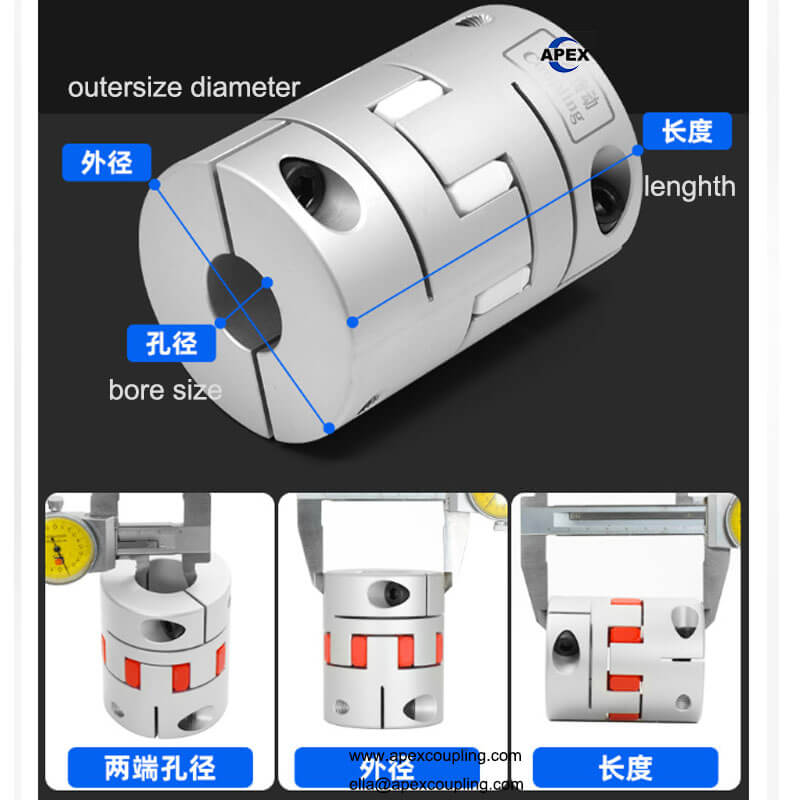
The DFC aluminum curved jaw coupling eliminates backlash through its unique design. The curved jaws create a press-fit with the polyurethane spider. This preload removes any clearance, ensuring that the motor’s rotation is transferred to the load instantly and accurately. However, the benefits of the DFC go beyond zero backlash:
Vibration Damping: The polyurethane spider absorbs shock and dampens vibration, protecting sensitive servo motors and encoders.
Misalignment Compensation: It accommodates angular, radial, and axial misalignment, which simplifies installation and reduces stress on bearings.
Lightweight Design: Made from high-strength aluminum alloy, the DFC coupling reduces inertia, allowing for faster acceleration and deceleration.
Maintenance-Free: The DFC coupling requires no lubrication, reducing downtime and maintenance costs.
3. How to Select the Right Coupling
Choosing the right coupling involves matching your application’s requirements with the coupling’s specifications.
Step 1: Determine the Torque
Calculate the torque required by your application. The coupling’s rated torque must be equal to or greater than your application’s peak torque.
Step 2: Match the Shaft Sizes
Measure your motor and load shaft diameters. The DFC series offers a wide range of bores and can be custom-machined to your exact specifications.
Step 3: Check the Speed and Environment
Ensure the coupling’s maximum RPM exceeds your motor’s speed. For harsh environments, the DFC’s anodized finish and oil-resistant spider provide excellent protection.
Step 4: Consider the Misalignment
While the DFC can compensate for some misalignment, it’s still best practice to align your shafts as accurately as possible to maximize the coupling’s life and performance.
4. Conclusion
Upgrading to a zero-backlash coupling like the DFC series is a simple yet powerful way to enhance the performance of your servo-driven machinery. By eliminating lost motion, dampening vibration, and providing a maintenance-free connection, the DFC aluminum curved jaw coupling is a reliable partner for any precision application.
Inquiry now:
ella@apexcoupling.com
Zero backlash coupling
Servo motor coupling guide
Aluminum jaw coupling
Coupling for stepper motor
Ball screw coupler
Spider coupling