WX vs WXD Universal Joint Coupling
Universal joint couplings are used to transmit torque between shafts that operate at an angle. They are common in industrial machinery where the driving shaft and driven shaft cannot always be arranged on the same straight axis.
When selecting a small cross universal joint coupling, buyers may encounter WX and WXD configurations. Understanding the differences between these two designs helps engineers select a suitable coupling for their shaft arrangement, operating angle and transmission requirements.
1. What Is a WX Universal Joint Coupling?
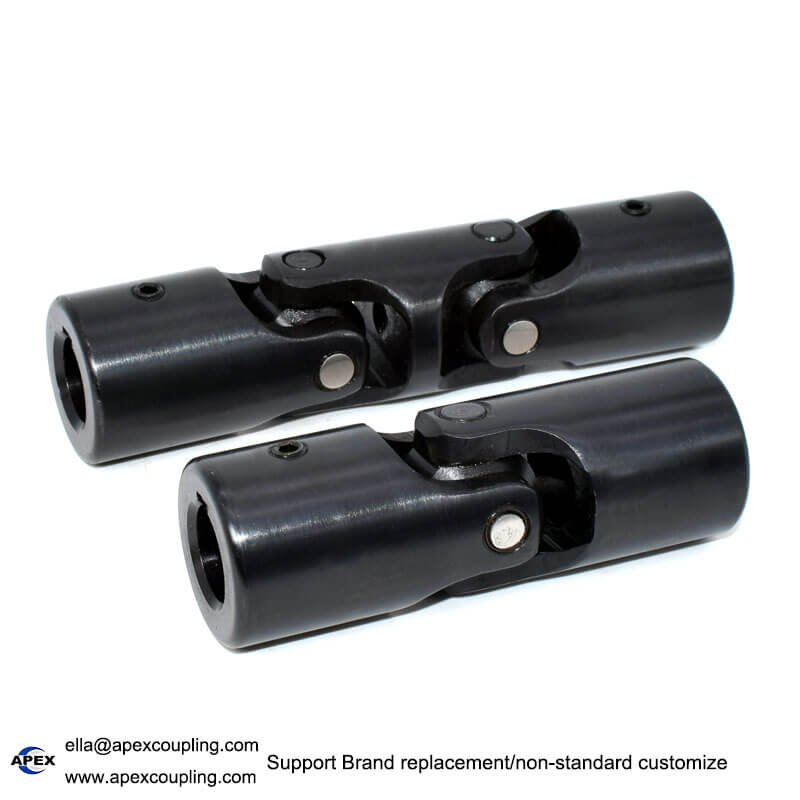
A WX universal joint coupling is a single-cross type in the product series described by Apex Coupling. It connects two shafts operating at an angle and transfers rotational motion through a cross-joint mechanism.
This configuration may be suitable when one joint section can accommodate the required shaft angle and the application can accept the resulting rotational characteristics.
A WX coupling is commonly evaluated according to its torque capacity, operating speed, shaft angle, bore dimensions and installation space.
2. What Is a WXD Universal Joint Coupling?
A WXD universal joint coupling uses a double-cross configuration. A double universal joint arrangement can help reduce the non-uniform output speed associated with a single Cardan joint when the joint angles are correctly matched and the yokes are properly phased.
This benefit depends on the complete shaft arrangement. Equal joint angles, correct phasing and suitable installation geometry are important for achieving the intended motion characteristics.
A double-cross configuration should therefore be selected based on the actual transmission layout rather than simply assuming that it is always better than a single-cross coupling.
3. WX vs WXD: Key Differences
| Feature | WX Type | WXD Type |
|---|---|---|
| Structure | Single-cross type | Double-cross type |
| Joint sections | One | Two |
| Shaft arrangement | One angled joint connection | Two joint sections in a combined arrangement |
| Installation considerations | Working angle and alignment | Working angles, yoke phasing and intermediate geometry |
| Selection factors | Torque, speed, bore and angle | Torque, speed, total geometry and synchronization |
| Typical use | Suitable applications requiring one joint section | Suitable applications requiring a double-joint arrangement |
The final performance depends on the selected model, dimensions and operating conditions.
4. Why Does the Number of Joint Sections Matter?
A single Cardan joint does not generally provide constant angular velocity between input and output shafts when operating at an angle. The output speed fluctuates during each revolution, and the effect becomes more pronounced as the working angle increases.
A properly arranged double Cardan joint can compensate for this fluctuation when the joint angles are equal and the yokes are correctly phased. However, incorrect installation or unequal angles can prevent the intended compensation.
For machinery requiring synchronized motion, consider the complete transmission design before choosing between WX and WXD.
5. Check the Allowable Working Angle
The WX/WXD product information supplied for this series specifies a maximum angle of 45° per joint section. This is a stated series limit, not a guarantee that every model can operate continuously at that angle under all loads and speeds.
The practical operating angle depends on:
Coupling size and bearing construction
Transmitted torque
Rotational speed
Duty cycle
Lubrication and maintenance
Required service life
Confirm the model-specific operating limits with the manufacturer before installation.
6. Consider Torque and Rotational Speed
Torque and speed must be evaluated together. A coupling operating at a larger angle or under frequent shock loads may require a different selection from one used under light, steady conditions.
The series information lists nominal torque values from 11.2 to 1120 N·m. These values cover a range of configurations and should not be treated as the rating of every WX or WXD model.
Before ordering, provide the required torque, operating speed, starting conditions and working angle so that the correct size can be reviewed.
7. Bore Options and Shaft Connections
The WX/WXD series supports different shaft connection requirements, subject to the selected model.
Options may include:
H7 finished bores
Keyways
Hexagonal bores
Square bores
Customized bore dimensions
The driving-side and driven-side bore diameters should be specified separately when they differ. Provide a technical drawing if the installation requires non-standard dimensions.
8. How to Choose Between WX and WXD
Use the following selection process:
Determine whether one or two joint sections are needed for the shaft layout.
Measure the angle between the connected shafts.
Calculate the required torque and confirm the operating speed.
Check the coupling dimensions and available installation space.
For a double-joint arrangement, confirm joint angles and yoke phasing.
Specify the required bore, keyway, hexagonal or square connection.
Verify the model-specific technical ratings before ordering.
9. Explore WX/WXD Small Universal Joint Couplings
Apex Coupling supplies WX/WXD small cross universal joint couplings for industrial transmission applications. Standard and customized bore configurations can be reviewed according to the machine’s technical requirements.
Visit our WX/WXD small universal joint coupling product page to review the product information and discuss your application with our team.
Conclusion
WX and WXD universal joint couplings serve different shaft transmission arrangements. WX is a single-cross type, while WXD is a double-cross type that may provide more uniform angular velocity when correctly designed and installed.
The right choice depends on shaft geometry, torque, speed, working angle and synchronization requirements. Confirm the technical specifications for the selected model before purchasing.
Inquiry now:
ella@apexcoupling.com
steel vs cast iron jaw coupling, rotex spider hardness guide, flexible coupling for motor, elastic coupling maintenance.