How to Select a Universal Joint for Angled Shafts
How to Select a Universal Joint for Angled Shafts
A universal joint coupling transmits rotary motion between shafts that operate at an angle. It is useful when machinery design, installation space or equipment movement prevents the connected shafts from being arranged in a straight line.
However, choosing a universal joint requires more than checking whether the shaft angle falls within a stated maximum. Torque, speed, joint configuration, bore dimensions and installation geometry all affect suitability.
This guide explains the main factors to review when selecting a universal joint for angled shafts.
1. Understand the Shaft Arrangement
Start by examining the relationship between the driving shaft and driven shaft.
Measure or calculate the angle between the shafts and determine whether that angle remains constant or changes during operation. Also consider the distance between the shaft ends and the available installation space.
This information helps determine whether a single universal joint, a double-joint arrangement or another transmission design is appropriate.
2. Single Universal Joint or Double Universal Joint?
Single Universal Joint
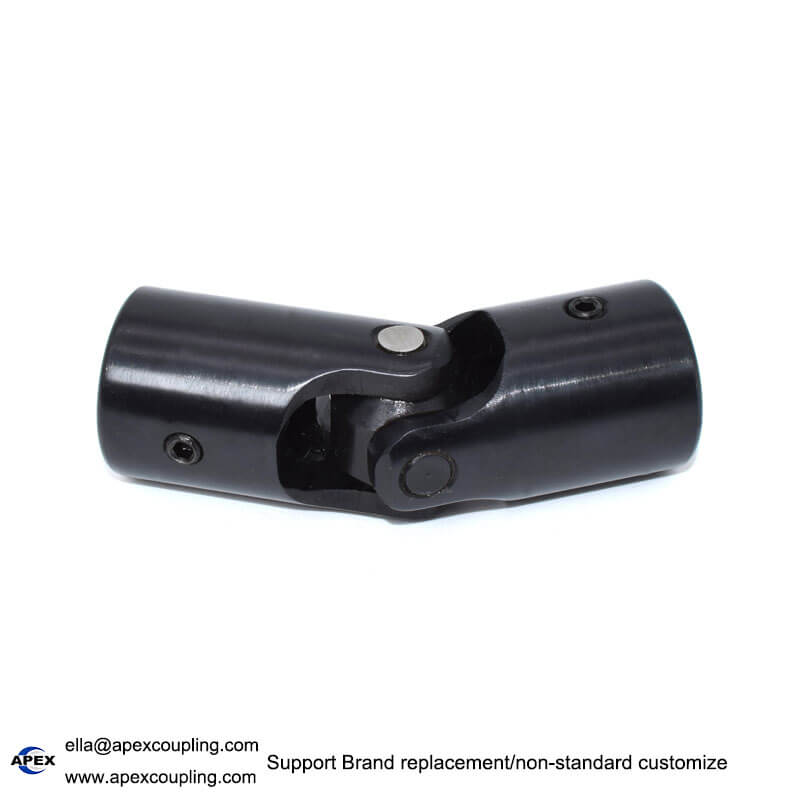
A single Cardan joint connects two angled shafts through one joint section. It can be suitable when the installation geometry and transmission requirements permit its characteristic motion.
When a single Cardan joint operates at an angle, the output angular velocity generally fluctuates during each revolution. The magnitude of this fluctuation depends on the working angle.
Double Universal Joint
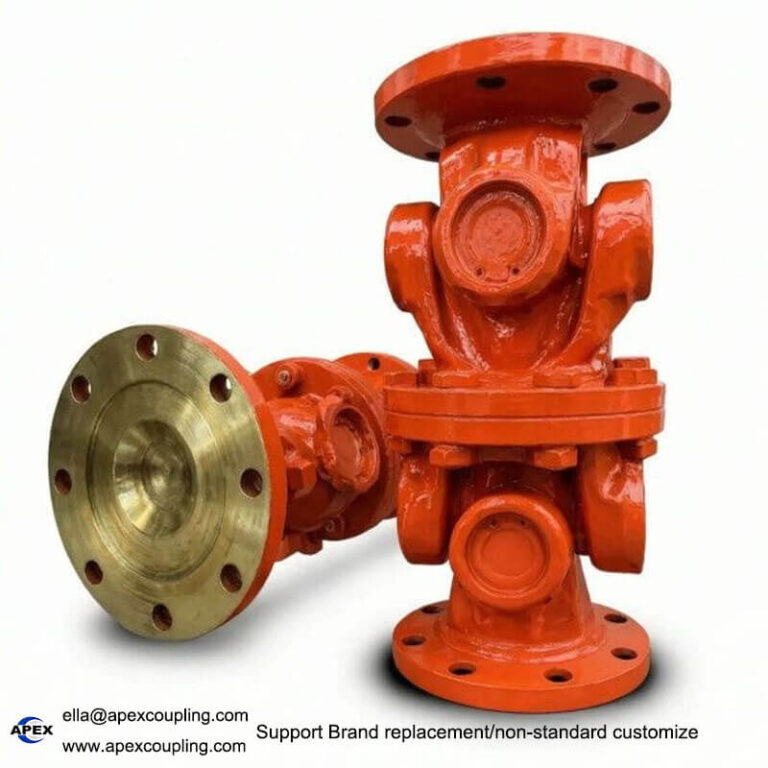
A double universal joint arrangement uses two joint sections. When correctly designed, with equal working angles and appropriate yoke phasing, it can compensate for the angular-velocity fluctuation associated with a single joint.
The result depends on the complete shaft geometry and correct installation. Unequal angles or incorrect phasing can prevent the intended compensation.
Choose the configuration based on the application’s synchronization requirements, not just the number of joint sections.
3. Check the Working Angle
Working angle is one of the most important selection factors.
The WX/WXD series information supplied for this product specifies a maximum angle of 45° per joint section. This stated maximum must be checked against the selected model’s technical data and should not automatically be treated as a recommended continuous operating angle.
When evaluating the working angle, consider:
Required continuous operating angle
Changes in angle during movement
Transmitted torque
Rotational speed
Duty cycle
Bearing and lubrication requirements
Expected service life
Where possible, avoid designing around a maximum limit without confirming the manufacturer’s operating recommendations.
4. Calculate the Required Torque
The coupling must transmit the torque required by the driven equipment.
Determine normal operating torque and consider starting, braking, reversing and shock loads. Equipment with variable loads may require a different coupling size from equipment operating under steady conditions.
The WX/WXD series information lists nominal torque values from 11.2 to 1120 N·m across the series. The appropriate rating depends on the selected size and configuration.
Always confirm the specific model’s rated and allowable torque before ordering.
5. Match the Operating Speed
A universal joint’s allowable speed depends on its construction, size, working angle, balance, lubrication and load.
A model that is suitable at a small working angle may not have the same allowable operating conditions at a larger angle. For this reason, torque and speed should be evaluated together.
Provide the required RPM and working angle to the supplier, especially for high-speed or continuous-duty applications.
6. Select the Correct Bore and Shaft Connection
The coupling must fit both connected shafts.
Before ordering, confirm:
Driving-side bore diameter
Driven-side bore diameter
Required bore tolerance
Keyway dimensions
Hexagonal or square connection, if applicable
Overall coupling dimensions
Available installation space
The WX/WXD series supports H7 finished bores where specified, with keyway, hexagonal and square-hole options subject to the selected model.
Do not assume that every size supports every bore or connection option.
7. Consider Material and Operating Environment
Material requirements depend on torque, load cycles, environment and service expectations.
The supplied WX/WXD series information identifies steel construction. The exact steel grade, heat treatment and manufacturing details should be confirmed for the selected model.
Also consider dust, moisture, temperature, lubrication access and other environmental factors that may affect joint wear and maintenance.
For demanding operating conditions, provide the supplier with a clear description of the environment and duty cycle.
8. Installation Geometry and Phasing
Correct installation is essential for reliable universal joint operation.
For double-joint arrangements, joint angles and yoke phasing must be configured according to the transmission design. An incorrect arrangement can cause output speed variation, vibration and additional mechanical loads.
Check the manufacturer’s installation drawing before assembly. Verify shaft alignment and fastening requirements, and make sure the joint can operate through the required movement without interference.
9. A Practical Universal Joint Selection Checklist
Before requesting a quotation, prepare the following details:
Single-cross or double-cross configuration
Required torque and operating speed
Working angle for each joint section
Driving and driven shaft diameters
Bore tolerance and shaft connection type
Overall length and installation space
Duty cycle and starting conditions
Operating environment and maintenance requirements
These details help the manufacturer evaluate the correct model more efficiently.
10. WX/WXD Universal Joints for Angled Shaft Applications
Apex Coupling offers WX/WXD small cross universal joint couplings for selected industrial transmission applications. The series supports different shaft connection options and customized requirements, subject to model availability and technical review.
Review our WX/WXD small universal joint coupling for product information and send us your application parameters for assistance with selection.
Conclusion
Selecting a universal joint for angled shafts requires a careful review of working angle, torque, speed, shaft dimensions and installation geometry. Single- and double-joint configurations have different transmission characteristics, so the correct arrangement depends on the application’s requirements.
Confirm model-specific operating limits and provide accurate technical information before placing an order. Proper selection and installation can help improve transmission reliability and reduce avoidable wear.
Inquiry now:
ella@apexcoupling.com
steel vs cast iron jaw coupling, rotex spider hardness guide, flexible coupling for motor, elastic coupling maintenance.