Steel vs Aluminum Spider Coupling – Which Material Is Right for Your Application?
Steel vs Aluminum Spider Coupling – Which Material Is Right for Your Application?
Spider couplings (jaw couplings) are available in a variety of hub materials – with steel and aluminum being the most common choices. But which one is right for your application?
This guide compares the DPG 45# steel spider coupling with aluminum alternatives, helping you choose the right material based on torque capacity, durability, environment, and cost.
1. Quick Comparison: 45# Steel vs Aluminum Spider Coupling
| Feature | DPG – 45# Steel | Aluminum Spider Coupling |
|---|---|---|
| Material | 45# high-strength carbon steel | Aluminum alloy |
| Torque Capacity | High | Moderate |
| Hardness | High | Low to moderate |
| Wear Resistance | Excellent | Good |
| Corrosion Resistance | Good (with black oxide) | Good (with anodizing) |
| Weight | Heavier | Lightweight |
| Inertia | Higher | Lower |
| Cost | Moderate | Lower |
| Durability | Excellent – long service life | Good |
| Best for | Heavy-duty, high-torque, harsh environments | Light-duty, high-speed, cost-sensitive applications |
2. Why Choose 45# Steel for Spider Couplings?
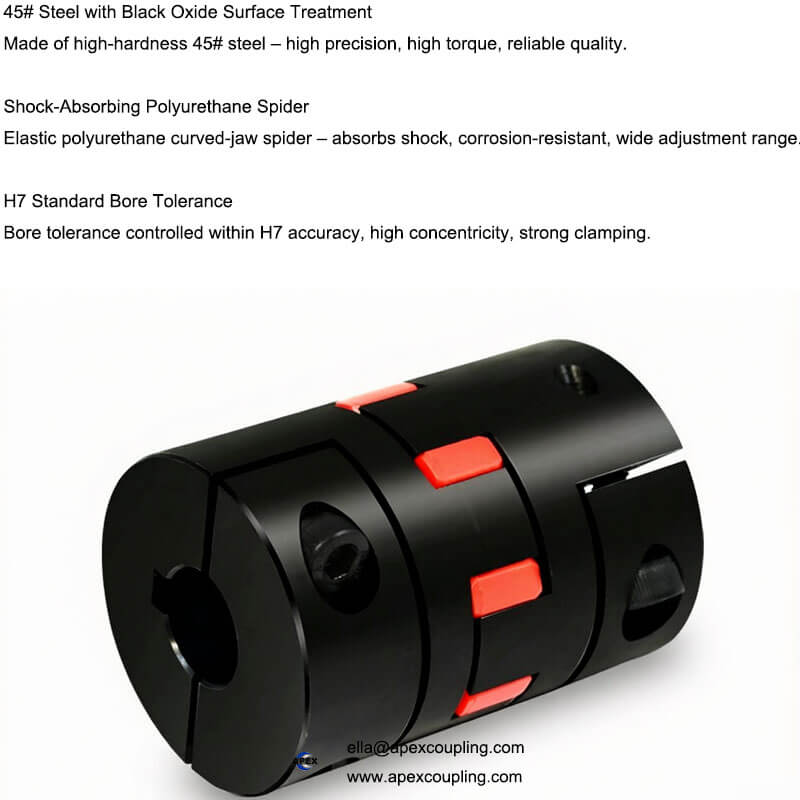
45# steel is a medium-carbon structural steel widely used in mechanical engineering. For spider couplings, it offers:
High strength and hardness – Handles high torque loads without deformation
Excellent wear resistance – Long service life in demanding applications
Good machinability – Precision machining for H7 bore tolerance
Cost-effective – Excellent performance-to-cost ratio
✅ The DPG series uses 45# steel with black oxide finish – combining strength, durability, and corrosion resistance.
3. Black Oxide Finish – More Than Just Appearance
The DPG series features a black oxide surface treatment, which provides:
Corrosion resistance – Protects against rust and oxidation
Improved wear resistance – Reduces friction and extends service life
Professional appearance – Uniform, matte black finish
Cost-effective – Affordable compared to other coatings
💡 Black oxide is the ideal surface treatment for industrial couplings exposed to moisture, dust, and moderate corrosive environments.
4. German Polyurethane Spider – The Heart of the Coupling
Both steel and aluminum spider couplings can use polyurethane spiders, but the DPG series uses German imported polyurethane:
| Feature | German Polyurethane | Standard Urethane |
|---|---|---|
| Wear resistance | Excellent | Good |
| Oil resistance | Excellent | Good |
| Load capacity | High | Moderate |
| Service life | Long | Moderate |
| Vibration absorption | Excellent | Good |
5. Misalignment Compensation – Protecting Your Equipment
The DPG series compensates for three types of misalignment:
| Misalignment Type | Description |
|---|---|
| Radial | Shafts are offset laterally |
| Angular | Shafts are at an angle to each other |
| Axial | Shafts have end-play or thermal expansion |
By absorbing these deviations, the coupling reduces stress on bearings, seals, and other components – extending equipment life.
6. Split Design – Easy Installation and Maintenance
The DPG series features a split hub design, which offers significant advantages:
Install without moving shafts – No need to disconnect motors or driven equipment
Quick maintenance – Replace spider without disassembling the entire drive train
Reduced downtime – Faster installation and servicing
Cost savings – Less labor and less production interruption
7. Applications – Where 45# Steel Spider Couplings Excel
| Industry | Application | Why 45# Steel? |
|---|---|---|
| Metallurgy | Rolling mills, continuous casting | High torque, heavy loads |
| Mining | Crushers, conveyors, feeders | Durability, wear resistance |
| Petroleum & Chemical | Pumps, compressors, mixers | Corrosion resistance (with black oxide) |
| Hoisting & Transportation | Cranes, conveyors, elevators | Reliability, safety |
| Light Industry & Textile | Spinning, weaving equipment | Long service life |
| Pumps & Fans | Centrifugal pumps, industrial fans | Smooth operation, low maintenance |
8. Real‑World Example – Mining Conveyor Upgrade
A mining company was using aluminum spider couplings on heavy-duty conveyors. The aluminum hubs wore out quickly under high torque loads, causing frequent downtime.
They switched to Apex Coupling DPG 45# steel spider couplings (black oxide finish, German polyurethane spider, H7 bore, 12.9 screws). Results:
Service life tripled – 45# steel withstood high torque loads
Corrosion resistance – black oxide protected against moisture and dust
Reduced downtime – split design allowed quick maintenance
Cost savings – fewer replacements and less production interruption
9. Installation & Maintenance Tips
Clean shaft and bore – Remove oil, grease, and debris
Check alignment – Even with misalignment compensation, keep within recommended limits
Tighten clamping screws evenly – Use a torque wrench to specification (star pattern)
No lubrication required – Polyurethane spider is self-lubricating
Inspect spider periodically – Replace if cracked or worn
Retighten after first operating hours – Normal bedding-in process
10. Selection Checklist
Material: 45# Steel for heavy-duty, high-torque applications
Surface treatment: Black oxide for corrosion resistance
Spider: German polyurethane for wear resistance and long life
Bore tolerance: H7 for precision shaft fit
Screws: 12.9 grade for secure fastening
Design: Split type for easy installation and maintenance
Application: Metallurgy, mining, petroleum, chemical, pumps, fans
11. Conclusion
The DPG 45# steel split spider coupling from Apex Coupling offers the perfect combination of strength, durability, and ease of maintenance for heavy-duty industrial applications. With 45# steel construction, black oxide finish, German polyurethane spider, H7 bore precision, and split design, it delivers reliable, long-lasting performance in demanding environments.
👉 Need a heavy-duty spider coupling for your application? Contact us with your torque, speed, and bore requirements.
Inquiry now:
ella@apexcoupling.com
steel vs aluminum spider coupling
45# steel coupling benefits
spider coupling material selection
heavy duty jaw coupling
DPG coupling guide
black oxide coupling