Spider Insert Selection Guide – MT Series Polyurethane Elastomers for Plum/Jaw Couplings
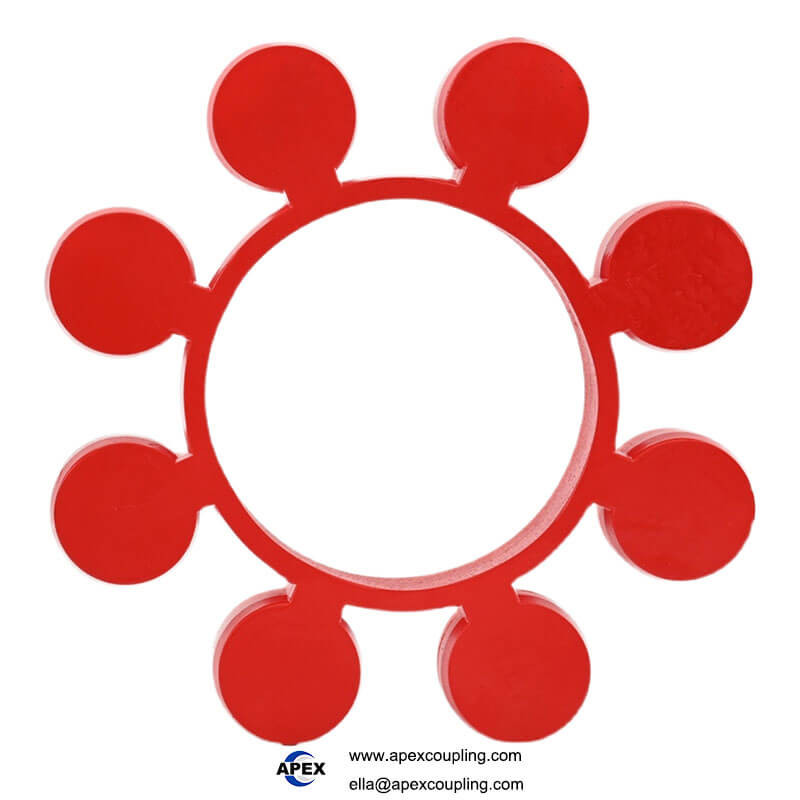
Spider inserts (also called elastomeric elements, coupling cushions, or plum coupling spiders) are the heart of plum/jaw couplings – transmitting torque, absorbing shock, damping vibration, and compensating for misalignment. Choosing the right spider material and size is critical for coupling performance, service life, and maintenance costs.
The MT Series from Apex Coupling offers a comprehensive range of polyurethane spider inserts from MT1 to MT13, covering torque capacities from 22.4 to 2500 N·m. This guide explains how to select the right MT spider for your application.
1. What Is a Spider Insert?
A spider insert is the flexible element that fits between the two hubs of a plum/jaw coupling. It:
Transmits torque from one hub to the other through the flaps
Absorbs shock loads and dampens vibration
Compensates for misalignment – angular, parallel, and axial
Protects equipment – acts as a fuse, failing before connected components
Eliminates metal-to-metal contact – reducing wear and noise
The spider is the wear element – designed for easy and cost-effective replacement without moving the hubs or disconnecting the shafts .
2. Why Polyurethane Over Rubber?
| Feature | Polyurethane (MT Series) | Rubber |
|---|---|---|
| Service Life | 3-5x longer | Standard |
| Wear Resistance | Excellent (<0.05 cm³/1.61 km) | Moderate |
| Oil Resistance | Excellent – non-corrosive in oil | Poor – degrades in oil |
| Temperature Range | -40°C to +100°C | Limited |
| Tensile Strength | High | Moderate |
| Tear Strength | Excellent | Moderate |
✅ Polyurethane is the superior choice for demanding applications – longer life, better wear resistance, superior oil resistance, and wider temperature range.
3. MT Series – Model Range Overview
The MT series covers a wide range of sizes from light to heavy-duty applications:
| Model | Flaps | Typical Application |
|---|---|---|
| MT1 | 4 | Small precision drives, instrumentation |
| MT2-MT6 | 6 | Standard industrial drives, pumps, conveyors |
| MT7-MT8 | 8 | Large industrial equipment, compressors |
| MT9-MT11 | 10 | Heavy machinery, mining equipment |
| MT12-MT13 | 12 | Extra-heavy equipment, crushers, mills |
💡 The number of flaps increases with size – providing more torque transmission capacity for larger applications.
4. Key Selection Criteria
When selecting an MT spider insert, consider these factors:
Step 1: Identify your coupling size
Measure the outer diameter, inner diameter, and thickness of your existing spider
Match to the MT series dimensions (MT1 to MT13)
Step 2: Determine torque requirements
Calculate the torque your application requires
Select a spider with rated torque ≥ your requirement
MT series covers 22.4–2500 N·m
Step 3: Consider operating environment
Temperature: MT series operates -40°C to +100°C
Oil exposure: Polyurethane is oil-resistant
Chemical exposure: Polyurethane offers good chemical resistance
Step 4: Select Shore hardness
Standard: 95A ±5 (90–98 Shore A)
Softer (80-92A): Better damping, lower torque capacity
Harder (95-98A): Higher torque capacity, less damping
5. Shore Hardness Selection – Match Your Application
| Hardness | Damping | Torque Capacity | Best For |
|---|---|---|---|
| 80 Shore A | Excellent | Low | High vibration, shock absorption |
| 92 Shore A | Good | Moderate | General purpose, good damping |
| 95 Shore A | Moderate | High | Standard industrial applications |
| 98 Shore A | Low | Highest | High torque, precision positioning |
💡 Standard MT series spiders are typically 95A ±5 – offering the best balance of damping and torque capacity for most applications .
6. Applications Where MT Spiders Excel
| Industry | Application | Recommended Size |
|---|---|---|
| Excavators | Power transmission | MT8-MT13 |
| Air Compressors | Vibration damping | MT5-MT10 |
| Mining | Crushers, conveyors | MT9-MT13 |
| Pumps | Centrifugal, gear pumps | MT3-MT8 |
| CNC Machines | Precision motion | MT1-MT4 |
| Conveyors | Material handling | MT4-MT10 |
| Automation | Pick-and-place | MT1-MT4 |
7. Real‑World Example – Mining Conveyor Upgrade
A mining company was experiencing frequent failure of rubber spider inserts on heavy-duty conveyors. The rubber spiders degraded due to oil contamination and high operating temperatures – requiring replacement every 2-3 months.
They switched to Apex Coupling MT series polyurethane spiders (MT8, 95 Shore A, polyurethane material). Results:
Service life extended to 12+ months – 4-6x longer than rubber
Oil degradation eliminated – polyurethane’s oil resistance
High temperature tolerance – withstood operating temperatures up to 80°C
Downtime reduced – fewer replacements
Maintenance costs reduced – no lubrication required
8. Installation & Maintenance Tips
Inspect the spider – Check for cracks, wear, or deformation at planned maintenance intervals
Clean the hubs – Remove debris before installing a new spider
Install the spider – Fit between the two hub jaws – ensure proper engagement
No lubrication required – Spider is self-lubricating
Replace when worn – Don’t wait for complete failure
Match hardness to application – Softer for damping, harder for torque
9. Selection Checklist
Model: MT1 to MT13 – match your coupling size
Material: Polyurethane – 3-5x longer life than rubber
Hardness: 90-98 Shore A – standard 95A ±5
Torque: 22.4–2500 N·m – ensure it exceeds your requirement
Temperature: -40°C to +100°C – verify operating range
Oil resistance: Excellent – suitable for oil-exposed environments
Application: Excavators, compressors, pumps, conveyors, CNC, mining
10. Conclusion
The MT series polyurethane spider insert from Apex Coupling offers superior performance compared to rubber spiders – with 3-5x longer service life, excellent oil resistance, superior wear resistance, and wider temperature range. With MT1 to MT13 sizes covering 22.4–2500 N·m torque capacity, there is a spider to suit every plum/jaw coupling application.
👉 Need a spider insert for your coupling? Contact us with your MT model and hardness requirements.
Inquiry now:
ella@apexcoupling.com
spider insert selection guide
MT series elastomer guide
polyurethane coupling spider selection
plum coupling elastomer guide
jaw coupling spider replacement
coupling cushion pad selection