ROTEX Coupling Spider Replacement: How to Identify the Correct Size
ROTEX Coupling Spider Replacement: How to Identify the Correct Size
Replacing a worn coupling spider is an important maintenance task for flexible jaw couplings.
Choosing the correct ROTEX coupling spider replacement requires more than simply matching the outside appearance or color of the old elastomer.
The coupling size, spider dimensions, hardness, material and operating conditions should all be checked before ordering.
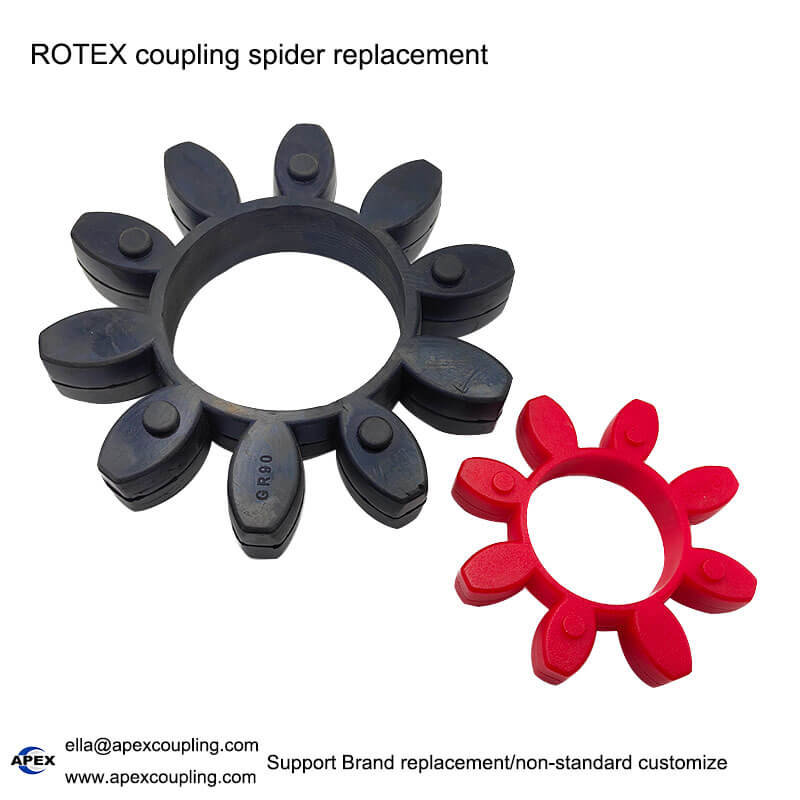
Apex Coupling supplies PU ROTEX-type / GR-compatible coupling spiders in multiple sizes from ROTEX 14 to ROTEX 180.
What Is a ROTEX Coupling Spider?
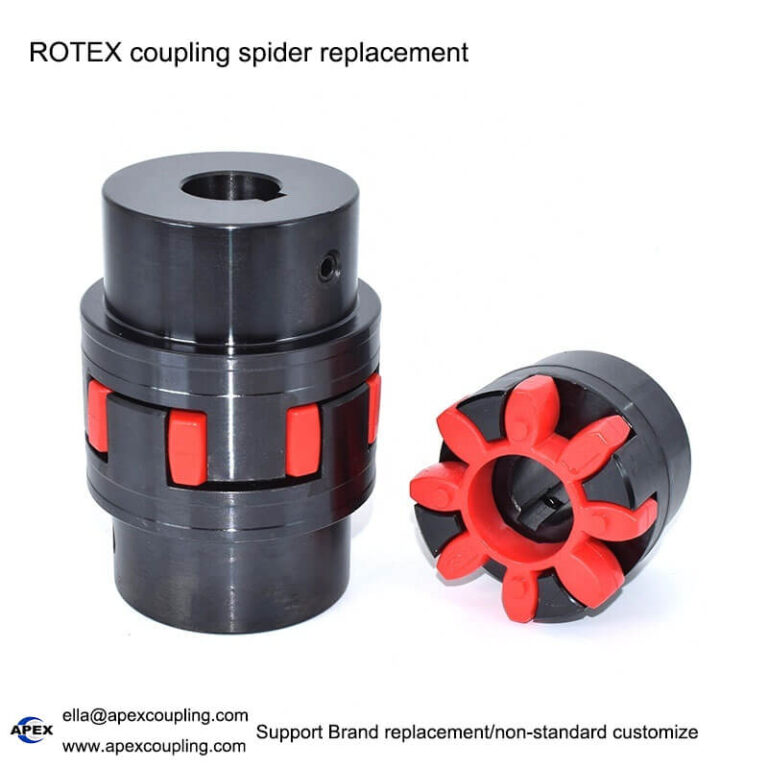
A ROTEX-type coupling spider is the flexible elastomer positioned between the jaws of two coupling hubs.
It provides:
- Torque transmission
- Vibration damping
- Shock absorption
- Elastic connection
- Limited misalignment compensation
The spider is a wear component and can normally be replaced separately when the coupling hubs remain serviceable.
When Should You Replace a ROTEX Spider?
Common signs of spider deterioration include:
- Visible cracks
- Excessive wear
- Deformation
- Hardening
- Material loss
- Increased backlash
- Excessive vibration
- Abnormal noise
If the elastomer is damaged, continuing to operate the coupling may affect transmission performance and place additional stress on connected equipment.
ROTEX Coupling Spider Size Chart
The following sizes are available for the Apex Coupling GR / ROTEX-type spider range:
| ROTEX Size | Diameter* |
|---|---|
| ROTEX 14 | 30 mm |
| ROTEX 19 | 40 mm |
| ROTEX 24 | 55 mm |
| ROTEX 28 | 65 mm |
| ROTEX 38 | 80 mm |
| ROTEX 42 | 95 mm |
| ROTEX 48 | 105 mm |
| ROTEX 55 | 120 mm |
| ROTEX 65 | 135 mm |
| ROTEX 75 | 160 mm |
| ROTEX 90 | 200 mm |
| ROTEX 100 | 225 mm |
| ROTEX 110 | 255 mm |
| ROTEX 125 | 290 mm |
| ROTEX 140 | 320 mm |
| ROTEX 160 | 370 mm |
| ROTEX 180 | 420 mm |
*Please confirm the exact dimensional definition with the manufacturer before ordering, as coupling drawings may use different dimensional references.
ROTEX 14 Coupling Spider
The ROTEX 14 is one of the smaller sizes in this product range.
For replacement ordering, confirm the coupling identification and required elastomer hardness before purchasing.
ROTEX 19 Coupling Spider
The ROTEX 19 spider is used with the corresponding coupling size.
Check the original coupling specification before selecting a replacement insert.
ROTEX 24 and ROTEX 28
ROTEX 24 and ROTEX 28 are additional sizes in the GR-compatible range.
Correct size identification is important because spiders are designed to fit the jaw geometry of their corresponding coupling hubs.
ROTEX 38 and ROTEX 42
ROTEX 38 and ROTEX 42 are commonly specified industrial coupling sizes.
For a replacement, confirm:
- Coupling size
- Spider material
- Hardness
- Operating torque
- Speed
ROTEX 48, 55 and 65
These larger coupling sizes are suitable for a broader range of industrial shaft connection applications.
Apex Coupling can provide polyurethane replacement spiders for these sizes and support OEM requirements.
ROTEX 75, 90 and 100
For larger coupling systems, selection should be based on the actual coupling configuration and operating conditions.
Do not select a replacement solely based on spider color.
ROTEX 110, 125, 140, 160 and 180
These larger sizes are included in the available range.
For high-torque or demanding applications, customers should provide the coupling model, operating speed and transmitted torque so the correct elastomer can be confirmed.
What Material Should a Replacement Spider Use?
Polyurethane is a common choice for flexible jaw coupling spiders.
A PU coupling spider can provide a balance of:
- Wear resistance
- Elasticity
- Mechanical strength
- Vibration damping
- Repeated-load performance
Apex Coupling offers 98 Shore A polyurethane spiders for compatible GR / ROTEX-type applications.
Does the Replacement Need the Same Hardness?
Ideally, yes.
The hardness of the elastomer affects coupling characteristics.
Replacing the original spider with a significantly different hardness may change:
- Torsional stiffness
- Vibration behavior
- Misalignment response
- Torque transmission characteristics
Always verify the required hardness before ordering.
ROTEX Spider Replacement: What Information Should You Provide?
For a quotation or replacement confirmation, provide as much of the following information as possible:
- Coupling model
- Spider size
- Original spider photo
- Spider dimensions
- Required hardness
- Material
- Operating speed
- Operating torque
- Operating temperature
- Quantity
If the original coupling model is unknown, photographs and dimensions can help the manufacturer identify the appropriate replacement.
ROTEX-Compatible Replacement vs Original Brand Product
A replacement spider can be manufactured as a compatible elastomeric insert for the corresponding coupling design.
Apex Coupling’s products should be described as:
- ROTEX-type
- ROTEX-compatible
- Replacement
- GR-compatible
They should not be represented as genuine or officially branded KTR components unless such authorization exists.
Why Choose a PU ROTEX-Type Replacement Spider?
A polyurethane replacement can be a practical option when the original elastomer has reached the end of its service life.
Advantages may include:
- Easy replacement
- Reduced maintenance downtime
- Multiple available sizes
- Custom manufacturing
- OEM support
- Consistent polyurethane material
Conclusion
Choosing the correct ROTEX coupling spider replacement requires accurate identification of the coupling size, elastomer hardness and application conditions.
Apex Coupling provides 98 Shore A PU ROTEX-type / GR-compatible coupling spiders covering sizes from ROTEX 14 to ROTEX 180.
Contact us with your coupling model, dimensions or photos for replacement spider confirmation and OEM quotation.
Inquiry now:
ella@apexcoupling.com
steel vs cast iron jaw coupling, rotex spider hardness guide, flexible coupling for motor, elastic coupling maintenance.