L Type Jaw Coupling Selection Guide – Cost-Effective Couplings for Wave Soldering Machines
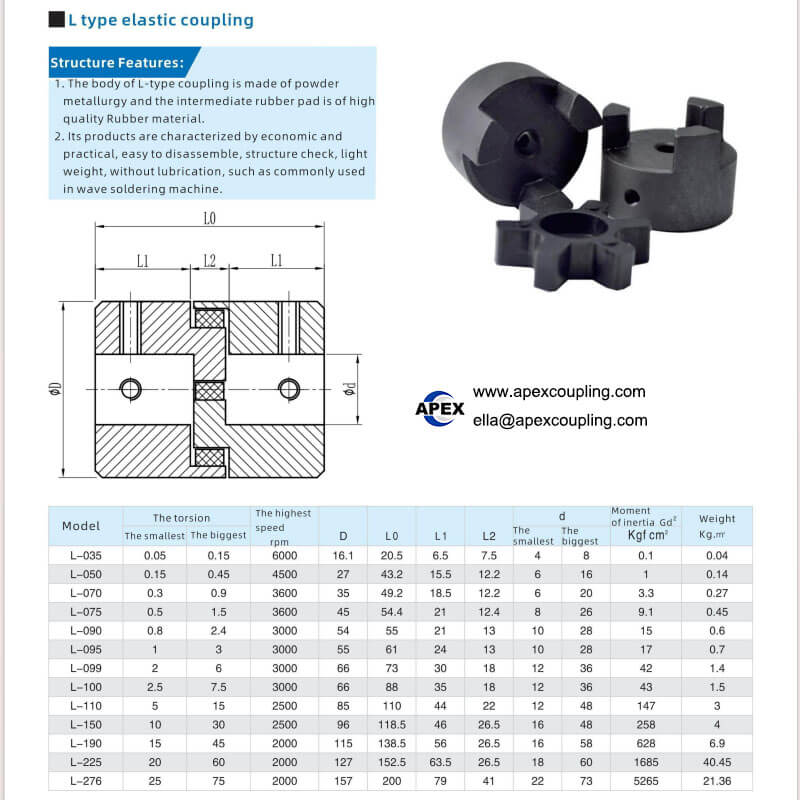
L Type jaw couplings (also known as L series or elastic jaw couplings) are among the most economical and widely used flexible couplings for light to medium-duty industrial applications. With a simple three-piece design – two powder metallurgy hubs and one rubber spider – they offer an excellent balance of cost, performance, and ease of maintenance.
This guide explains how L Type couplings work, why they are ideal for wave soldering machines, and how to select the right model for your application.
1. What Is an L Type Jaw Coupling?
An L Type jaw coupling consists of:
Two powder metallurgy (sintered iron) hubs – lightweight, precision-made, cost-effective
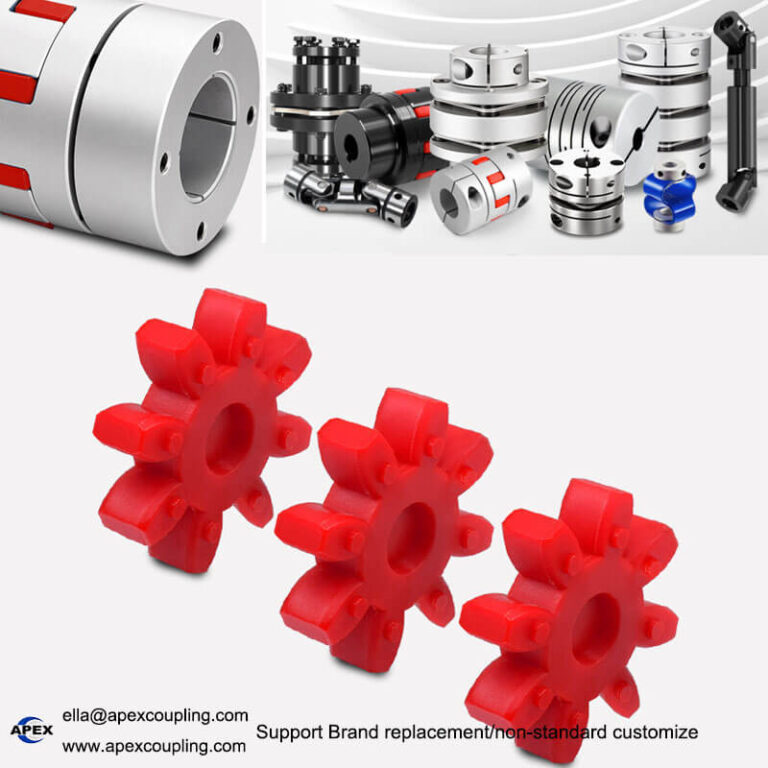
One rubber spider (NBR/nitrile butadiene rubber) – resilient, elastic, and oil-resistant
The spider transmits torque while absorbing shock, dampening vibration, and compensating for misalignment. The simple three-piece design allows for quick assembly and disassembly without special tools .
2. Key Advantages of L Type Couplings
| Advantage | Benefit |
|---|---|
| Cost-effective | Powder metallurgy hubs – economical for high-volume applications |
| Lightweight | Low inertia – suitable for high-speed applications |
| Maintenance-free | No lubrication required – reduces operating costs |
| Easy assembly | Three-piece design – no special tools required |
| Fail-safe | Continues to operate if spider fails |
| Industry standard | Interchangeable with Lovejoy, Martin, Browning |
| Oil & dirt resistant | Suitable for harsh environments |
3. Why L Type Couplings Are Ideal for Wave Soldering Machines
Wave soldering machines are used in large-scale electronic assembly processes to solder components to PCBs. L Type couplings are commonly used in these machines:
| Requirement | How L Type Coupling Meets It |
|---|---|
| Cost-effective | Powder metallurgy hubs – economical for production equipment |
| Lightweight | Low inertia – suitable for high-speed conveyor drives |
| Maintenance-free | No lubrication – reduces downtime |
| Easy maintenance | Quick spider replacement – minimizes production stops |
| Vibration damping | Rubber spider – protects sensitive electronics |
| Fail-safe | Continues to operate if spider fails – prevents production stops |
✅ Commonly used in wave soldering and reflow soldering equipment – L070 and L075 are popular sizes .
4. Material Selection – Powder Metallurgy vs Cast Iron
Standard L Type coupling hub materials are:
| Size Range | Hub Material |
|---|---|
| L035 to L190 | Powder metallurgy (sintered iron) |
| L225 to L276 | Cast iron |
✅ Powder metallurgy provides a cost-effective, lightweight solution for most applications. Cast iron is used for larger, higher-torque models.
5. Spider Material Options
| Spider Material | Torque | Temperature Range | Best For |
|---|---|---|---|
| NBR Rubber (Standard) | Baseline | -40°C to 100°C | General purpose, oil resistance, vibration damping |
| Urethane | Higher | Limited | Higher torque, less damping |
| Hytrel® | Up to 3x NBR | -51°C to 121°C | High torque, high temperature, oil/chemical resistance |
| Bronze | Up to 3x NBR | -40°C to 232°C | Low speed (≤250 RPM), extreme conditions |
✅ The standard NBR rubber spider is recommended for most applications requiring vibration damping and oil resistance.
| Model | Min. Torque | Max. Torque | Max. Speed (rpm) | D (mm) | L0 (mm) | L1 (mm) | L2 (mm) | Min. (mm) | Max. (mm) | d (mm) | Moment of Inertia (kgf·cm²) | Weight (kg) |
|---|---|---|---|---|---|---|---|---|---|---|---|---|
| L‑035 | 0.05 | 0.15 | 6000 | 16.1 | 20.5 | 6.5 | 7.5 | 4 | 8 | 0.1 | 0.04 | 0.04 |
| L‑050 | 0.15 | 0.45 | 4500 | 27 | 43.2 | 15.5 | 12.2 | 6 | 16 | 1 | 0.14 | 0.14 |
| L‑070 | 0.3 | 0.9 | 3600 | 35 | 49.2 | 18.5 | 12.2 | 6 | 20 | 3.3 | 0.27 | 0.27 |
| L‑075 | 0.5 | 1.5 | 3600 | 45 | 54.4 | 21 | 12.4 | 8 | 26 | 9.1 | 0.45 | 0.45 |
| L‑090 | 0.8 | 2.4 | 3000 | 54 | 55 | 21 | 13 | 10 | 28 | 15 | 0.6 | 0.6 |
| L‑095 | 1 | 3 | 3000 | 55 | 61 | 24 | 13 | 10 | 28 | 17 | 0.7 | 0.7 |
| L‑099 | 2 | 6 | 3000 | 66 | 73 | 30 | 18 | 12 | 36 | 42 | 1.4 | 1.4 |
| L‑100 | 2.5 | 7.5 | 3000 | 66 | 88 | 35 | 18 | 12 | 36 | 43 | 1.5 | 1.5 |
| L‑110 | 5 | 15 | 2500 | 85 | 110 | 44 | 22 | 12 | 48 | 147 | 3 | 3 |
| L‑150 | 10 | 30 | 2500 | 96 | 118.5 | 46 | 26.5 | 16 | 48 | 258 | 4 | 4 |
| L‑190 | 15 | 45 | 2000 | 115 | 138.5 | 56 | 26.5 | 16 | 58 | 628 | 6.9 | 6.9 |
| L‑225 | 20 | 60 | 2000 | 127 | 152.5 | 63.5 | 26.5 | 18 | 60 | 1685 | 40.45 | 40.45 |
| L‑276 | 25 | 75 | 2000 | 157 | 200 | 79 | 41 | 22 | 73 | 5265 | 21.36 | 21.36 |
7. Installation & Maintenance Tips
Clean shafts and bores – Remove oil, grease, and debris before assembly.
Check alignment – Even with misalignment compensation, keep within recommended limits.
Install spider correctly – Ensure proper fit between the two hubs.
No lubrication required – Spider is self-lubricating .
Inspect spider periodically – Replace if cracked, worn, or deformed.
Fail-safe backup – If spider fails, schedule prompt replacement .
8. Selection Checklist
- □
Model: L035 to L276 – select based on torque and bore requirements
- □
Hub material: Powder metallurgy (L035-L190) or cast iron (L225-L276)
- □
Spider material: NBR rubber (standard) – oil-resistant, vibration damping
- □
Spider hardness: 80A, 55D, or 90-95A – match your torque/damping needs
- □
Bore size: Match your shaft diameters – custom bores available
- □
Temperature: -40°C to 100°C – verify operating range
- □
Application: Wave soldering, conveyors, pumps, compressors
- □
Maintenance: Maintenance-free – no lubrication required
9. Conclusion
The L Type elastic jaw coupling from Apex Coupling offers the perfect combination of cost-effectiveness, lightweight construction, and maintenance-free operation for wave soldering machines and general industrial applications. With powder metallurgy hubs, NBR rubber spider, and a wide model range from L035 to L276, there is a model to suit every application.
👉 Need an L Type coupling for your application? Contact us with your model size and bore requirements.
Inquiry now:
ella@apexcoupling.com
L type jaw coupling selection guide
Wave soldering machine coupling
Powder metallurgy coupling guide
Cost effective jaw coupling
L series coupling guide
Lovejoy L series replacement