Industrial V-Belt Selection Guide – XPZ/XPA/XPB/XPC & SPA/SPB/SPC Series
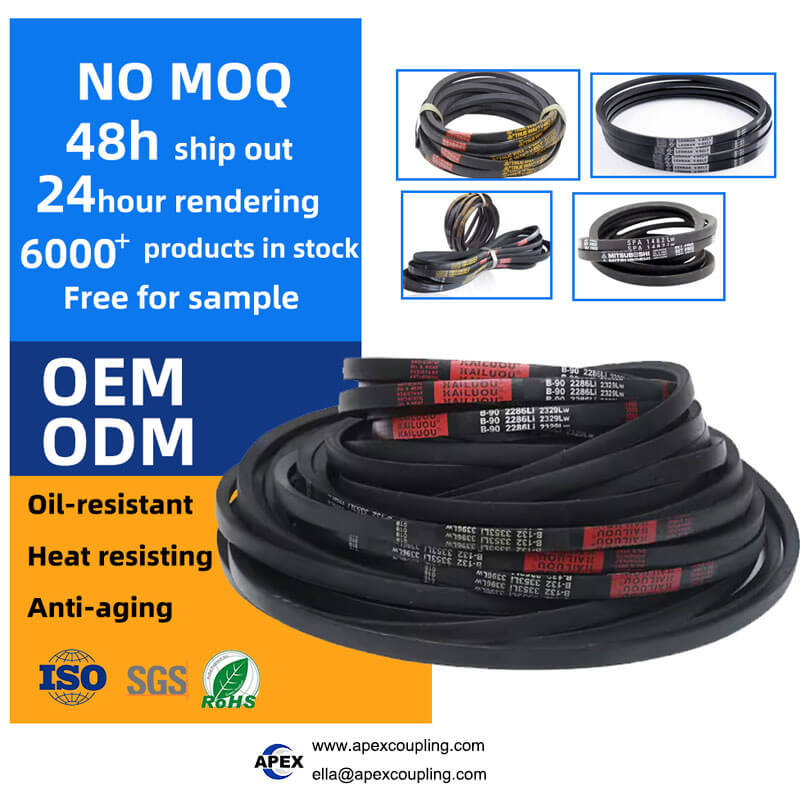
Industrial V-belts are essential components in power transmission systems across countless industries. With a wide range of profiles – narrow wedge (XPZ, XPA, XPB, XPC) and classical (SPA, SPB, SPC) – selecting the right belt for your application is critical for optimal performance, efficiency, and service life.
This guide explains how industrial V-belts work, the differences between profiles, and how to select the right belt for your application.
1. What Is an Industrial V-Belt?
An industrial V-belt is a power transmission belt with a trapezoidal cross-section that transmits power through friction between the belt’s sidewalls and the pulley grooves. Key characteristics include:
Trapezoidal cross-section – wedges into pulley grooves for grip
High-strength tensile cords – polyester or aramid for low stretch
Rubber compound – oil, heat, ozone, and abrasion resistant
Anti-static – dissipates static electricity safely (ISO 1813)
Cogged or wrapped – flexibility options for different applications
2. Narrow Wedge vs Classical – Which One Do You Need?
| Feature | Narrow Wedge (XPZ/XPA/XPB/XPC) | Classical (SPA/SPB/SPC) |
|---|---|---|
| Construction | Raw edge cogged – better grip, heat dissipation | Wrapped – fabric cover |
| Power Capacity | 50-100% higher than classical belts | Standard |
| Transmission Efficiency | 15-30% higher | Good |
| Space Efficiency | Excellent – saves space in compact drives | Standard |
| Flexibility | Superior – bends around small pulleys | Moderate |
| Heat Buildup | Lower – cogs dissipate heat | Higher |
| Best for | Compact drives, high torque, high speed | Standard industrial drives |
💡 Choose narrow wedge (XPZ/XPA/XPB/XPC) for high-power, compact drives where space is limited. Choose classical (SPA/SPB/SPC) for standard industrial applications.
3. Profile Dimensions – XPZ, XPA, XPB, XPC
The “X” series are narrow wedge cogged belts designed for compact, high-power drives:
| Profile | Top Width (mm) | Height (mm) | Length Range (mm) | Applications |
|---|---|---|---|---|
| XPZ | 9.7 – 10.0 | 8.0 | 562 – 4,000 | Light-duty, compact drives, high speed |
| XPA | 12.7 – 13.0 | 10.0 | 630 – 4,000 | Medium-duty, general industrial |
| XPB | 16.3 – 17.0 | 13.0 | 1,000 – 5,070 | Heavy-duty, high power |
| XPC | 22.0 | 18.0 | 1,800 – 5,300 | Extra-heavy-duty, high torque |
💡 XPZ/XPA/XPB/XPC are metric narrow wedge profiles that offer 50-100% higher transmission power than classical belts.
4. Profile Dimensions – SPA, SPB, SPC
The “SP” series are classical wrapped belts for standard industrial applications:
| Profile | Top Width (mm) | Height (mm) | Length Range (mm) | Applications |
|---|---|---|---|---|
| SPA | 12.7 | 10.0 | 1,190 – 4,440 | Medium-duty, general industrial |
| SPB | 16.3 – 17.0 | 14.0 | 1,924 – 7,924 | Heavy-duty, general industrial |
| SPC | 22.0 | 18.0 | 2,882 – 12,382 | Extra-heavy-duty, high torque |
💡 SPA/SPB/SPC are metric classical wrapped belts for standard industrial power transmission.
5. Cogged vs Wrapped – Why Choose Cogged?
Cogged V-belts (X series) have molded notches on their inner surface that provide significant advantages over wrapped belts:
| Feature | Cogged V-Belt (X Series) | Wrapped V-Belt (SP Series) |
|---|---|---|
| Flexibility | ✅ Superior – bends around small pulleys | Moderate |
| Heat Buildup | ✅ Lower – cogs dissipate heat | Higher |
| Power Capacity | ✅ 20-30% higher | Standard |
| Small Pulley Operation | ✅ Excellent | Limited |
| Suitable for compact drives | ✅ Yes | No |
✅ Choose cogged (X series) for applications requiring flexibility, small pulleys, and high power capacity.
6. How to Select the Right V-Belt
Step 1: Determine Required Profile
Narrow wedge (XPZ/XPA/XPB/XPC): High power, compact drives.
Classical (SPA/SPB/SPC): Standard industrial drives.
Step 2: Determine Required Length
Measure the center distance of your pulleys and required belt wrap.
Length range: 500-12,000 mm (customizable).
Step 3: Determine Required Width
Width determines load capacity – wider belts handle higher loads.
Custom widths available.
Step 4: Consider Operating Environment
Oil exposure: Choose oil-resistant compound.
Temperature: Standard -30°C to +100°C.
Static risk: Choose anti-static (ISO 1813).
Step 5: Consider OEM Customization
Custom length, width, and profiles available.
7. Applications Where V-Belts Excel
| Industry | Application | Recommended Profile |
|---|---|---|
| Conveyor Systems | Material handling, assembly lines | XPA, XPB, SPA, SPB |
| Packaging Machinery | Wrapping, sealing, labeling | XPA, SPA |
| Printing Equipment | Paper feed, register control | XPA, SPB |
| Textile Machinery | Spinning, weaving | XPA, XPB, SPA |
| Agricultural Machinery | Farm equipment, harvesters | XPB, XPC, SPB, SPC |
| Compressors & Pumps | Air compressors, water pumps | XPA, XPB, SPA, SPB |
| Machine Tools | CNC, grinders, saws | XPA, SPB |
| Woodworking Machinery | Saws, planers | XPA, SPB |
| Food Processing | Conveying, packaging | XPA, SPA |
8. Real‑World Example – Conveyor System Upgrade
A manufacturing plant was experiencing belt failure on their conveyor systems due to oil exposure and high temperatures. The standard V-belts required replacement every 2-3 months.
They switched to Apex Coupling XPA cogged V-belts (narrow wedge, oil and heat-resistant compound, cogged design). Results:
Belt life extended – oil and heat-resistant compound
Flexibility improved – cogged design allowed smaller pulleys
Power capacity increased – 50-100% higher than classical belts
Downtime reduced – longer service life
Cost savings – fewer replacements, reduced maintenance
9. Installation & Maintenance Tips
Measure accurately – Ensure the required belt length is measured correctly.
Clean pulleys – Remove debris from pulleys before installation.
Proper tension – Tension according to manufacturer’s recommendations.
Alignment – Ensure pulleys are properly aligned to prevent tracking issues.
No lubrication required – V-belts operate dry.
Inspect regularly – Check for wear, cracks, or damage.
Keep clean – Remove dust and debris to prevent premature wear.
Check for glazing – Glazed belts indicate slippage – check tension.
10. Selection Checklist
- □
Profile: Narrow wedge (XPZ/XPA/XPB/XPC) or Classical (SPA/SPB/SPC)
- □
Cogged: Yes (X series) – for flexibility, small pulleys, high power
- □
Length: Measure your required length
- □
Width: Match your load requirements
- □
Material: NR/CR/EPDM – oil, heat, ozone resistant
- □
Tensile cord: Polyester or aramid – high strength, low stretch
- □
Anti-static: ISO 1813 – for safety
- □
Temperature: -30°C to +100°C – verify operating range
- □
Application: Conveyors, packaging, printing, agriculture, compressors
- □
Customization: OEM length, width, profiles – specify if required
11. Conclusion
The industrial rubber V-belt from Apex Coupling offers the perfect combination of high power capacity, flexibility, and durability for demanding industrial applications. With narrow wedge (XPZ/XPA/XPB/XPC) and classical (SPA/SPB/SPC) profiles, cogged design, oil and heat resistance, anti-static properties, and OEM customization, it is the ideal solution for conveyors, packaging machinery, printing equipment, agricultural machinery, compressors, and general industrial drives.
👉 Need an industrial V-belt for your application? Contact us with your profile, length, and customization requirements.
Inquiry now:
ella@apexcoupling.com
industrial V-belt selection guide
XPZ XPA XPB XPC V-belt guide
SPA SPB SPC V-belt selection
narrow wedge V-belt guide
cogged V-belt selection
OEM V-belt guide
conveyor V-belt selection