How to Select a Telescopic Universal Joint Coupling for Industrial Machinery
How to Select a Telescopic Universal Joint Coupling for Industrial Machinery
When machinery requires torque transmission across a long distance or at a significant angle, a standard rigid coupling simply won’t work. You need a telescopic universal joint coupling (also known as a cardan shaft coupling). This component not only transmits torque but also compensates for axial displacement, angular misalignment, and radial offset.
In this guide, we will walk you through the key factors to consider when selecting a WSP-type telescopic universal joint coupling, including material selection, torque and speed ratings, bore tolerance, stroke calculation, and surface treatment options.
What is a Telescopic Universal Joint Coupling?
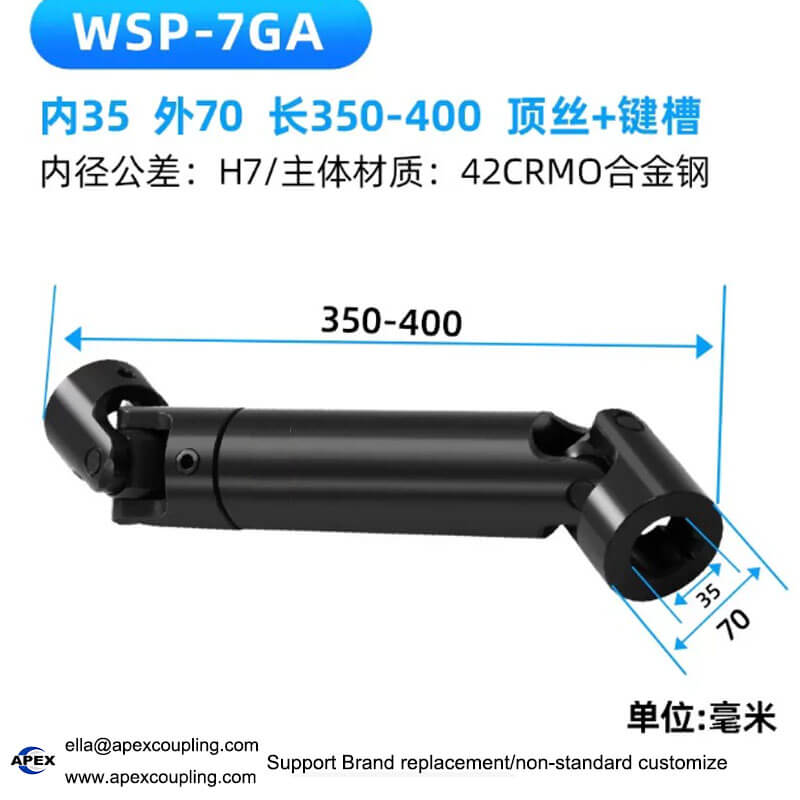
A telescopic universal joint coupling is a mechanical component that connects two shafts at an angle while allowing the length of the drive shaft to change. This is achieved through a splined sleeve and sliding hub design, which allows the coupling to extend and retract (telescope) as the machinery moves or expands due to thermal changes.
The WSP series is a small cross-shaft universal joint coupling known for its high rigidity, compact size, and ability to operate at angles up to 45° per section.
Key Selection Factors
1. Torque and Speed Requirements
Determine the required rated torque of your application. The WSP series offers a rated torque of 181 N·m with a maximum speed of 1000 RPM. If your application requires higher torque or speed, you may need to step up to a larger model or a different series. Always consider peak torque and service factors.
2. Shaft Diameter and Bore Tolerance
Standard bore diameter for this model is 35mm. The finished hole tolerance is H7. You can choose keyway, hexagon hole, or square hole connections depending on your shaft design. For custom applications, always provide the exact shaft drawing to ensure a perfect fit.
3. Angular Misalignment
The WSP universal joint can accommodate a maximum rotation angle of 45° per section. This is significantly higher than most flexible couplings. If your machinery has a large angle between the driving and driven shafts, a universal joint is the ideal solution.
4. Stroke and Installation Length
Telescopic couplings must be sized correctly for the stroke (X) and installation length (L). If the coupling is too short, it may bottom out and damage the bearings. If it is too long, it may not transmit torque effectively. The minimum size can be calculated as: Lmin = L2 + B + X + L2. Our engineering team can help you confirm the exact dimensions based on your application.
5. Material and Durability
The WSP series uses 42CrMo alloy steel for the body, which offers high strength and excellent fatigue resistance. The pin shafts are made from bearing steel with HRC 55-60 hardness. The joint is designed not to detach, with a hardness of HRC 48-52. This combination ensures a long service life, even in heavy-duty applications. Our precision-ground design offers minimal backlash, and 1 set can replace up to 5 standard sets.
6. Environmental Protection
Consider the working environment. For dusty environments, a dust cover is highly recommended to protect the joint and extend its lifespan. For corrosive environments, choose a suitable surface treatment such as zinc-nickel alloy, Dacromet, or chrome plating. The standard blackening treatment offers basic rust protection, but more advanced options are available for extreme conditions.
7. Temperature and Speed Extremes
If your application involves high temperatures, low temperatures, or ultra-high speeds, standard joints may fail prematurely. Apex Coupling offers customized universal joints designed for these extreme conditions, ensuring reliable performance where standard parts cannot survive.
Installation Best Practices
- Clean the shaft and bore before installation.
- Check that the keyway or hexagon hole matches the shaft perfectly.
- Align the shafts as closely as possible to minimize the operating angle (although the joint can handle 45°, smaller angles reduce wear).
- Tighten the fasteners evenly and according to the recommended torque.
- Apply the dust cover if required for your environment.
- Rotate the shaft by hand to check for binding or excessive backlash.
- Lubricate the joint if necessary. The standard maintenance cycle is 1000 hours.
FAQ
What is the difference between a universal joint coupling and a diaphragm coupling?
A universal joint coupling uses cross-shaft bearings to transmit torque at large angles and long distances, making it ideal for cardan shafts. A diaphragm coupling uses flexible metal discs to transmit torque with zero backlash, ideal for high-precision servo applications. They serve different purposes.
Can I use a WSP universal joint for high-speed applications?
The standard WSP model has a maximum speed of 1000 RPM. For ultra-high-speed applications, please contact our engineers for a customized solution.
What is the maximum operating angle?
Each section can handle up to 45°. If you need a larger angle, multiple sections can be combined.
What surface treatments do you offer for rust protection?
We offer blackening, phosphating, nickel plating, galvanizing, chrome plating, Dacromet, and zinc-nickel alloy. Zinc-nickel alloy is recommended for highly corrosive environments.
Conclusion
Selecting the right telescopic universal joint coupling is critical for the reliability and efficiency of your industrial machinery. By considering torque, speed, angle, stroke, material, and environmental factors, you can choose a coupling that delivers long-lasting performance.
Apex Coupling is a direct manufacturer of WSP telescopic universal joint couplings, offering 42CrMo alloy steel construction, precision grinding, and full customization for OEM and ODM projects. View our WSP Universal Joint Coupling → | Request a Quote →
Inquiry now:
ella@apexcoupling.com
steel vs cast iron jaw coupling, rotex spider hardness guide, flexible coupling for motor, elastic coupling maintenance.