How to Choose a Double Universal Joint Coupling
Selecting the correct double universal joint coupling is important for reliable power transmission, accurate installation and long-term equipment performance. A suitable coupling must match the shaft dimensions, required torque, operating speed, working angle and mounting configuration.
This guide explains the main factors to check before purchasing a double universal joint coupling for industrial machinery.
1. Confirm the Shaft Diameters
Start by measuring the diameters of the two shafts that will be connected. The input and output sides may require equal or different bore sizes.
Also confirm the required bore tolerance, keyway dimensions and set-screw arrangement. If the application uses a square, hexagonal or splined connection, provide the corresponding dimensions and drawing.
For precision installations, do not select a coupling based only on nominal diameter. Confirm the fit and tolerance requirements for the exact model.
2. Check the Overall Length
The overall length must fit the available installation space and the distance between the connected components.
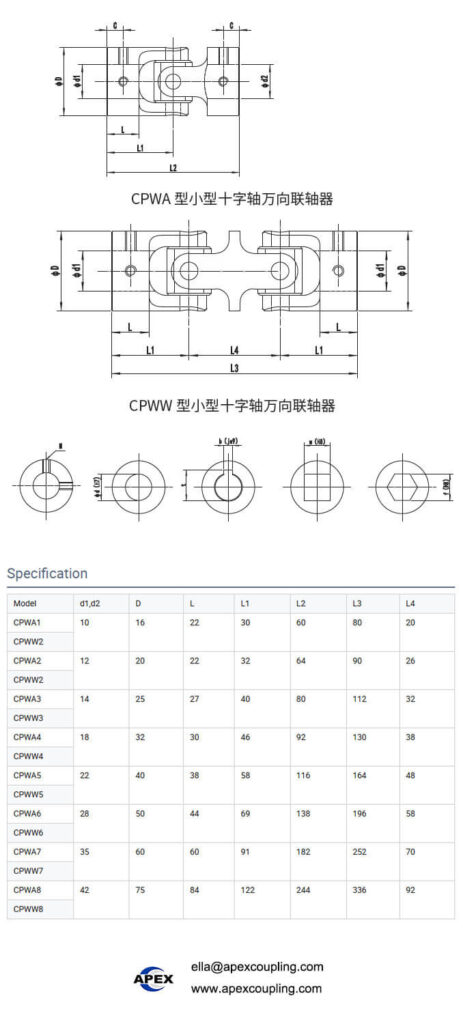
A product series may offer multiple lengths for the same nominal size. For example, the Apex Coupling product list includes D16, D20, D25, D32, D40, D50, D60 and D75 size groups, with different listed lengths.
Confirm the dimensional definition on the manufacturer’s drawing. Do not assume that the model code describes every dimension without verification.
3. Determine the Required Torque
Torque selection should account for the actual operating cycle, including:
Normal running torque
Starting and acceleration loads
Frequent starting and stopping
Forward and reverse rotation
Shock or impact loads, where applicable
Compare these requirements with the rated torque of the exact coupling model. A torque range published for an entire product family should not be treated as the rating of every size.
If the equipment has significant shock loads or frequent reversals, provide these details to the manufacturer during selection.
4. Verify the Working Angle
Determine the angle between the connected shaft centerlines and, for a double-joint arrangement, the angle at each joint.
The allowable articulation angle depends on the coupling design. A listed maximum angle is not necessarily a recommended continuous operating angle.
Joint angle can also affect motion characteristics. For a double Cardan arrangement, the relative joint angles and phasing influence whether output-speed variation can be reduced.
Confirm the applicable angle limits and assembly requirements with the manufacturer.
5. Check Operating Speed
Operating speed must be evaluated together with torque, working angle, joint construction and lubrication requirements.
Do not assume that a double universal joint coupling has a higher speed rating simply because it contains two joint sections. The actual rating depends on the design, dimensions and operating conditions.
Request the rated speed for the exact model before using it in a high-speed application.
6. Select the Mounting Configuration
The mounting interface must match the connected shafts.
Depending on the product configuration, options may include:
H7 finished bore
Keyway
Set screw
Square bore
Hexagonal bore
Splined bore
Other non-standard mounting details
Not every connection type is necessarily available for every size. Confirm availability and dimensions before ordering.
7. Confirm Material Requirements
Material selection depends on mechanical loads, temperature, corrosion exposure and the application environment.
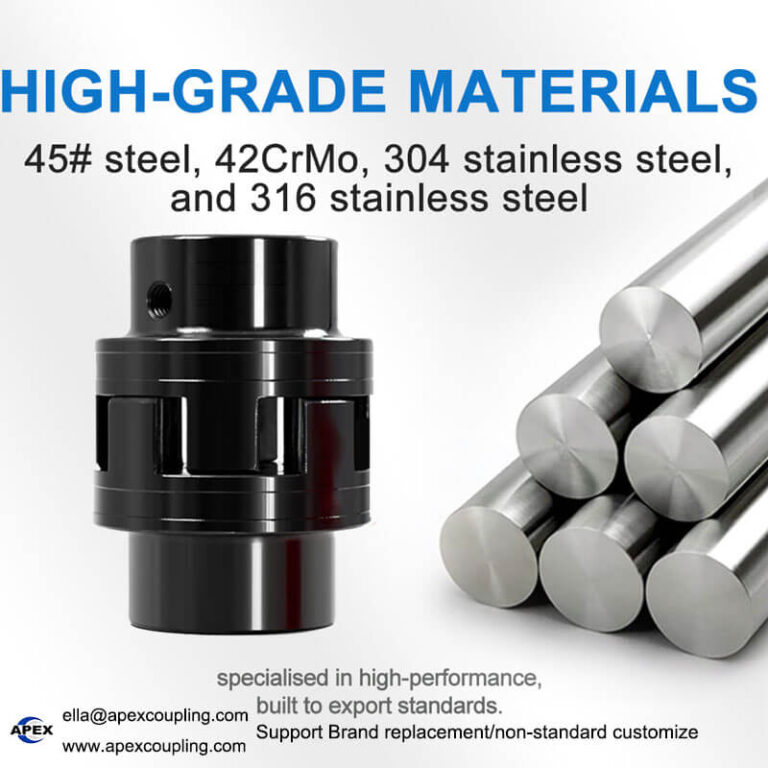
The Apex Coupling product specification lists 42CrMo alloy steel for this product configuration. Confirm the material grade and supporting documentation for the exact model being purchased.
Where corrosion resistance or another special property is required, discuss alternative materials and surface treatments with the manufacturer rather than assuming all options are available across the range.
8. Review the Technical Drawing
Before placing an order, verify the following:
Overall length and external dimensions
Input and output bore diameters
Bore tolerance and connection type
Joint structure and allowable working angle
Rated torque and operating speed
Installation and maintenance requirements
A technical drawing helps ensure that the selected coupling fits the equipment and meets its operating requirements.
Double Universal Joint Coupling Models from Apex Coupling
Apex Coupling offers a precision universal joint coupling series with single and double configurations and a range of nominal sizes.
Listed models include:
D16-L60-d10-e10 and D16-L80-d10-e10
D20-L64-d12-e12 and D20-L90-d12-e12
D25-L80-d14-e14 and D25-L112-d14-e14
D32-L92-d18-e18 and D32-L130-d18-e18
D40-L116-d22-e22 and D40-L164-d22-e22
D50-L138-d28-e28 and D50-L196-d28-e28
D60-L182-d35-e35 and D60-L252-d35-e35
D75-L244-d42-e42 and D75-L336-d42-e42
These model numbers are reproduced from the supplied product list. Confirm the actual overall dimensions, bore sizes, configuration and ratings using the manufacturer’s drawing before ordering.
Request a Double Universal Joint Coupling Quote
To help identify the correct coupling, provide the following information:
Model number or required bore diameters
Required overall length
Operating torque and speed
Working angle at each joint
Keyway, set-screw or other mounting requirements
Required quantity and any customization needs
Apex Coupling supports inquiries for selected non-standard dimensions and mounting configurations, subject to technical feasibility.
Email: ella@apexcoupling.com
WhatsApp: +86 13437856962
Contact Apex Coupling to discuss your application and request a quotation.
Frequently Asked Questions
How do I select the correct size?
Start with the two shaft diameters and required overall length. Then confirm torque, speed, working angle and mounting details against the model-specific technical drawing.
Can the two bore diameters be different?
Selected configurations may allow different input and output bore diameters. Confirm availability with the manufacturer.
What does H7 bore tolerance mean?
H7 is a standardized bore tolerance designation. The required fit depends on the shaft tolerance, connection design and application. Confirm the complete fit specification before ordering.
Is the maximum working angle the recommended operating angle?
Not necessarily. The maximum articulation angle and recommended operating angle can differ. Use the limits specified for the exact coupling model.
Can I order a custom-length coupling?
Custom lengths may be available subject to technical feasibility. Provide the required dimensions and operating conditions for review.