High-Speed Universal Joint Selection Guide – Needle Bearing vs Sliding Bearing for 4000 RPM Applications
Universal joints (cardan joints) are essential for transmitting power between misaligned shafts. However, not all universal joints are created equal – the choice between needle bearing and sliding bearing designs significantly impacts speed capability, maintenance requirements, and overall performance.
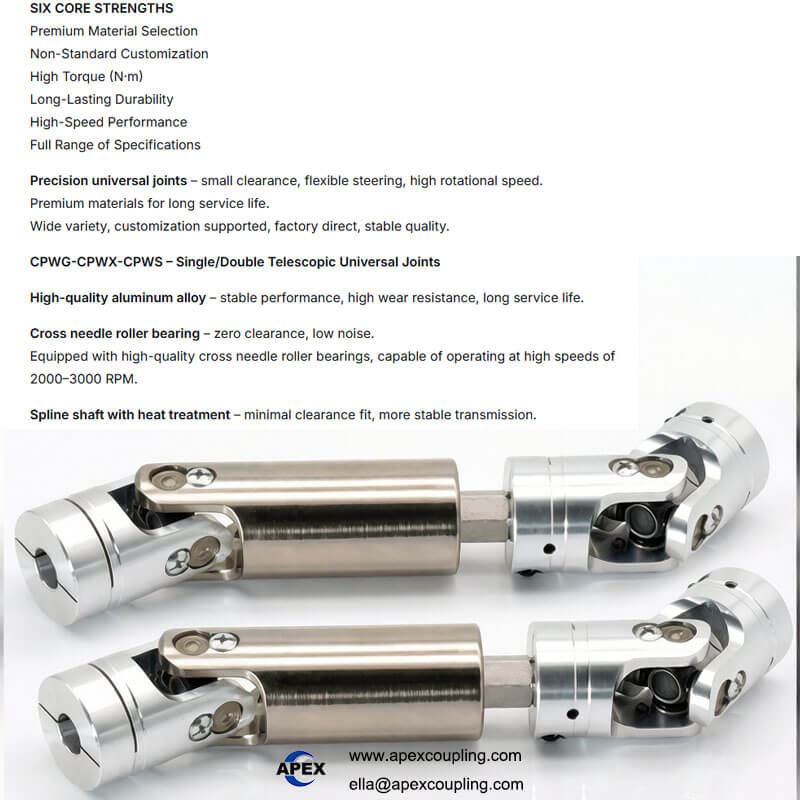
This guide compares needle bearing and sliding bearing universal joints, explains the advantages of aluminum construction for high-speed applications, and helps you select the right configuration – single, double, or telescopic – for your application, using the CPWD series as a practical example.
1. Needle Bearing vs Sliding Bearing – Which One Do You Need?
| Feature | Needle Bearing (CPWD) | Sliding Bearing |
|---|---|---|
| Maximum Speed | 4000 RPM [0†L5][3†L15-L16] | 1000 RPM [0†L10] |
| Friction | Low – rolling elements | High – metal-to-metal contact |
| Maintenance | Maintenance-free – sealed for life [3†L40-L41] | Requires periodic lubrication |
| Efficiency | High – reduced friction losses [3†L36-L38] | Lower |
| Dynamic Load Capacity | High | Moderate |
| Bearing Clearance | Small – precise positioning | Larger |
| Best for | High-speed, precision applications | Low-speed, high-torque applications |
| Noise | Lower | Higher |
✅ Choose needle bearing when: Your application requires speeds above 1000 RPM, precision positioning, and maintenance-free operation. Choose sliding bearing when: Your application operates at low speeds and high torque.
Why needle bearings enable higher speeds:
Roller bearings have inherently lower friction than plain bearings, enabling high-speed operation. Unlike plain bearings, which rely on a lubricating film, roller bearings use rolling elements that reduce friction and heat generation [3†L15-L16].
2. Why Aluminum for High-Speed Universal Joints?
Aluminum alloy offers significant advantages for high-speed applications:
| Feature | Aluminum Alloy | Steel |
|---|---|---|
| Weight | Lightweight – 1/3 the weight of steel | Heavy |
| Inertia | Low – faster acceleration/deceleration | High |
| Corrosion resistance | Excellent (with anodizing) | Moderate (needs coating) |
| Strength-to-weight ratio | High | Moderate |
| Best for | High-speed, precision applications | Heavy-duty, low-speed applications |
✅ Aluminum is the material of choice for high-speed universal joints where low inertia and rapid response are critical.
3. Single Joint vs Double Joint vs Telescopic – Which Configuration?
| Feature | Single (CPWG) | Double (CPWX) | Telescopic (CPWS) |
|---|---|---|---|
| Angular misalignment | ✅ Up to 45° | ✅ Up to 45° per joint | ✅ Up to 45° per joint |
| Parallel offset | ❌ No | ✅ Yes | ✅ Yes |
| Axial length adjustment | ❌ No | ❌ No | ✅ Yes |
| Total articulation | Up to 45° | Up to 90° | Up to 90° |
| Length | Short | Medium | Variable |
| Best for | Angled shafts on same plane | Angled + offset shafts | Variable shaft spacing, thermal expansion |
Rule of thumb:
Use single (CPWG) when shafts are on the same plane but angled.
Use double (CPWX) when shafts are both angled and offset.
Use telescopic (CPWS) when the distance between shafts varies during operation.
4. 45° Operating Angle – What It Means for Your Application
The CPWD series offers 45° angular capacity per joint [0†L12]. This means:
Single joint (CPWG): Up to 45° total articulation
Double joint (CPWX/CPWS): Up to 90° total articulation
| Angle Range | Recommendation |
|---|---|
| 0° – 30° | ✅ Ideal for continuous operation – maximum bearing life |
| 30° – 45° | ⚠️ Acceptable for short periods – reduced bearing life |
| >45° | ❌ Not recommended – can cause joint failure |
Practical tip: For most applications, try to keep operating angles below 30° for continuous operation to maximize service life.
5. Low Backlash – Why It Matters for Precision Applications
Backlash (rotational clearance) in a coupling causes:
Position errors – Inaccurate positioning in automation
Reduced accuracy – Poor system performance
Control instability – Oscillations in servo systems
Reduced repeatability – Inconsistent positioning
✅ Needle bearing universal joints like the CPWD series offer low backlash for precise positioning [2†L9]. Needle bearings are manufactured with tight component tolerances, making them well suited for applications that require minimal backlash.
6. Applications Where High-Speed Universal Joints Excel
| Industry | Application | Recommended Configuration |
|---|---|---|
| Packaging Machinery | High-speed conveyors | CPWG or CPWX |
| Printing Equipment | Register control, high-speed | CPWG |
| Robotics | Joint drives, precision motion | CPWX |
| CNC Machines | Feed drives, positioning | CPWG |
| Semiconductor | Wafer handling | CPWX or CPWS |
| Automation | Pick-and-place systems | CPWX |
7. Real‑World Example – Packaging Line Upgrade
A packaging machinery manufacturer was experiencing friction and heat buildup with sliding bearing universal joints operating at 1800 RPM. The joints required frequent lubrication and replacement, causing production downtime.
They switched to Apex Coupling CPWD needle bearing universal joints (aluminum, needle bearing, 4000 RPM, double joint). Results:
Speed capability increased – needle bearing handled 1800 RPM smoothly
Maintenance eliminated – sealed, maintenance-free design [3†L40-L41]
Friction reduced – rolling elements minimized heat generation
Service life extended – reduced wear and tear
Downtime reduced – fewer replacements
8. Installation & Maintenance Tips
Check alignment – Keep operating angles ≤30° for continuous operation
No lubrication required – Needle bearings are sealed and lubricated for life [3†L40-L41]
Clamping screw fastening – Tighten screws evenly for secure shaft attachment
Inspect periodically – Check for wear or damage
Bore fit – Use H7 shaft tolerance for best concentricity
9. Selection Checklist
Bearing type: Needle bearing (CPWD) for high-speed (4000 RPM), low friction, maintenance-free
Configuration: Single (CPWG), double (CPWX), or telescopic (CPWS)
Material: Aluminum alloy for lightweight, high-speed applications
Angle: Up to 45° per joint – keep ≤30° for continuous use
Speed: Up to 4000 RPM – match your motor speed [0†L5][3†L15-L16]
Finish: Anodized for corrosion resistance
Fastening: Clamping screw for secure, damage-free shaft attachment
10. Conclusion
The CPWD series high-speed precision universal joint from Apex Coupling offers the perfect combination of needle bearing performance, lightweight aluminum construction, and configuration flexibility for high-speed automation, packaging, printing, robotics, and CNC applications. With 4000 RPM capability, 45° angular capacity, low backlash, and maintenance-free operation, it delivers reliable, long-lasting performance in demanding industrial environments.
👉 Need a high-speed universal joint for your application? Contact us with your configuration, speed, and bore requirements.
Inquiry now:
ella@apexcoupling.com
high speed universal joint selection
needle bearing vs sliding bearing universal joint
4000 RPM universal joint guide
aluminum universal joint coupling
single double telescopic universal joint
CPWD series selection