

CONTACT US
INQUIRY US
Apex Coupling, Our Core Expertise: Customization and Quality.
Your One-Stop Custom Coupling Manufacturer
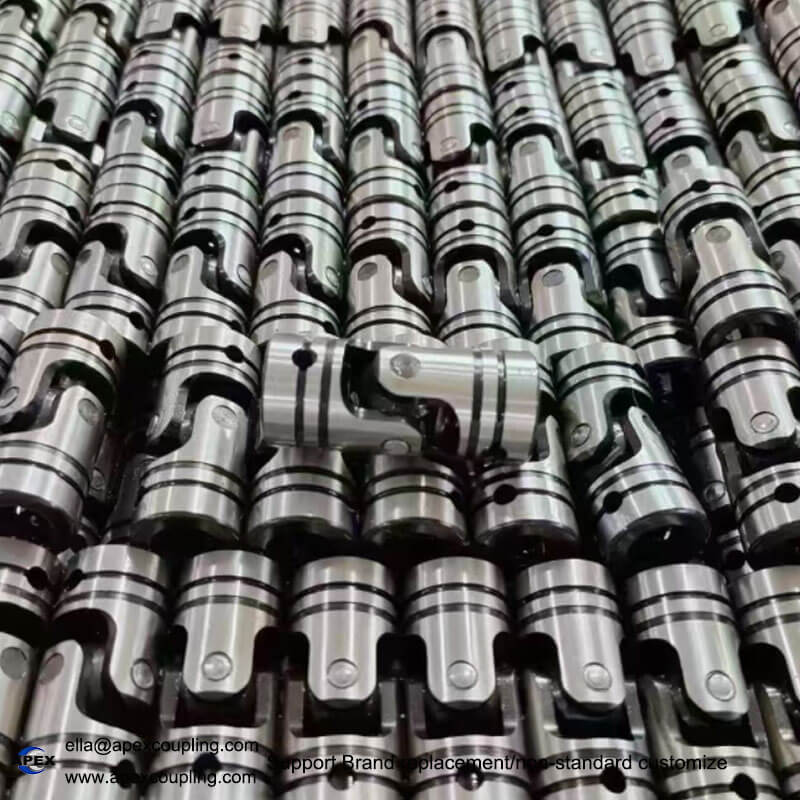
When selecting a precision universal joint, one of the first questions is whether to use a G type or GD type universal joint.
Both are designed to transmit torque between shafts operating at an angle, but their structures and application conditions are different.
A G type universal joint is a single universal joint configuration.
It is generally used when two shafts require angular transmission and the shaft arrangement is relatively straightforward.
A GD type universal joint is a double universal joint configuration.
Two joint sections work together to provide greater flexibility for shaft arrangement.
GD configurations are particularly useful when the transmission system involves more complex shaft geometry.
| Feature | G Type | GD Type |
|---|---|---|
| Configuration | Single | Double |
| Main purpose | Angular transmission | Angular + more complex offset conditions |
| Structure | One joint | Two joint sections |
| Installation | Compact | More flexible |
| Shaft arrangement | Relatively simple | More complex |
| Total articulation | Configuration dependent | Greater flexibility |
| Typical application | Machine tools / transmission | More complex transmission systems |
Choose a G type universal joint when:
Choose a GD type universal joint when:
A common mistake is to assume that a double universal joint automatically means that each joint can operate at 90°.
This is incorrect.
The allowable angle of each joint depends on its design.
For Apex precision universal joints, a single joint is generally specified for up to approximately 45°, while a suitable double arrangement can provide greater overall articulation.
Always confirm the actual angle according to the model.
Apex supports customized:
For a custom G/GD universal joint, provide your shaft dimensions and operating requirements.
See the [Apex U Joints product page] for available configurations.
Inquiry now:
ella@apexcoupling.com
steel vs cast iron jaw coupling, rotex spider hardness guide, flexible coupling for motor, elastic coupling maintenance.
Apex Coupling, Our Core Expertise: Customization and Quality.
Your One-Stop Custom Coupling Manufacturer