How to Choose a Double Diaphragm Shaft Coupling for Servo and Stepper Motors
How to Choose a Double Diaphragm Shaft Coupling for Servo and Stepper Motors
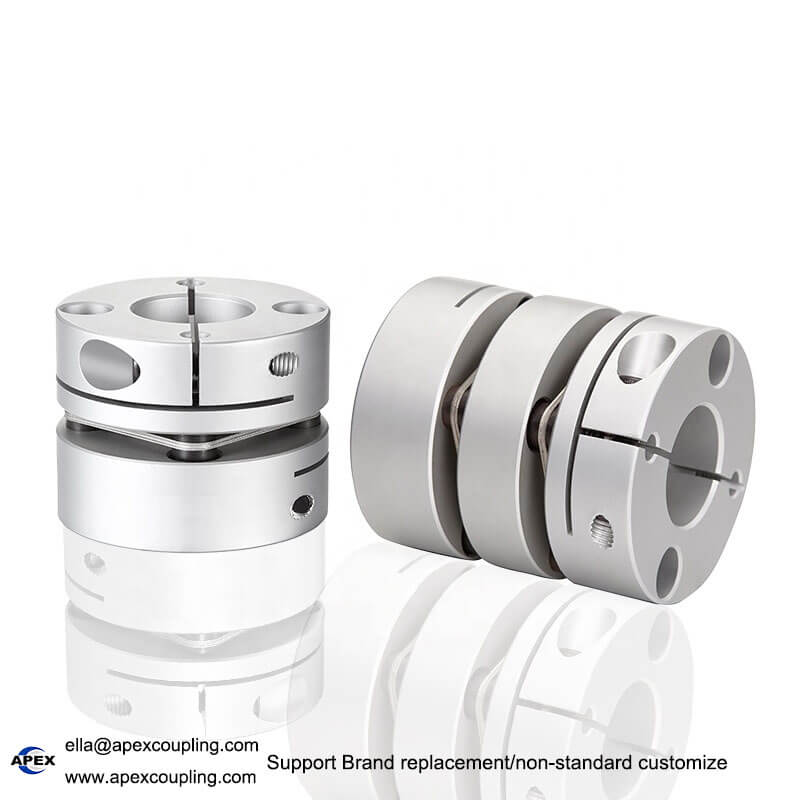
Choosing the right double diaphragm shaft coupling can directly affect the accuracy, speed and service life of your servo or stepper motor system. A good coupling transmits torque with zero backlash, compensates for small misalignments and keeps inertia low. A wrong coupling can cause vibration, positioning errors, noise and premature failure.
This guide explains how to select an aluminum double diaphragm shaft coupling for servo motors, stepper motors, CNC machines and automation equipment. It also compares single disc and double disc diaphragm couplings, clamping screw and keyway options, and important technical parameters.
Why Use a Double Diaphragm Shaft Coupling for Servo Motors?
Servo and stepper motor systems require accurate rotational positioning. Any backlash in the coupling can cause positioning errors, especially in forward and reverse operation. A double diaphragm shaft coupling uses stainless steel diaphragm discs and a clamping connection to eliminate clearance between the shaft and sleeve.
Key advantages for servo applications include:
- Zero backlash for accurate motion control
- Low inertia for fast acceleration and deceleration
- High torsional rigidity for precise shaft rotation
- Flexible compensation for angular, radial and axial misalignment
- Maintenance-free stainless steel disc design
- Suitable for positive and negative rotation
Single Disc vs Double Disc Diaphragm Coupling
A single disc diaphragm coupling has one diaphragm pack and is compact. It is suitable for applications with small misalignment and limited installation space. A double diaphragm shaft coupling has two diaphragm packs, which allows greater misalignment compensation and higher flexibility.
| Feature | Single Disc Coupling | Double Disc Coupling |
|---|---|---|
| Misalignment compensation | Moderate | Better |
| Axial flexibility | Lower | Higher |
| Torsional rigidity | High | Very high |
| Typical application | Compact drives | Servo, stepper, precision automation |
| Backlash | Zero | Zero |
For most servo and stepper motor applications, a double disc diaphragm coupling is the safer choice when misalignment, high speed or frequent reversing is expected.
Key Selection Factors for Double Diaphragm Shaft Coupling
1. Torque
Calculate the required torque based on motor power, speed and service factor. The coupling’s allowable torque must be higher than the peak torque of the drive system. For example, the DLF series covers an allowable torque range of 1–350 N·m, with selected models rated up to 500 N·m.
2. Speed
Check the maximum speed of the coupling. Standard models may be listed at 3,000 RPM, while suitable balanced configurations can reach up to 10,000 r/min. High-speed applications require proper balancing and alignment.
3. Bore Diameter
The bore diameter must match the motor shaft and driven shaft. A standard 30 mm bore is common, but custom bore sizes are available for OEM projects.
4. Backlash
For servo and stepper systems, zero backlash is critical. A clamping double diaphragm coupling provides a frictional connection without clearance, making it ideal for precise forward and reverse motion.
5. Inertia
Low inertia improves dynamic response. Aluminum alloy bodies are lighter than steel, which helps reduce the total inertia of the drive train and supports faster acceleration.
6. Misalignment
Even with careful installation, small angular, radial and axial misalignment can occur. A double diaphragm coupling can compensate for these deviations while maintaining torque transmission.
7. Environment
For food machinery, medical equipment or corrosive environments, stainless steel discs and suitable surface treatment are important. The DLF series uses 304 stainless steel discs and a high-strength aluminum alloy body.
Aluminum Alloy vs Steel Body Diaphragm Coupling
Aluminum alloy diaphragm couplings are lightweight, low inertia and suitable for high-speed servo applications. Steel body couplings are heavier and may be chosen for very high torque or heavy industrial drives. If your priority is fast response, low inertia and precision motion control, an aluminum double diaphragm shaft coupling is usually the better option.
Clamping Screw vs Keyway Connection
Clamping screw connections provide a zero-backlash fit and are widely used in servo and stepper motor systems. Keyway connections offer a more traditional mechanical drive but may introduce small clearance. Many applications choose clamping screw fastening, with keyway available as an option when required.
Typical Applications
- Servo motor and stepper motor drives
- CNC machines and engraving equipment
- Packaging and printing machinery
- Food and beverage production lines
- Robotics and automated assembly
- Semiconductor and medical equipment
- General industrial motion control
Installation Tips for Double Diaphragm Shaft Coupling
- Clean the shaft and coupling bore before assembly.
- Check that the bore and keyway dimensions match the shaft.
- Align the motor shaft and driven shaft as accurately as possible.
- Tighten the clamping screws evenly and in the recommended sequence.
- Do not force the coupling onto the shaft.
- Rotate the shaft by hand after installation to check for binding.
- For high-speed operation, confirm dynamic balance and alignment.
FAQ
What is a double diaphragm shaft coupling used for?
It is used to transmit torque between two shafts while compensating for misalignment. It is common in servo motors, stepper motors, pumps, compressors, CNC machines and automation equipment.
Is a double diaphragm coupling zero backlash?
Yes. A well-designed double diaphragm shaft coupling with clamping connection provides zero backlash, which is important for precise positioning and forward/reverse operation.
Can I customize the bore and keyway?
Yes. Apex Coupling supports OEM, ODM and OBM. Custom bore diameter, keyway, clamping screw, material and marking are available.
What material is used for the diaphragm disc?
The DLF series uses 304 stainless steel diaphragm discs and a high-strength aluminum alloy body.
How do I choose between single and double disc?
Choose single disc for compact, low-misalignment applications. Choose double disc for better misalignment compensation, higher flexibility and precision servo control.
Conclusion
Selecting the right double diaphragm shaft coupling for servo and stepper motors requires attention to torque, speed, bore size, backlash, inertia, misalignment and connection type. An aluminum alloy double diaphragm coupling with 304 stainless steel discs and clamping screw fastening is an excellent choice for high-precision, zero-backlash motion control.
Apex Coupling manufactures standard and custom double diaphragm shaft couplings for global OEMs and distributors. Send us your application details and we will recommend the right model for your project.
View Aluminum Double Diaphragm Shaft Coupling → | Request a Quote →
Inquiry now:
ella@apexcoupling.com
DLF double diaphragm coupling, servo motor diaphragm coupling, zero backlash double diaphragm coupling, double disc diaphragm coupling, clamping diaphragm coupling