Single vs. Double Universal Joint Coupling: Which Should You Choose?
Universal joint couplings transmit torque between shafts operating at an angle. Depending on the shaft layout and motion requirements, an application may use a single universal joint or a double universal joint arrangement.
Understanding the difference helps engineers select a suitable coupling for their equipment. The decision should be based on joint geometry, operating angle, speed, torque, available space and the manufacturer’s ratings.
What Is a Single Universal Joint Coupling?
A single universal joint coupling uses one universal joint to connect two shafts. It allows angular movement between the input and output shafts while transmitting torque.
This configuration can be suitable for applications where one articulation point meets the mechanical requirements. However, when a single Cardan joint operates at a non-zero angle, its instantaneous output angular velocity generally varies during rotation, even if the input speed is constant.
Whether this variation is acceptable depends on the application.
What Is a Double Universal Joint Coupling?
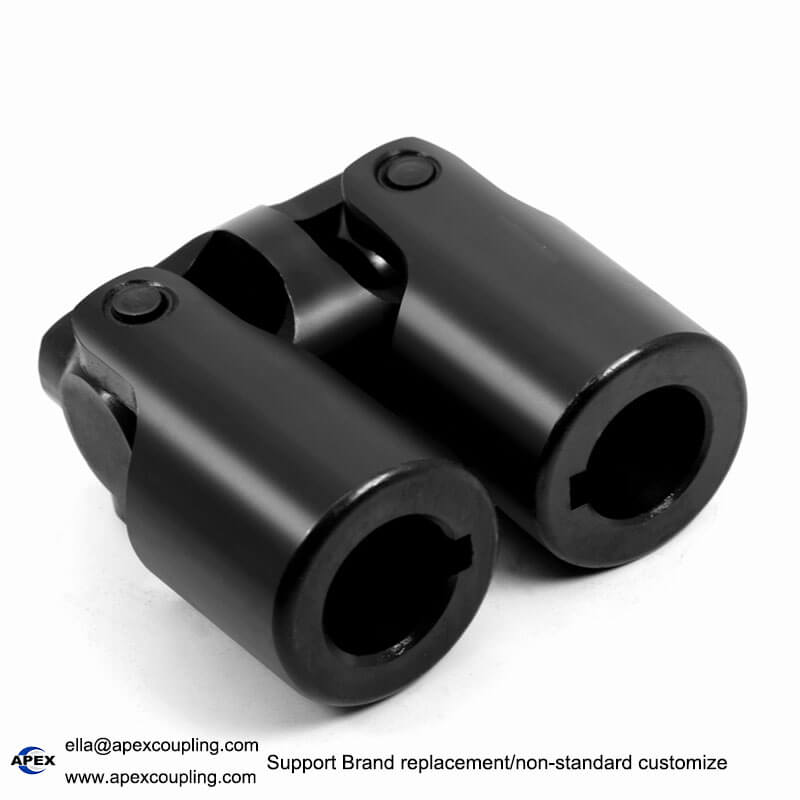
A double universal joint coupling uses two universal joint sections connected through an intermediate member. This creates two articulation points between the input and output shafts.
When the joint angles and phasing are correctly arranged, a double-joint system can reduce the output-speed variation associated with a single Cardan joint. Its performance depends on the geometry and configuration; the benefit should not be assumed without checking the design.
Double universal joint couplings are used where a more complex angular shaft connection or specific motion characteristics are required.
Single vs. Double Universal Joint: Main Differences
| Factor | Single Universal Joint | Double Universal Joint |
|---|---|---|
| Joint sections | One | Two |
| Articulation points | One | Two |
| Shaft arrangement | Suitable for simpler angular connections | Suitable for arrangements requiring two joint sections |
| Output-speed behavior | Instantaneous speed variation can occur at an operating angle | Variation can be reduced with suitable geometry and phasing |
| Installation | Generally fewer joint components | Requires correct arrangement of both joints |
| Selection considerations | Angle, torque, speed and fitment | Angle at each joint, phasing, torque, speed and fitment |
Neither configuration is automatically better for every application. The appropriate choice depends on the required performance and installation conditions.
When Should You Choose a Single Universal Joint?
A single joint may be appropriate when the shaft arrangement is straightforward and the resulting motion characteristics are acceptable.
Before choosing one, evaluate the working angle, operating speed, torque and the driven equipment’s sensitivity to speed variation. Check the manufacturer’s allowable operating range for the selected model.
When Should You Choose a Double Universal Joint?
A double-joint arrangement may be considered when the shaft layout requires two articulation points or when reducing the speed variation of a single Cardan joint is important.
The two joints must be arranged according to the intended geometry. Joint angles and phasing influence performance, so the design should be reviewed before installation.
Factors to Check Before Purchasing
Torque and Load
Check continuous torque, starting torque, shock loading and reversing duty. Select a model with an appropriate rating for the complete operating cycle.
Working Angle
Determine the angle at each joint, not only the overall angle between the input and output shafts. Compare the results with the manufacturer’s limits.
Rotational Speed
Confirm rated speed for the selected size and configuration. Do not assume that a double-joint design automatically supports higher speed.
Shaft Diameter and Length
Verify the bore diameters, connection type and overall length. Confirm keyway or set-screw dimensions where applicable.
Installation and Maintenance
Consider the available installation space, alignment, lubrication and inspection requirements. Correct assembly is especially important when the application depends on the kinematic behavior of a double-joint arrangement.
Precision Double Universal Joint Couplings from Apex Coupling
Apex Coupling offers precision universal joint couplings in single and double configurations for industrial transmission applications.
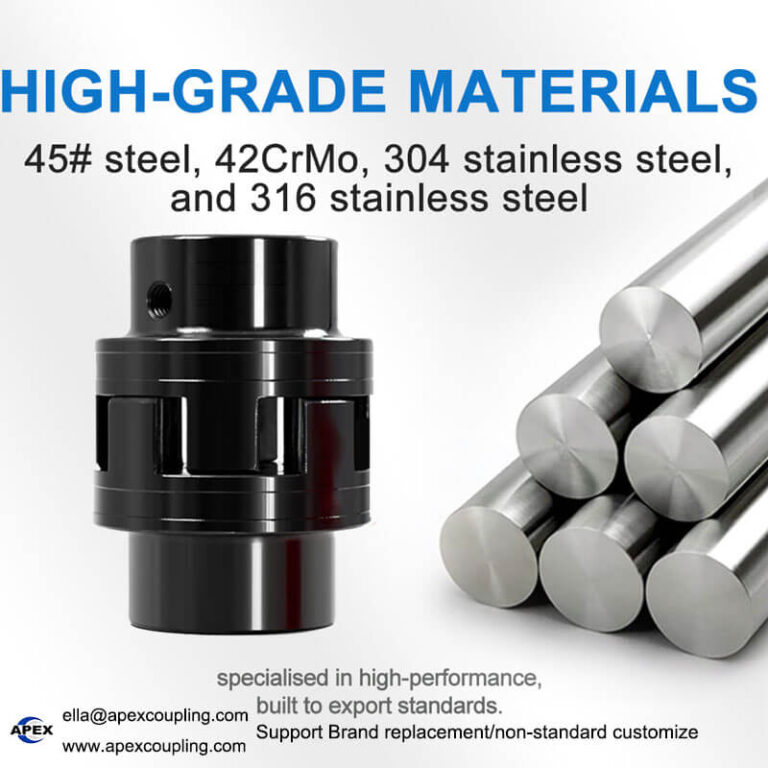
The listed product series includes multiple bore sizes and lengths, H7 finished-bore options, and keyway or set-screw mounting configurations. Selected models are specified in 42CrMo alloy steel with a pin-and-block joint structure.
For product selection, provide the shaft dimensions, torque, operating speed, required joint angles and installation drawing if available.
Contact Apex Coupling for model confirmation and a quotation.
Email: ella@apexcoupling.com
WhatsApp: +86 13437856962
Frequently Asked Questions
Is a double universal joint always better than a single joint?
No. The best configuration depends on shaft geometry, torque, speed, working angle and the motion requirements of the equipment.
Does a double universal joint produce constant output speed?
It can reduce speed variation when the joint angles and phasing are appropriately arranged. Constant-speed behavior should not be assumed for every double-joint assembly.
Can I replace a single universal joint with a double universal joint?
Not without checking the installation. A double-joint assembly may require different overall length, mounting dimensions, joint angles and support arrangements.
What information is needed to select a coupling?
Provide shaft diameters, torque, speed, working angle, overall length, mounting type and the application details.
Can the coupling be made to a custom length?
Selected configurations may be customized. Confirm the required length, bore dimensions and mounting details with the manufacturer.