What Is a Double Universal Joint Coupling? Design, Working Principle and Applications
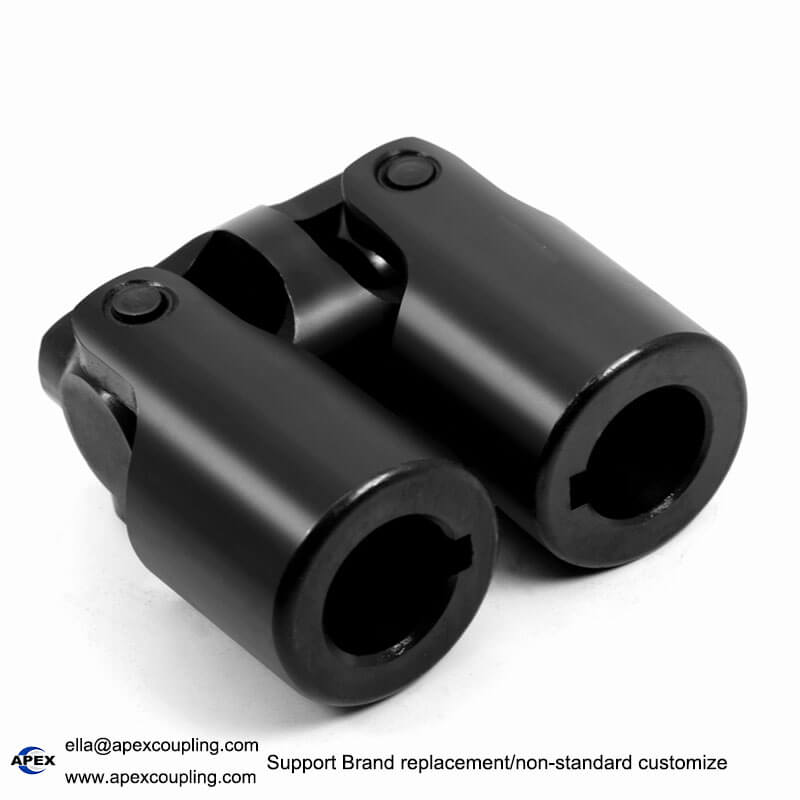
A double universal joint coupling is a mechanical transmission component that uses two universal joint sections to transfer torque between shafts operating at an angle. It is used in industrial machinery where the connected shafts cannot be arranged in a single straight line.
Compared with a single universal joint, a double-joint arrangement provides additional flexibility in shaft layout. When correctly designed and phased, it can also reduce the output-speed variation associated with a single Cardan joint. The actual performance depends on the joint angles, shaft geometry and assembly configuration.
What Is a Double Universal Joint Coupling?
A universal joint connects two rotating shafts whose centerlines operate at an angle. A double universal joint coupling incorporates two joint sections connected by an intermediate shaft or member.
This arrangement allows torque to pass through two articulation points. It is useful in machinery where angular movement is required between the driving and driven components.
The term “double universal joint” describes the joint arrangement, but not every design has identical dimensions, bearing structures, allowable angles or performance ratings. Always refer to the manufacturer’s drawing for the exact model.
How Does a Double Universal Joint Coupling Work?
The first universal joint receives torque from the input shaft and transfers it to the intermediate member. The second joint then transmits torque to the output shaft.
Each joint accommodates angular movement within its design limits. In a properly configured double Cardan arrangement, suitable joint phasing and geometry can help compensate for the speed variation produced by the first joint.
However, this compensation is not automatic in every assembly. The working angles, joint phasing and alignment must match the intended design.
For this reason, selecting a double universal joint coupling requires more than checking the maximum angle stated in a product listing.
Double Universal Joint vs. Single Universal Joint
A single universal joint has one articulation point and may be suitable for applications with a relatively simple angular shaft connection.
A double universal joint arrangement has two articulation points. It can accommodate a more complex shaft layout and, under the appropriate geometry, can reduce output-speed variation.
The right choice depends on the application. Consider the shaft angles, required speed, torque, available space and the machine’s motion requirements before selecting a configuration.
Key Benefits
Flexible Shaft Arrangement
The joint arrangement allows power transmission between angled shafts, helping engineers accommodate space constraints and machine geometry.
Multiple Size Options
Universal joint couplings are available in different dimensions to match shaft diameters and installation requirements.
Custom Mounting Configurations
Depending on the model, bore sizes, keyways, set-screw connections and other mounting details may be customized.
Suitability for Industrial Equipment
Double universal joint couplings can be considered for motor-driven equipment, packaging machinery, textile machinery and other mechanical transmission systems where angular articulation is required.
How to Select a Double Universal Joint Coupling
Confirm Shaft Dimensions
Measure both shaft diameters and determine the required overall length. Check the bore tolerance, keyway and set-screw requirements against the technical drawing.
Calculate Torque
Include continuous torque, starting loads, acceleration and shock loads. The selected coupling must meet the requirements for the actual duty cycle.
Check Working Angle
Determine the angle at each joint and compare it with the manufacturer’s permitted operating range. Do not assume that a stated maximum articulation angle is appropriate for continuous operation.
Verify Speed
Confirm the rated speed for the exact model. Speed suitability depends on the joint construction, balance, load, lubrication and working angle.
Review the Installation
Ensure that the coupling fits the available space and that the shafts can be aligned and mounted according to the manufacturer’s instructions.
Apex Coupling Double Universal Joint Coupling
Apex Coupling offers precision universal joint couplings in single and double configurations, with selected sizes using 42CrMo alloy steel and pin-and-block joint construction.
Available configurations include different bore diameters, overall lengths, H7 finished bores and keyway or set-screw mounting options. Custom dimensions may be discussed according to technical feasibility.
To confirm a suitable model, provide your shaft diameters, installation length, torque, operating speed and working angle.
Request product information or a quotation from Apex Coupling.
Email: ella@apexcoupling.com
WhatsApp: +86 13437856962
Frequently Asked Questions
What is the purpose of a double universal joint coupling?
It transmits torque between angled shafts using two universal joint sections. Depending on the geometry, the arrangement can also help reduce output-speed variation.
Does a double universal joint eliminate all speed variation?
Not automatically. Speed variation depends on the joint angles, phasing and assembly geometry. Correct design and installation are essential.
How do I select the right size?
Confirm the bore diameters, overall length, torque, speed, working angle and mounting configuration. Use the manufacturer’s model-specific technical drawing.
Can a double universal joint coupling be customized?
Selected models may support custom lengths, bore configurations, keyways and other mounting requirements, subject to technical feasibility.
Is a double universal joint suitable for every angular transmission application?
No. Suitability depends on the allowable angle, torque, speed, shaft arrangement and other operating conditions. Check the exact model specifications before use.
Inquiry now:
ella@apexcoupling.com
steel vs cast iron jaw coupling, rotex spider hardness guide, flexible coupling for motor, elastic coupling maintenance.