

CONTACT US
INQUIRY US
Apex Coupling, Our Core Expertise: Customization and Quality.
Your One-Stop Custom Coupling Manufacturer
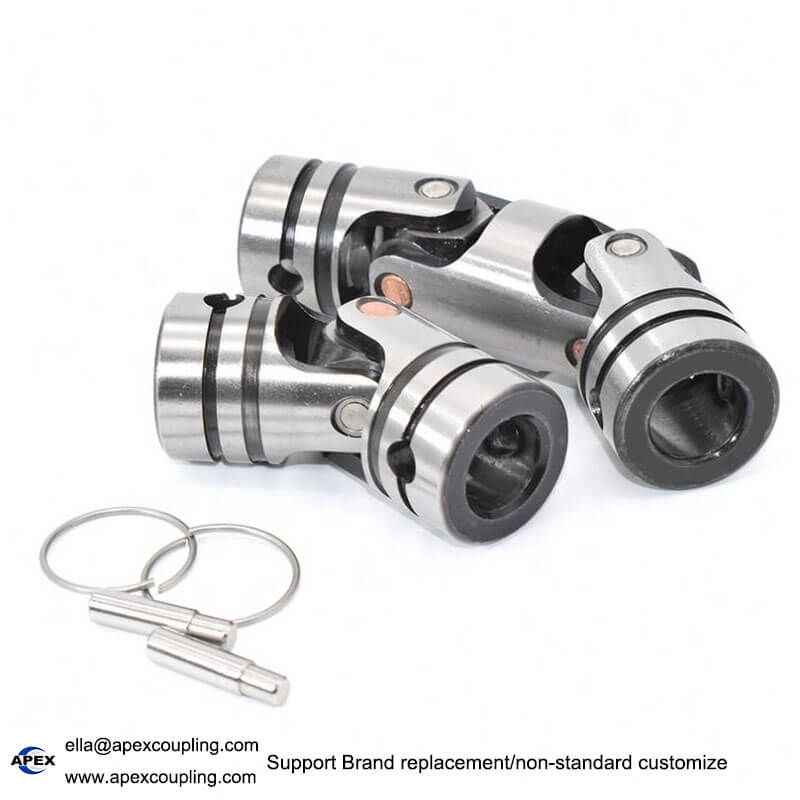
Bearing configuration can significantly affect the operating characteristics of an industrial universal joint.
Two common configurations are needle-bearing universal joints and pin-and-block universal joints.
Choosing between them depends on speed, load, operating angle, lubrication, and application requirements.
A needle bearing universal joint uses small-diameter cylindrical rollers arranged within the bearing assembly.
The rolling elements can reduce friction and are particularly suitable for applications requiring relatively high rotational speed.
Apex needle-bearing universal joints can be configured for applications requiring speeds of up to approximately 4000 RPM, depending on model and operating conditions.
Pin-and-block configurations use mechanical pins and blocks to transmit torque through the joint.
They are commonly used for applications where robust mechanical transmission is more important than very high rotational speed.
These configurations can be suitable for lower-speed industrial machinery.
| Feature | Needle Bearing | Pin & Block |
|---|---|---|
| Rotational Speed | Higher | Lower |
| Friction | Generally lower | Generally higher |
| High-Speed Application | More suitable | Less suitable |
| Mechanical Robustness | High | High |
| Maintenance | Application dependent | Application dependent |
| Typical Use | Precision / higher speed | Heavy-duty / lower speed |
Choose a needle bearing universal joint when:
Consider a pin-and-block universal joint when:
Do not select a universal joint based on RPM alone.
You should also consider:
For example, a joint that can reach a high RPM under a certain configuration may have a different allowable speed when operated at a larger angle or higher torque.
Apex supplies G/GD universal joints with different bearing configurations.
Needle-bearing configurations are available for selected high-speed applications, while pin-and-block designs can be used for lower-speed transmission requirements.
For product specifications and customization, see the [Apex U Joints product page].
Apex Coupling, Our Core Expertise: Customization and Quality.
Your One-Stop Custom Coupling Manufacturer