When Should You Replace a Coupling Spider? 8 Signs of Wear SEO Title
When Should You Replace a Coupling Spider? 8 Signs of Wear
A flexible jaw coupling spider is a wear component.
Although polyurethane elastomers can provide long service life under suitable conditions, the spider will eventually deteriorate because of repeated torque, vibration, temperature and environmental exposure.
Knowing when to perform coupling spider replacement can help prevent unexpected downtime and additional equipment damage.
Here are eight common signs that a coupling spider should be inspected or replaced.
1. Visible Cracks
Cracking is one of the clearest signs of elastomer deterioration.
Inspect the spider for:
- Radial cracks
- Surface cracks
- Splitting
- Broken sections
- Cracks around the jaws
If significant cracking is present, replacement should be considered.
2. Excessive Wear
The coupling spider may gradually lose material through repeated mechanical loading.
Signs include:
- Worn jaw contact areas
- Reduced material thickness
- Rounded contact surfaces
- Missing elastomer material
Excessive wear can increase backlash and affect torque transmission.
3. Permanent Deformation
A healthy flexible element should maintain its designed geometry.
Permanent deformation may indicate:
- Excessive torque
- Excessive temperature
- Incorrect hardness
- Overloading
- Long-term fatigue
A deformed spider should be inspected before continued operation.
4. Increased Coupling Backlash
Backlash can increase as the spider wears.
If the equipment develops noticeably more rotational play than normal, inspect the flexible element and coupling hubs.
A worn spider may allow excessive movement between the two hubs.
5. Increased Vibration
A damaged or deteriorated elastomer may no longer provide the intended damping characteristics.
Unexpected vibration can result from several causes, so the entire drive system should be inspected.
Possible sources include:
- Worn spider
- Shaft misalignment
- Damaged bearings
- Unbalanced equipment
- Loose mounting
The spider should therefore be inspected as part of the overall troubleshooting process.
6. Abnormal Coupling Noise
A flexible jaw coupling normally operates with limited mechanical noise.
Unusual clicking, knocking or rattling may indicate excessive clearance or damaged elastomer.
If abnormal noise develops, inspect the coupling before continued operation.
7. Hardened or Deteriorated Elastomer
The spider may change properties over time.
Depending on the material and environment, the elastomer may become:
- Hard
- Brittle
- Soft
- Swollen
- Discolored
- Cracked
Temperature, chemicals, oil exposure and aging can all influence elastomer performance.
8. Visible Jaw Contact Damage
The metal coupling hubs should also be inspected when replacing a spider.
Check for:
- Worn jaws
- Deformation
- Cracks
- Corrosion
- Excessive clearance
Replacing only the spider may not solve the problem if the coupling hubs are already significantly damaged.
How Often Should a Coupling Spider Be Replaced?
There is no universal replacement interval for every application.
Service life depends on:
- Torque
- Speed
- Operating temperature
- Misalignment
- Duty cycle
- Material
- Hardness
- Environment
- Installation quality
Instead of replacing the spider purely according to calendar time, regular inspection can help identify deterioration before failure.
How to Replace a Coupling Spider
A typical replacement procedure includes:
Step 1: Shut Down the Equipment
Always follow the equipment manufacturer’s safety procedures before working on the coupling.
Step 2: Inspect the Coupling
Check the hubs and shaft connections.
Step 3: Remove the Worn Spider
Remove the damaged elastomer from between the coupling jaws.
Step 4: Inspect the Hubs
Check for wear, cracks and deformation.
Step 5: Install the Correct Replacement
Install the correctly sized coupling spider.
Step 6: Check Alignment
Verify shaft alignment according to the coupling manufacturer’s requirements.
Step 7: Test the Equipment
After installation, operate the equipment under controlled conditions and check for abnormal vibration or noise.
Choosing a Replacement Coupling Spider
When ordering a replacement, provide:
- Coupling model
- Coupling size
- Spider dimensions
- Material
- Hardness
- Operating torque
- Operating speed
- Temperature
- Quantity
If you are unsure about the exact model, photographs and dimensions can help identify the required replacement.
ROTEX and GR Coupling Spider Replacement
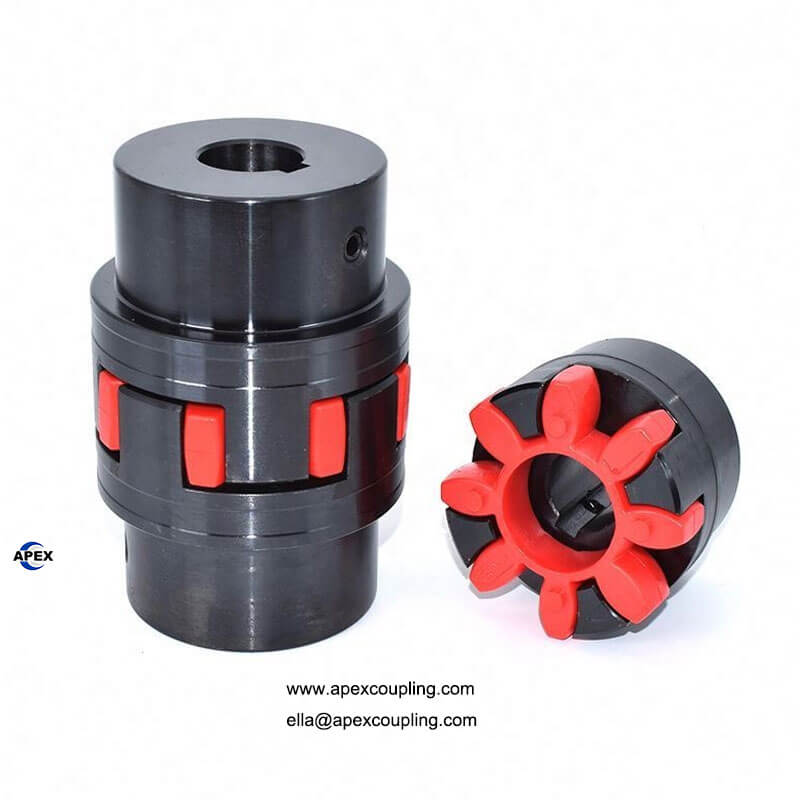
Apex Coupling manufactures polyurethane ROTEX-type and GR-compatible coupling spiders for flexible jaw coupling applications.
The available range includes:
ROTEX 14, 19, 24, 28, 38, 42, 48, 55, 65, 75, 90, 100, 110, 125, 140, 160 and 180.
For applications requiring a firm polyurethane elastomer, 98 Shore A PU coupling spiders are available.
Use the following internal link:
ROTEX coupling spider replacement → Main product page
Conclusion
A coupling spider should be inspected whenever cracks, wear, deformation, increased backlash, vibration or abnormal noise appears.
Replacing a worn elastomer can help restore the intended performance of a flexible jaw coupling, provided that the coupling hubs and shaft connections are also in good condition.
Apex Coupling supplies 98 Shore A PU ROTEX-type / GR-compatible coupling spiders in multiple sizes and supports OEM and custom production.
Contact us with your coupling size or photos for replacement spider identification and quotation.
Inquiry now:
ella@apexcoupling.com
steel vs cast iron jaw coupling, rotex spider hardness guide, flexible coupling for motor, elastic coupling maintenance.