Anti-Static V-Belt Selection Guide – Oil-Resistant Toothed Transmission Belts
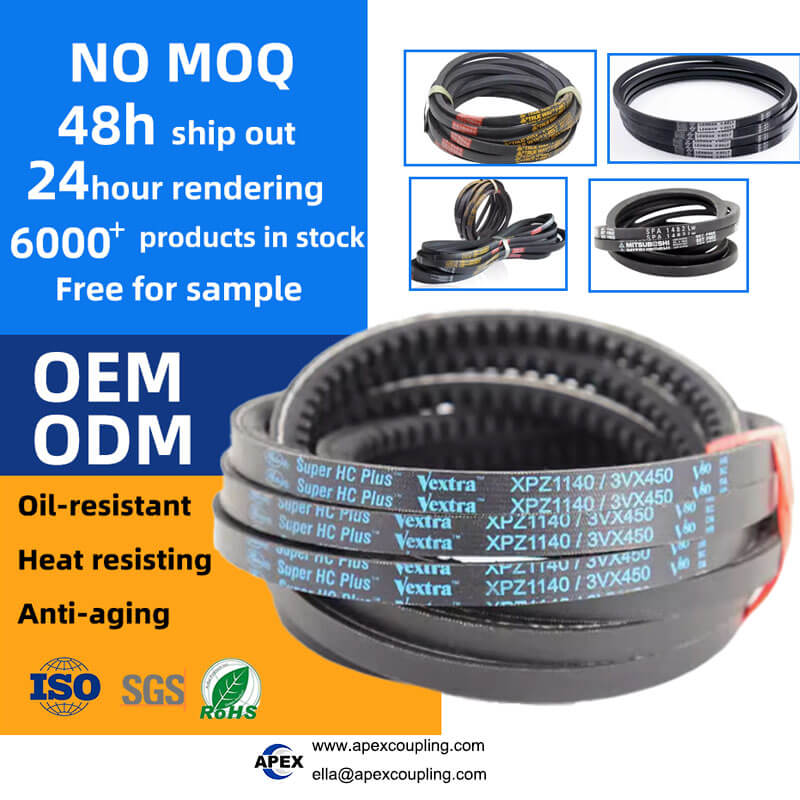
Anti-static V-belts (also known as static-conductive or oil-resistant V-belts) are essential components in industrial power transmission applications where static electricity buildup poses a safety risk or can damage sensitive equipment. With ISO 1813 certification, oil and heat resistance, and toothed/cogged designs, these belts deliver reliable, long-lasting performance in demanding environments.
This guide explains how anti-static V-belts work, their key advantages, and how to select the right belt for your application.
1. What Is an Anti-Static V-Belt?
An anti-static V-belt is a toothed transmission belt designed to safely dissipate static electricity buildup during operation. Key characteristics include:
Static-conductive compound – safely dissipates static electricity
Oil and heat resistance – withstands harsh industrial environments
Toothed/cogged design – superior flexibility, reduced heat buildup
High-strength tensile cords – polyester or aramid for low stretch and dimensional stability
Fabric cover – protects belt core from oil, dirt, and heat
2. Why Anti-Static Matters
Static electricity buildup in V-belts can cause:
Spark hazards – risk of ignition in explosive environments
Equipment damage – static discharge can harm sensitive electronics
Operator safety risks – static shocks to personnel
Product contamination – static attraction of dust and debris
✅ Anti-static V-belts meeting ISO 1813 standards safely dissipate static electricity, preventing these hazards.
3. Oil & Heat Resistance – Why It Matters
Industrial V-belts are often exposed to:
Oil and grease – from machinery lubrication
High temperatures – from friction and ambient heat
Ozone and weathering – from outdoor or industrial environments
✅ Oil and heat-resistant V-belts meeting ARPM/RMA IP-3-2 standards provide extended service life in these harsh conditions.
4. Toothed vs Classical V-Belts – Why Choose Toothed?
| Feature | Toothed / Cogged V-Belt | Classical (Smooth) V-Belt |
|---|---|---|
| Flexibility | ✅ Superior – bends around small pulleys | Moderate |
| Heat Buildup | ✅ Lower – notches dissipate heat | Higher |
| Noise | ✅ Quieter operation | Standard |
| Speed Capability | ✅ Higher – suitable for high-speed drives | Lower |
| Best for | Small pulleys, high-speed, demanding drives | Standard drives, larger pulleys |
✅ Choose toothed/cogged V-belts for applications requiring flexibility, high speed, and operation on small diameter pulleys.
5. How to Select the Right Anti-Static V-Belt
Step 1: Determine Required Length
Measure the center distance of your pulleys and the required belt wrap.
Open-ended belts can be cut to any length.
Step 2: Determine Required Width
Width determines load capacity – wider belts handle higher loads.
Standard widths available; custom widths on request.
Step 3: Consider Operating Environment
Oil exposure: Choose oil-resistant compound.
Temperature: Standard -30°C to +70°C; high-temp options available.
Static risk: Choose anti-static (ISO 1813) for safety and equipment protection.
Step 4: Determine Tooth Profile
Toothed/cogged: For flexibility, small pulleys, high-speed drives.
Classical (smooth): For standard drives, larger pulleys.
Step 5: Consider OEM Customization
Custom length, width, profiles, and surface treatments available.
6. Applications Where Anti-Static V-Belts Excel
| Industry | Application | Why Anti-Static? |
|---|---|---|
| Conveyor Systems | Material handling, packaging lines | Static buildup from friction, oil exposure |
| Printing Equipment | Paper feed, register control | Static can attract dust, affect print quality |
| Packaging Machinery | Wrapping, sealing, labeling | Static sparks in explosive environments |
| Agricultural Machinery | Farm equipment, harvesters | Dusty environments, static hazards |
| Compressors & Pumps | Air compressors, vacuum pumps | Oil exposure, heat buildup |
| Machine Tools | CNC, grinders, saws | Oil and coolant exposure |
| Textile Machinery | Spinning, weaving | Static attraction of fibers, dust |
7. Real‑World Example – Conveyor System Upgrade
A packaging facility was experiencing static discharge issues on their conveyor systems, causing product contamination and equipment interference. The belts also degraded quickly due to oil exposure from machinery lubrication.
They switched to Apex Coupling anti-static oil-resistant V-belts (ISO 1813, toothed design, oil-resistant compound). Results:
Static issues eliminated – ISO 1813 anti-static compound
Belt life extended – oil and heat-resistant construction
Flexibility improved – toothed design allowed smaller pulleys
Downtime reduced – longer service life
Safety improved – static hazards eliminated
8. Installation & Maintenance Tips
Measure accurately – Ensure the required belt length is measured correctly.
Clean pulleys – Remove debris from pulleys before installation.
Proper tension – Tension according to manufacturer’s recommendations.
Alignment – Ensure pulleys are properly aligned to prevent tracking issues.
No lubrication required – V-belts operate dry.
Inspect regularly – Check for wear, cracks, or damage.
Keep clean – Remove dust and debris to prevent premature wear.
9. Selection Checklist
- □
Anti-static: ISO 1813 certified – for static safety
- □
Oil & heat resistance: ARPM/RMA IP-3-2 – for harsh environments
- □
Toothed/cogged design: For flexibility, small pulleys
- □
Length: Measure your required length
- □
Width: Match your load requirements
- □
Temperature: -30°C to +70°C – verify operating range
- □
Material: Premium rubber/EPDM – oil, heat, ozone resistant
- □
Tensile cord: Polyester or aramid – high strength, low stretch
- □
Certifications: REACH and RoHS 2 compliant
10. Conclusion
The anti-static oil-resistant V-belt from Apex Coupling offers the perfect combination of static safety, oil and heat resistance, and superior flexibility for demanding industrial applications. With ISO 1813 certification, toothed/cogged design, and OEM customization, it is the ideal solution for conveyors, packaging machinery, printing equipment, agricultural machinery, compressors, and general industrial drives.
👉 Need an anti-static V-belt for your application? Contact us with your length, width, and customization requirements.
Inquiry now:
ella@apexcoupling.com
anti-static V-belt selection guide
oil-resistant V-belt guide
toothed transmission belt selection
ISO 1813 V-belt guide
industrial V-belt selection
OEM V-belt guide