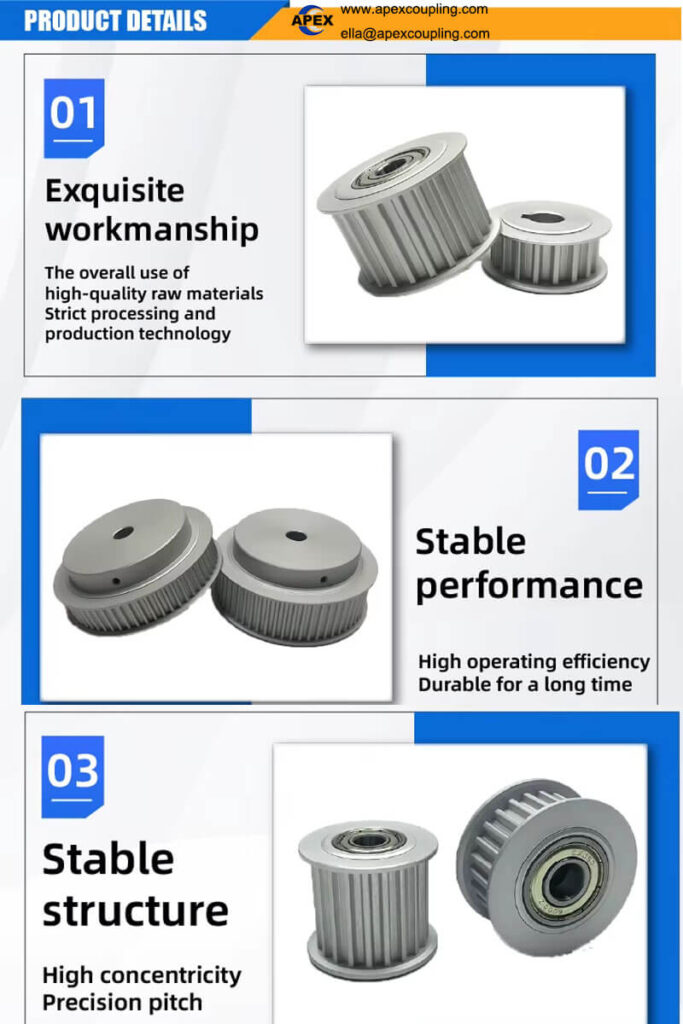
Steel Timing Pulley Selection Guide – HTD/RPP/8YU/AT/T/XL/L/H/XH/XXH Series
Steel timing pulleys (synchronous pulleys) are essential components in precision power transmission and conveying systems. With taper lock mounting for quick installation and a wide range of pitch profiles, they offer reliable, slip-free synchronous transmission for demanding industrial applications.
This guide explains how steel timing pulleys work, the differences between pitch profiles, taper lock advantages, and how to select the right pulley for your application.
1. What Is a Steel Timing Pulley?
A steel timing pulley (synchronous pulley) is a toothed wheel that engages with a timing belt to provide accurate, slip-free power transmission. Key characteristics include:
Toothed profile – mates with timing belt teeth for positive engagement
Taper lock mounting – quick installation and easy removal [4†L5-L7]
Steel construction – high strength, durability, and wear resistance
Precision CNC hobbing – superior tooth accuracy and smooth operation [6†L25-L27]
H7 bore tolerance – precise shaft fit, concentricity ≤0.05mm
2. Pitch Profile Selection – HTD, RPP, 8YU, AT, T, XL, L, H, XH, XXH
| Pitch Code | Pitch (mm) | Tooth Profile | Load Capacity | Typical Applications |
|---|---|---|---|---|
| HTD 8M | 8 | Curvilinear | High | General industrial, conveyors, packaging [7†L7] |
| RPP8M | 8 | Curvilinear | High | High precision, automation, robotics [4†L8-L9] |
| 8YU | 8 | Curvilinear | High | Positioning, high-accuracy drives [3†L16-L17] |
| 3M / 5M | 3 / 5 | Curvilinear | Light-Medium | Light-duty conveying, small machinery |
| H | 12.7 | Trapezoidal | Medium-Heavy | Machine tools, printing [0†L18-L19] |
| XH | 22.225 | Trapezoidal | Heavy | Crushers, large machinery [0†L18-L19] |
| XXH | 31.75 | Trapezoidal | Extreme Heavy | Steel mills, mining [0†L18-L19] |
| L | 9.525 | Trapezoidal | Medium | General industrial conveying [0†L18-L19] |
| XL | 5.08 | Trapezoidal | Light | Light-duty conveying, office equipment [0†L18-L19] |
| T10 / AT10 | 10 | Trapezoidal | Medium-Heavy | Packaging, conveying, heavy load [0†L13-L14] |
| T20 / AT20 | 20 | Trapezoidal | Heavy | Heavy-duty conveying, large machinery [0†L13-L14] |
Selection tip:
Choose HTD 8M / RPP8M / 8YU for high-torque, precision applications.
Choose AT10 / T10 for general conveying and packaging.
Choose XL / L / H / XH / XXH for inch-based machinery and heavy-duty applications.
3. Taper Lock Mounting – Why Choose It?
The taper lock (taper bushing) mounting system is the preferred choice for industrial timing pulleys:
| Advantage | Benefit |
|---|---|
| Quick Installation | Simple bolt tightening – no special tools required [4†L5-L7] |
| Easy Removal | Remove bolts, tap release – no pullers needed [4†L5-L7] |
| Secure Fixation | Friction lock + keyway – positive torque transmission [4†L5-L7] |
| Axial Locking | Prevents shaft displacement [4†L5-L7] |
| Reusability | Multiple installations – reduces spare parts inventory |
| Concentricity | Precision taper fit – minimizes runout |
✅ Choose taper lock for applications requiring quick installation, frequent maintenance, and secure shaft fixation.
4. Material Selection – Steel, Stainless Steel, Cast Iron, Aluminum
| Material | Properties | Best For |
|---|---|---|
| 45# Steel (S45C) | High strength, good wear resistance, cost-effective [6†L20-L21] | General industrial, high torque |
| Stainless Steel (SUS304) | Corrosion-resistant, hygienic [6†L20-L21] | Food processing, chemical, marine [1†L24-L29] |
| Cast Iron | High damping, cost-effective [2†L8-L11] | Heavy-duty, vibration-prone applications |
| Aluminum Alloy | Lightweight, corrosion-resistant [6†L20-L21] | High-speed, low-inertia applications |
5. How to Select the Right Steel Timing Pulley
Step 1: Determine Pitch Profile
Calculate torque and load requirements.
Select the appropriate pitch (HTD 8M, RPP8M, 8YU, AT10, T10, XL, L, H, XH, XXH, etc.).
Step 2: Determine Number of Teeth
Calculate the required pitch diameter based on belt speed and center distance.
More teeth = larger diameter = higher torque capacity.
Step 3: Determine Belt Width
Standard belt widths: 15mm, 20mm, 25mm, 30mm, 50mm, 60mm, 85mm [3†L5-L6][7†L8-L9].
Wider belts handle higher loads.
Step 4: Determine Bore Diameter
Measure your shaft diameter.
H7 bore tolerance recommended for precision fit.
Step 5: Select Material
45# steel for general industrial.
Stainless steel for corrosion resistance.
Cast iron for heavy-duty, vibration damping.
Aluminum for high-speed, low-inertia.
Step 6: Select Surface Treatment
Black oxide – corrosion resistance, standard.
Anodized – aluminum only, enhanced corrosion resistance.
Nickel plating – corrosion resistance, bright finish [6†L19-L20].
6. Applications Where Steel Timing Pulleys Excel
| Industry | Application | Recommended Pitch |
|---|---|---|
| Conveyor Systems | Material handling, assembly lines [5†L21-L22] | HTD 8M, AT10, L |
| Packaging Machinery | Wrapping, sealing, labeling [5†L4-L7] | HTD 8M, T10, XL |
| Printing Equipment | Paper feed, register control [5†L4-L7] | HTD 8M, L, H |
| Textile Machinery | Spinning, weaving [5†L27-L28] | HTD 8M, L |
| Factory Automation | Robotics, pick-and-place [5†L16-L17] | RPP8M, 8YU |
| CNC Machines | Precision positioning [5†L17] | HTD 8M, H |
| Heavy Industry | Crushers, steel mills | XH, XXH, 20M |
7. Real‑World Example – Packaging Line Upgrade
A packaging machinery manufacturer was experiencing belt slippage and pulley wear on their high-speed labeling equipment. The existing pulleys had poor concentricity and required frequent replacement.
They switched to Apex Coupling steel timing pulleys (HTD 8M, taper lock, 45# steel, black oxide). Results:
Slippage eliminated – accurate synchronous transmission
Wear reduced – precision CNC hobbing, H7 bore
Maintenance simplified – taper lock mounting, easy removal
Service life extended – high-quality 45# steel
Cost savings – reduced downtime and replacement frequency
8. Installation & Maintenance Tips
Clean shaft – Remove oil, grease, and debris before installation.
Insert taper bushing – Place the bushing on the shaft.
Mount pulley – Slide the pulley onto the bushing.
Tighten bolts – Tighten mounting bolts evenly to the specified torque [4†L5-L7].
Check alignment – Ensure pulleys are properly aligned to prevent belt tracking issues.
No lubrication required – Timing pulleys operate dry.
Inspect regularly – Check for wear, cracks, or damage on teeth.
For removal – Loosen bolts, use removal holes to release the bushing [4†L5-L7].
9. Selection Checklist
- □
Pitch profile: HTD 8M, RPP8M, 8YU, 3M, 5M, H, XH, XXH, L, XL, T10, AT10, T20, AT20, 20M
- □
Number of teeth: Based on required pitch diameter
- □
Belt width: 15, 20, 25, 30, 50, 60, 85mm or custom
- □
Bore diameter: Match your shaft (H7 tolerance)
- □
Material: 45# steel, stainless steel, cast iron, aluminum
- □
Surface treatment: Black oxide, anodized, nickel plating
- □
Mounting: Taper lock – quick installation, easy removal [4†L5-L7]
- □
Application: Conveying, packaging, printing, automation, heavy industry
10. Conclusion
The steel timing pulley with taper lock mounting from Apex Coupling offers the perfect combination of precision, durability, and ease of installation for demanding industrial applications. With HTD 8M to XXH pitch profiles, multiple material options, H7 bore tolerance, and OEM customization, it is the ideal solution for conveyor systems, packaging machinery, printing equipment, factory automation, and heavy industry.
👉 Need a steel timing pulley for your application? Contact us with your pitch profile, teeth, width, bore, and material requirements.
Inquiry now:
ella@apexcoupling.com
steel timing pulley selection guide
taper lock timing pulley guide
HTD 8M pulley guide
RPP8M timing pulley selection
8YU timing pulley
timing pulley with taper bushing
OEM timing pulley guide