Rubber Timing Belt Selection Guide – MXL, L, H, XH, XXH Pitches for Industrial Applications
Rubber timing belts are essential components in industrial power transmission and conveying systems. With their excellent heat resistance, impact absorption, and cost-effectiveness, they are the preferred choice for a wide range of applications. Available in MXL, XL, L, H, XH, and XXH pitch profiles per ANSI/RMA standards, rubber timing belts offer reliable, slip-free synchronous transmission.
This guide explains how rubber timing belts work, the differences between pitch profiles, rubber vs PU selection, and how to choose the right belt for your application.
1. What Is a Rubber Timing Belt?
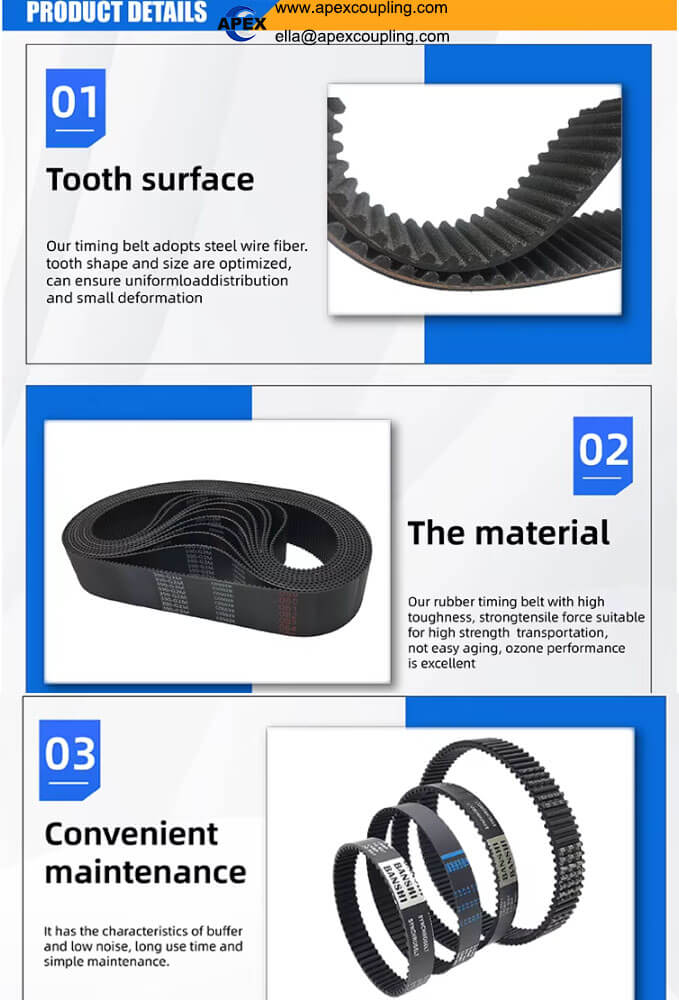
A rubber timing belt is a toothed synchronous belt made of premium rubber with embedded fiberglass tension cords. It provides accurate, slip-free synchronous transmission with constant rotation rate during operation.
Key characteristics include:
Toothed profile – mates with timing belt pulleys for positive engagement
Fiberglass tension cord – provides tensile strength and dimensional stability
Rubber body – offers excellent heat resistance, impact resistance, and hydrolysis resistance
Open-ended or endless – customizable length for any application
2. Pitch Profile Selection – MXL, XL, L, H, XH, XXH
The pitch code indicates the belt’s tooth spacing and load capacity:
| Pitch Code | Pitch (inch) | Pitch (mm) | Load Capacity | Typical Applications |
|---|---|---|---|---|
| MXL | 0.080″ | 2.032 | Lightest | Miniature drives, small instrumentation |
| XL | 0.200″ | 5.080 | Light | Light-duty conveying, office equipment |
| L | 0.375″ | 9.525 | Medium | General industrial conveying |
| H | 0.500″ | 12.70 | Medium-Heavy | Machine tools, printing equipment |
| XH | 0.875″ | 22.225 | Heavy | Crushers, large machinery |
| XXH | 1.250″ | 31.750 | Extreme Heavy | Steel mills, mining equipment |
💡 Selection tip: Choose smaller pitches (MXL, XL) for light-duty, precision applications. Choose larger pitches (XH, XXH) for heavy-duty, high-torque applications.
3. Rubber vs Polyurethane Timing Belts – Which One Do You Need?
| Feature | Rubber Timing Belt | Polyurethane Timing Belt |
|---|---|---|
| Heat Resistance | ✅ Superior | Moderate |
| Impact Resistance | ✅ Superior | Moderate |
| Hydrolysis Resistance | ✅ Superior | Moderate |
| Quietness | ✅ Superior | Moderate |
| Cost | ✅ More economical | Higher |
| Wear Resistance | Good | ✅ Superior (8x more) |
| Oil Resistance | Good | ✅ Superior |
| Precision | Good | ✅ Superior |
| Dust Generation | May shed powder | ✅ No dust |
Selection guide:
Choose rubber for applications requiring heat resistance, impact resistance, quiet operation, and cost-effectiveness – ideal for welding, painting, general conveying, and heavy-duty industrial environments.
Choose polyurethane for high-precision, oil-exposed, clean-room, or high-wear applications.
4. Belt Construction – What Makes a Quality Rubber Timing Belt?
| Component | Material | Function |
|---|---|---|
| Body | Premium rubber | Provides heat resistance, impact resistance, flexibility |
| Tension Cord | Fiberglass | Provides tensile strength, dimensional stability, zero stretch |
| Tooth Surface | Fabric (optional) | Reduces friction and noise |
| Surface | Smooth or rough | Customizable for specific conveying requirements |
5. How to Select the Right Rubber Timing Belt
Step 1: Determine Required Pitch Profile
Calculate the torque and load requirements.
Select the appropriate pitch: MXL (light), XL (light), L (medium), H (medium-heavy), XH (heavy), XXH (extreme heavy).
Step 2: Determine Belt Width
Wider belts handle higher loads.
Standard widths available; custom widths on request.
Step 3: Determine Belt Length
Open-ended belts can be cut to any length (1000-20000mm).
Measure the center distance of your pulleys and required belt wrap.
Step 4: Consider Environmental Factors
Temperature: Rubber handles heat better than PU.
Impact: Rubber provides superior shock absorption.
Oil exposure: PU is superior for oil resistance.
Cleanliness: PU generates no dust; rubber may shed powder.
Step 5: Consider Customization
OEM custom length, width, surface treatment, and coatings available.
6. Applications Where Rubber Timing Belts Excel
| Industry | Application | Recommended Pitch |
|---|---|---|
| Conveying Systems | Material handling, assembly lines | L, H |
| Packaging Machinery | Wrapping, sealing, labeling | XL, L |
| Printing Equipment | Paper feed, register control | L, H |
| Textile Machinery | Spinning, weaving | L, H |
| Heavy Industry | Crushers, steel mills | XH, XXH |
| Machine Tools | CNC, milling machines | H |
| Agricultural Machinery | Farm equipment, harvesters | L, H |
| Advertising Equipment | Signage, labeling | MXL, XL |
7. Real‑World Example – Conveyor System Upgrade
A manufacturing plant was experiencing belt stretch and premature failure with standard conveyor belts in a high-temperature environment. The belts were exposed to heat up to 80°C, causing degradation and frequent replacements.
They switched to Apex Coupling rubber timing belts (L pitch, fiberglass cord, heat-resistant rubber). Results:
Heat degradation eliminated – rubber withstood high temperatures
Belt stretch eliminated – fiberglass cord provided dimensional stability
Service life extended – improved heat and impact resistance
Noise reduced – rubber belts offered quieter operation
Cost savings – more economical than polyurethane alternatives
8. Installation & Maintenance Tips
Measure accurately – Ensure the required belt length is measured correctly
Clean pulleys – Remove debris from pulleys before installation
Proper tension – Tension according to manufacturer’s recommendations
Alignment – Ensure pulleys are properly aligned to prevent tracking issues
No lubrication required – Timing belts are self-lubricating
Inspect regularly – Check for wear, cracks, or damage
Keep clean – Remove dust and debris to prevent premature wear
9. Selection Checklist
- □
Pitch profile: MXL, XL, L, H, XH, XXH – match your load requirements
- □
Width: Custom – match your application
- □
Length: 1000-20000mm – measure your required length
- □
Material: Rubber – for heat, impact, and quiet operation
- □
Tension member: Fiberglass cord – high tensile strength, zero stretch
- □
Surface: Smooth or rough – specify if required
- □
Customization: OEM length, width, coating – specify if required
- □
Application: Conveying, packaging, printing, heavy industry, automation
10. Conclusion
The industrial rubber timing belt from Apex Coupling offers the perfect combination of heat resistance, impact absorption, quiet operation, and cost-effectiveness for a wide range of industrial applications. With MXL to XXH pitch profiles, fiberglass tension cords, and OEM customization, it is the ideal solution for conveying systems, packaging machinery, printing equipment, and heavy industry.
👉 Need a rubber timing belt for your application? Contact us with your pitch profile, width, length, and customization requirements.
Inquiry now:
ella@apexcoupling.com
rubber timing belt selection guide
MXL XL L H XH XXH timing belt guide
industrial timing belt selection
rubber vs polyurethane timing belt
conveyor timing belt guide
OEM timing belt selection