Elastic Sleeve Pin Coupling Selection Guide – LT Series for Pumps & Reducers
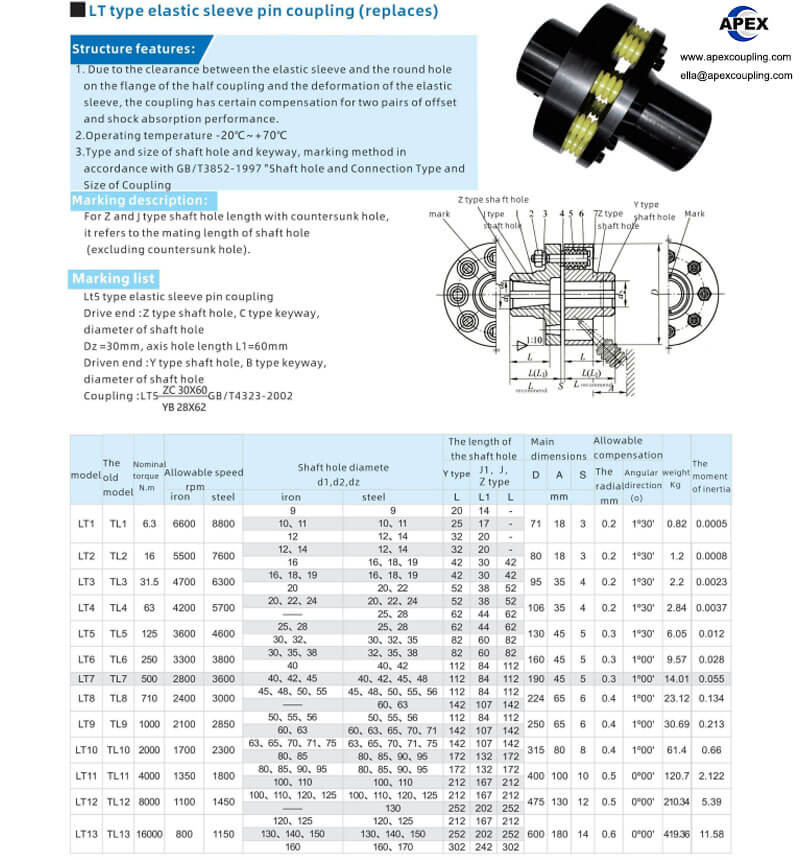
Elastic sleeve pin couplings (also known as pin couplings or LT/TL couplings) are among the most widely used flexible couplings for medium-power transmission applications. With a simple two-flange and pin design, they offer reliable power transmission, moderate vibration damping, and maintenance-free operation – all at a cost-effective price point.
This guide explains how elastic sleeve pin couplings work, their key advantages, and how to select the right LT model for your application.
1. What Is an Elastic Sleeve Pin Coupling?
An elastic sleeve pin coupling consists of:
Two flanged hubs – precision-machined from 45# steel
Steel pins – that transmit torque between the hubs
Rubber elastic sleeves – fitted over the pins for vibration damping
Torque is transmitted from the driving hub through the steel pins to the driven hub. The rubber elastic sleeves deform to absorb shock, dampen vibration, and compensate for misalignment. This simple design requires no lubrication and allows for easy sleeve replacement without axial movement of the connected shafts .
💡 The LT Type coupling is manufactured to GB/T4323-2002 and is also known as the TL Type under the older GB4323-1984 standard .
2. Key Advantages of LT Type Couplings
| Advantage | Benefit |
|---|---|
| Simple, Compact Design | Easy to install, lightweight, small size |
| Maintenance-Free | No lubrication required – reduces operating costs |
| Easy Sleeve Replacement | Replace sleeves without axial shaft movement – reduces downtime |
| Cost-Effective | Economical solution for medium-power applications |
| Moderate Misalignment Compensation | Accommodates angular, radial, and axial misalignment |
| Moderate Vibration Damping | Rubber sleeves absorb shock and reduce vibration |
| Wide Torque Range | 6.3-16000 N·m – covers light to heavy-duty applications |
| Standardized Design | GB/T4323-2002 – quality assured and widely available |
3. LT vs TL – Understanding the Naming
| Designation | Standard | Status |
|---|---|---|
| TL | GB4323-1984 | Original designation – obsolete |
| LT | GB/T4323-2002 | Current designation – replaces TL |
💡 LT and TL refer to the same coupling design. LT is the current standard designation under GB/T4323-2002 .
4. How to Select the Right LT Model
Step 1: Determine Your Torque Requirement
Calculate the torque your application requires.
Select a model with nominal torque ≥ 1.5× your requirement.
LT series covers 6.3–16000 N·m.
Step 2: Match Shaft Diameters
Measure your shaft diameters.
Select a model with a bore range that accommodates your shafts (9–200 mm).
Shaft hole types: Y (cylindrical), J (with countersink), J1 (with countersink), Z (with countersink).
Step 3: Consider Speed Requirements
Verify the coupling’s maximum speed exceeds your operating speed.
LT series offers speeds up to 8000 RPM.
Step 4: Consider Space Constraints
Measure available space for the coupling (outer diameter D and length).
LT series offers compact sizes from 71 mm OD.
Step 5: Select Keyway Type
Keyway types per GB/T3852-1997: A, B, C .
Specify when ordering.
Step 6: Consider Material Options
45# steel – standard, high strength.
Cast iron – economical for lower torque.
Forged steel – higher strength for heavy-duty applications.
5. Applications Where LT Couplings Excel
| Industry | Application | Why LT? |
|---|---|---|
| Pumps | Centrifugal, gear pumps | Maintenance-free, moderate damping |
| Gear Reducers | Speed reducer connections | Simple, cost-effective |
| Fans & Blowers | Ventilation systems | High speed, easy maintenance |
| Compressors | Air and gas compressors | Reliable, maintenance-free |
| Conveyors | Material handling | Moderate misalignment, durability |
| Mixers | Industrial mixing | Shock absorption, easy maintenance |
| General Machinery | Light to medium-duty drives | Cost-effective, reliable |
6. Real‑World Example – Pump Drive Upgrade
A water treatment facility was experiencing frequent coupling failures on their pump drives. The existing couplings required regular lubrication and failed prematurely due to misalignment.
They switched to Apex Coupling LT Type elastic sleeve pin couplings (LT6, 45# steel, rubber sleeves). Results:
Maintenance eliminated – no lubrication required
Downtime reduced – easy sleeve replacement without shaft movement
Service life extended – rubber sleeves absorbed shock and vibration
Cost savings – economical solution reduced operating costs
7. Installation & Maintenance Tips
Align shafts – Even with misalignment compensation, keep within recommended limits.
Install hubs – Mount the flanged hubs on the driving and driven shafts.
Install pins with sleeves – Insert the steel pins with rubber sleeves into the flange holes.
Secure pins – Use retaining rings or locking nuts to secure the pins.
No lubrication required – Coupling is maintenance-free .
Inspect sleeves periodically – Check for wear, cracking, or deformation.
Replace sleeves – When worn, replace sleeves without axial shaft movement .
8. Selection Checklist
- □
Type: LT – elastic sleeve pin coupling
- □
Standard: GB/T4323-2002 – quality assured
- □
Model: LT1 to LT23 – select based on torque and bore requirements
- □
Material: 45# steel – high strength, durable
- □
Bore: GB/T3852-1997 – Y, J, J1, Z type shaft holes
- □
Keyway: A, B, or C type – specify when ordering
- □
Torque: 6.3-16000 N·m – ensure it exceeds your requirement
- □
Speed: Up to 8000 RPM – match your motor speed
- □
Temperature: -20°C to +70°C – verify operating range
- □
Maintenance: Maintenance-free – no lubrication
- □
Application: Pumps, reducers, fans, compressors, conveyors
9. Conclusion
The LT Type elastic sleeve pin coupling from Apex Coupling offers the perfect combination of simplicity, cost-effectiveness, and maintenance-free operation for medium-power transmission applications. With 6.3-16000 N·m torque capacity, GB/T4323-2002 compliance, and easy sleeve replacement without shaft movement, it is the ideal solution for pumps, gear reducers, fans, compressors, and general industrial machinery.
👉 Need an elastic sleeve pin coupling for your application? Contact us with your model, bore, and torque requirements.
Inquiry now:
ella@apexcoupling.com
Elastic sleeve pin coupling selection guide
LT coupling guide
Pin coupling selection
Pump motor coupling guide
Reducer coupling selection
GB/T4323-2002 coupling guide