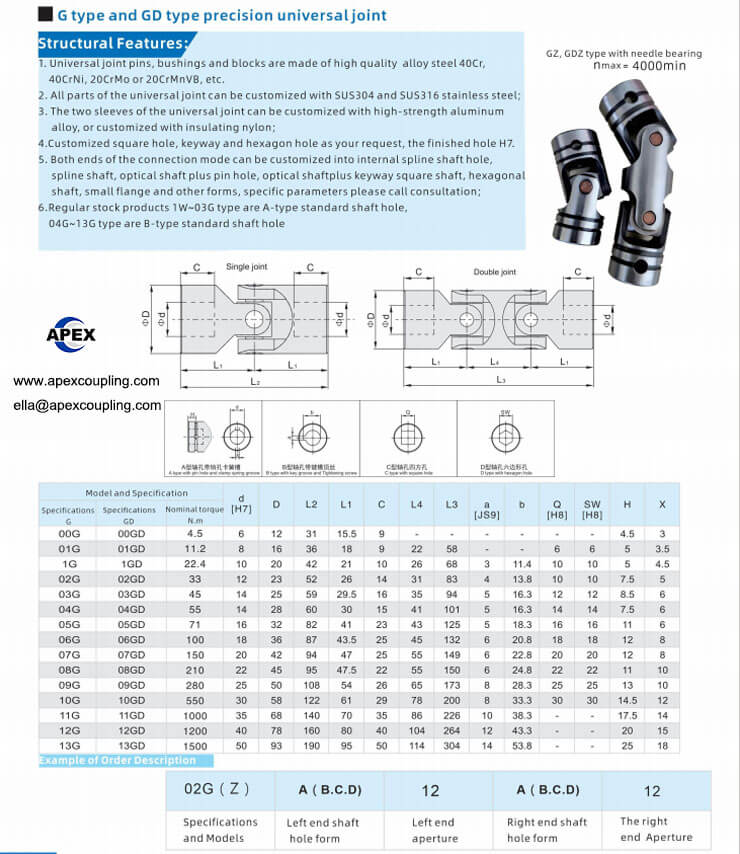
Needle Bearing Universal Joint Selection Guide – G/GD Series for High-Speed Applications
Universal joints (cardan joints) are essential for transmitting power between misaligned shafts. One of the most critical decisions when selecting a universal joint is the bearing type – pin/block (plain bearing) or needle roller bearing. The choice significantly impacts speed capacity, torque capability, maintenance requirements, and overall reliability.
This guide compares needle bearing and pin/block universal joints, helping you select the right type for your application – using the G/GD series as a practical example.
1. Pin/Block (Plain Bearing) – High Torque, Compact Design
How it works: Pin/block universal joints transmit torque through direct metal-to-metal contact between the pins and the yoke bores.
| Parameter | Pin/Block Bearing |
|---|---|
| Max Speed | 1000 RPM |
| Torque Capacity | Higher for given joint size |
| Space Requirement | More compact |
| Friction | Higher – metal-to-metal contact |
| Maintenance | Requires periodic lubrication |
| Best for | Low-speed, high-torque, shock loads |
| Typical Applications | Heavy machinery, conveyors, mixers, crushers |
✅ Choose pin/block when: You need high torque capacity, compact design, and are operating at speeds below 1000 RPM.
2. Needle Roller Bearing – High Speed, Low Friction
How it works: Needle bearing universal joints use roller bearings between the pins and the yoke bores, reducing friction and enabling higher speeds.
| Parameter | Needle Roller Bearing |
|---|---|
| Max Speed | 4000 RPM |
| Torque Capacity | Lower (approx. 50% of pin/block) |
| Space Requirement | Larger |
| Friction | Low – rolling elements reduce friction |
| Maintenance | Sealed, low maintenance |
| Best for | High-speed, smooth rotation, precision |
| Typical Applications | Packaging, printing, CNC, robotics, high-speed automation |
✅ Choose needle bearing when: You need high-speed operation (above 1000 RPM), low friction, and maintenance-free performance.
3. Quick Comparison Table
| Feature | Pin/Block (Plain) | Needle Roller Bearing |
|---|---|---|
| Max Speed | 1000 RPM | 4000 RPM |
| Torque Capacity | Higher | Lower (~50% of pin/block) |
| Friction | Higher | Lower |
| Maintenance | Requires lubrication | Sealed, low maintenance |
| Contamination Sensitivity | Lower | Higher |
| Space Requirement | Compact | Larger |
| Best for | Low speed, high torque, shock loads | High speed, smooth rotation, precision |
4. Material & Hardness – Why 42CrMo?
The G/GD series is manufactured from 42CrMo / 40Cr alloy steel with quenched & tempered treatment:
Body Hardness: HRC48-52 – provides high strength and wear resistance
Pin Hardness: HRC56-58 – bearing steel pins for superior durability
Tensile Strength: ≥600MPa – handles high torque loads
Fatigue Resistance: Excellent – withstands millions of cycles
✅ This combination of materials and heat treatment ensures long service life and reliable performance in demanding applications.
5. Single Joint (G) vs Double Joint (GD)
| Feature | G Type (Single) | GD Type (Double) |
|---|---|---|
| Angular misalignment | ✅ Up to 45° | ✅ Up to 45° per joint |
| Parallel offset | ❌ No | ✅ Yes |
| Total articulation | Up to 45° | Up to 90° |
| Length | Shorter | Longer |
| Best for | Shafts intersect at an angle | Shafts both angled and offset |
Rule of thumb:
Use G type when shafts are on the same plane but angled.
Use GD type when shafts are both angled and offset – provides smoother motion.
6. Operating Angle – 30° Working vs 45° Limit
The G/GD series is designed for smooth operation up to 30° in continuous use. The absolute limit per joint is 45°.
| Angle Range | Recommendation |
|---|---|
| 0° – 30° | ✅ Ideal for continuous operation – maximum bearing life |
| 30° – 45° | ⚠️ Acceptable for short periods – reduced bearing life |
| >45° | ❌ Not recommended – can cause joint failure |
Practical tip: For most applications, try to keep operating angles below 30° for continuous operation to maximize service life.
7. Surface Finish Options – Protection & Appearance
| Finish | Corrosion Protection | Best For |
|---|---|---|
| Black Oxide (Standard) | Moderate | General industrial |
| Nickel Plated | Good | Moderate corrosion environments |
| Zinc Plated | Good | Outdoor, moisture-prone applications |
| Chrome Plated | Good | Aesthetic or high-wear applications |
8. Applications Where Each Bearing Type Excels
| Industry | Application | Recommended Bearing |
|---|---|---|
| Packaging Machinery | High-speed conveyors | Needle bearing (4000 RPM) |
| Woodworking | Multi-spindle drills | Pin/block (high torque) |
| Printing | Register control | Needle bearing (high speed) |
| CNC Machines | Feed drives | Needle bearing (precision) |
| Conveyors | Heavy material handling | Pin/block (high torque) |
| Mixers | Industrial mixing | Pin/block (shock loads) |
| FA Automation | Pick-and-place | Needle bearing (high speed) |
9. Real‑World Example – High-Speed Packaging Line Upgrade
A packaging machinery manufacturer was experiencing friction and heat buildup with pin/block universal joints operating at 1800 RPM. The joints required frequent lubrication and replacement.
They switched to Apex Coupling G type needle bearing universal joints (42CrMo, needle bearing, 4000 RPM, H7 bore). Results:
Speed capability increased – needle bearing handled 1800 RPM smoothly
Maintenance eliminated – sealed, low-maintenance design
Friction reduced – rolling elements minimized heat generation
Service life extended – reduced wear and tear
10. Installation & Maintenance Tips
Check alignment – Keep operating angles ≤30° for continuous operation
Lubricate pin/block bearings – Regular lubrication extends service life
Needle bearings – Sealed, low maintenance – inspect periodically
Check for wear – Inspect cross shaft and bearings periodically
Dynamic balancing – For speeds above 1000 RPM, ensure the joint is balanced
Bore fit – Use H7 shaft tolerance for best concentricity
11. Selection Checklist
Bearing type: Pin/block (1000 RPM, high torque) or Needle bearing (4000 RPM, low friction)
Configuration: G (single) or GD (double)
Material: 42CrMo/40Cr (standard) or 304/316 stainless steel
Hardness: HRC48-52 body, HRC56-58 pins
Bore: H7 tolerance – match your shaft diameter
Angle: ≤30° for continuous operation (45° limit)
Finish: Black oxide, nickel, zinc, or chrome
Connection: Keyway, hexagon, square, spline, or plain
12. Conclusion
The G/GD precision universal joint coupling from Apex Coupling offers the flexibility of pin/block or needle bearing options, allowing you to match the bearing type to your application requirements. With 42CrMo construction, HRC48-52 hardness, H7 bore precision, and 45° angle capacity, it delivers reliable, long-lasting performance in demanding industrial environments.
👉 Need a precision universal joint for your application? Contact us with your bearing type, configuration, and bore requirements.
Inquiry now:
ella@apexcoupling.com
Needle bearing universal joint selection guide
Pin/block vs needle bearing universal joint
G/GD universal joint guide
42CrMo universal joint selection
High speed universal joint 4000 RPM
Packaging machinery coupling