Hytrel Spider Insert vs Polyurethane – Why Hytrel Lasts 3-5x Longer for Demanding Applications
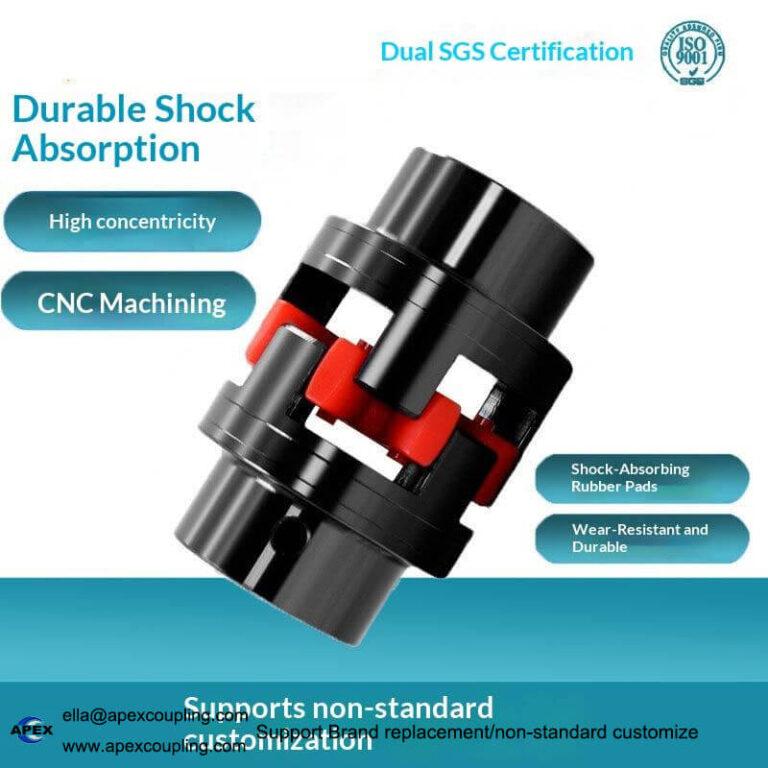
Spider inserts (also called elastomeric spiders or coupling elements) are the heart of jaw couplings – transmitting torque, absorbing shock, dampening vibration, and compensating for misalignment. Choosing the right spider material is critical for coupling performance, service life, and maintenance costs.
This guide compares Hytrel® (DuPont™ thermoplastic polyester elastomer) with standard polyurethane spiders, explaining why Hytrel delivers 3-5x longer service life and superior performance in demanding applications.
1. What Is a Spider Insert?
A spider insert is the flexible element that fits between the two jaw hubs of a jaw coupling. It:
Transmits torque from one hub to the other through the spider arms
Absorbs shock loads and dampens vibration
Compensates for misalignment – angular, parallel, and axial
Eliminates metal-to-metal contact – reducing wear and noise
The spider is the wear component – it compresses with each torque pulse and gradually loses its elastomeric properties.
2. Hytrel vs Polyurethane – Quick Comparison
| Feature | Hytrel (DuPont™) | Standard Polyurethane (98 Shore A) |
|---|---|---|
| Service Life | 3-5x longer | Standard |
| Torque Capacity | 2.5x greater than NBR | Good |
| Temperature Range | -60°F to 250°F (-51°C to 121°C) | -30°F to 160°F (-34°C to 71°C) |
| Oil Resistance | Excellent | Good |
| Chemical Resistance | Excellent | Good |
| Heat Resistance | Excellent – up to 250°F | Limited – up to 160°F |
| Abrasion Resistance | Superior | Good |
| Vibration Damping | Fair | Good |
| Cost | Higher | Lower |
3. Why Hytrel Outperforms Polyurethane
Reason 1: 3-5x Longer Service Life
Hytrel exhibits superior resistance to fatigue and creep – ensuring long-lasting performance and minimal downtime. Standard polyurethane degrades prematurely in demanding drives, requiring frequent replacement.
Reason 2: Higher Torque Capacity
Hytrel spiders provide 2.5 times greater torque capability than Buna-N (NBR) spiders – making them ideal for high-torque applications.
Reason 3: Wider Temperature Range
While polyurethane operates in a limited range of -30°F to 160°F (-34°C to 71°C), Hytrel operates from -60°F to 250°F (-51°C to 121°C) – suitable for extreme operating conditions.
Reason 4: Superior Oil & Chemical Resistance
Hytrel offers excellent resistance to oil, chemicals, and abrasion – making it ideal for compressors, pumps, and other oil-exposed environments.
Reason 5: High Temperature Tolerance
Hytrel is specified for high-temperature environments where polyurethane would degrade prematurely.
4. GS Series Design – Zero Backlash & High Stiffness
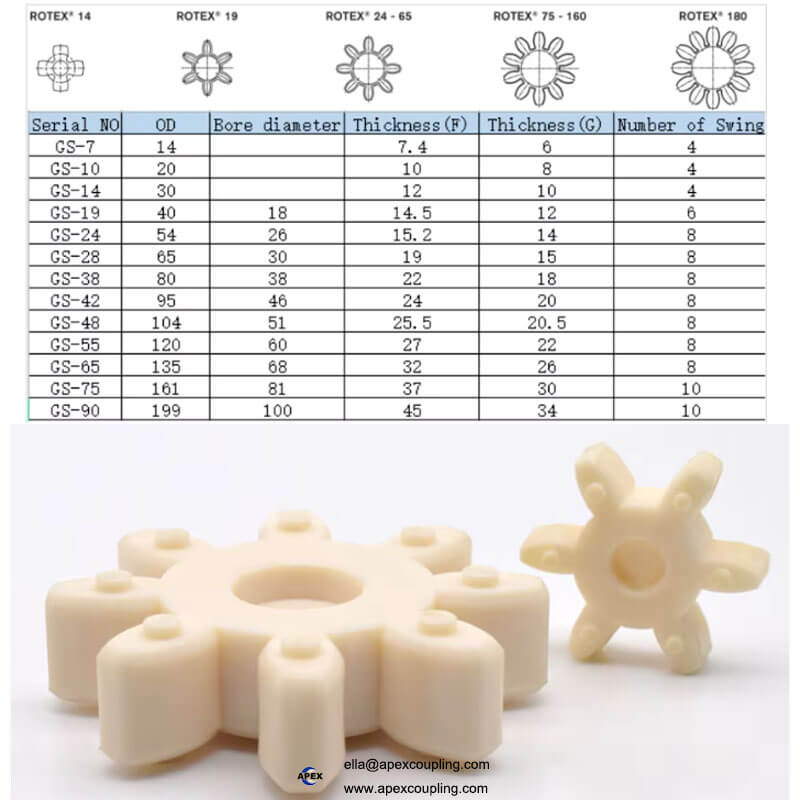
The GS Series spider features a straight center of the spider tooth, providing higher stiffness due to coupling prestress. This design delivers:
Zero backlash – essential for precision positioning and servo applications
High-speed capability – curved jaws and solid spider center enable high-speed operation
Misalignment compensation – crowned spider legs allow for angular and parallel misalignment
Easy assembly – chamfered jaws and spider legs for blind assembly in tight spaces
✅ The GS Series is available with four different spider materials (80A, 92A, 95/98A, & 64D shore).
5. When to Choose Hytrel Over Polyurethane
Choose Hytrel if your application requires:
| Requirement | Why Hytrel |
|---|---|
| High torque | 2.5x greater torque capacity than Buna-N |
| High temperature | Operates up to 250°F (121°C) |
| Oil exposure | Excellent oil resistance |
| Chemical exposure | Excellent chemical resistance |
| Long service life | 3-5x longer than polyurethane |
| Low maintenance | No lubrication required |
Choose Polyurethane if:
Cost is the primary concern
Operating conditions are mild (low temperature, no oil/chemical exposure)
Vibration damping is the highest priority
6. Applications Where Hytrel Excels
| Industry | Application | Why Hytrel? |
|---|---|---|
| Air Compressors | Compressor drives | Oil resistance, high temperature |
| Pumps | Centrifugal, gear pumps | Oil resistance, long life |
| Conveyors | Material handling | High torque, durability |
| Mixers | Industrial mixing | Shock absorption, chemical resistance |
| Machine Tools | Main spindle drives | Zero backlash, high stiffness |
| Servo Drives | Positioning systems | Zero backlash, precision |
7. Spider Replacement – When to Replace
Spider inserts should be inspected at every planned maintenance shutdown. Signs that replacement is due include:
Visible compression set – spider legs are permanently compressed
Cracking or splitting – visible damage to the spider
Increased backlash or noise – in the drive
Loss of elastomeric properties – reduced performance
💡 Spider replacement is a low-cost, short-duration task that prevents more expensive drive failures.
8. Real‑World Example – Air Compressor Upgrade
An industrial air compressor manufacturer was experiencing premature failure of standard polyurethane spiders in their compressor drives. The spiders degraded due to oil exposure and high operating temperatures – requiring replacement every 3-4 months.
They switched to Apex Coupling Hytrel GS spider inserts (64D shore hardness, Hytrel material). Results:
Service life extended to 18+ months – 3-5x longer than polyurethane
Oil degradation eliminated – Hytrel’s oil resistance
High temperature tolerance – Withstood compressor operating temperatures
Downtime reduced – fewer replacements
Maintenance costs reduced – no lubrication required
9. Selection Checklist
Coupling size: GS14 to GS55 – identify your coupling size
Shore hardness: 80A (damping), 92A (general), 95/98A (heavy), 64D (high stiffness)
Temperature: Ensure operating temperature within -51°C to 121°C range
Oil exposure: Hytrel for oil-exposed environments
Torque: Hytrel for high-torque applications
Maintenance: Hytrel – no lubrication required
10. Conclusion
The Hytrel GS type spider insert from Apex Coupling offers superior performance compared to standard polyurethane spiders – with 3-5x longer service life, 2.5x greater torque capacity, wider temperature range (-51°C to 121°C), and excellent oil/chemical resistance. For demanding applications including air compressors, pumps, conveyors, and machine tools, Hytrel is the clear choice.
👉 Need a Hytrel spider insert for your application? Contact us with your coupling size and shore hardness preference.
Inquiry now:
ella@apexcoupling.com
Hytrel vs polyurethane spider
GS spider insert selection
oil-resistant coupling spider
DuPont Hytrel coupling insert
high temperature spider insert
compressor coupling spider