Encoder Coupling Selection Guide – How to Choose the Right Coupling for Rotary Encoders
Rotary encoders are critical components in precision motion control systems, providing accurate position and speed feedback. The coupling between the encoder and motor shaft plays a crucial role in ensuring accurate feedback – a poorly chosen coupling can introduce errors, reduce accuracy, and shorten encoder life.
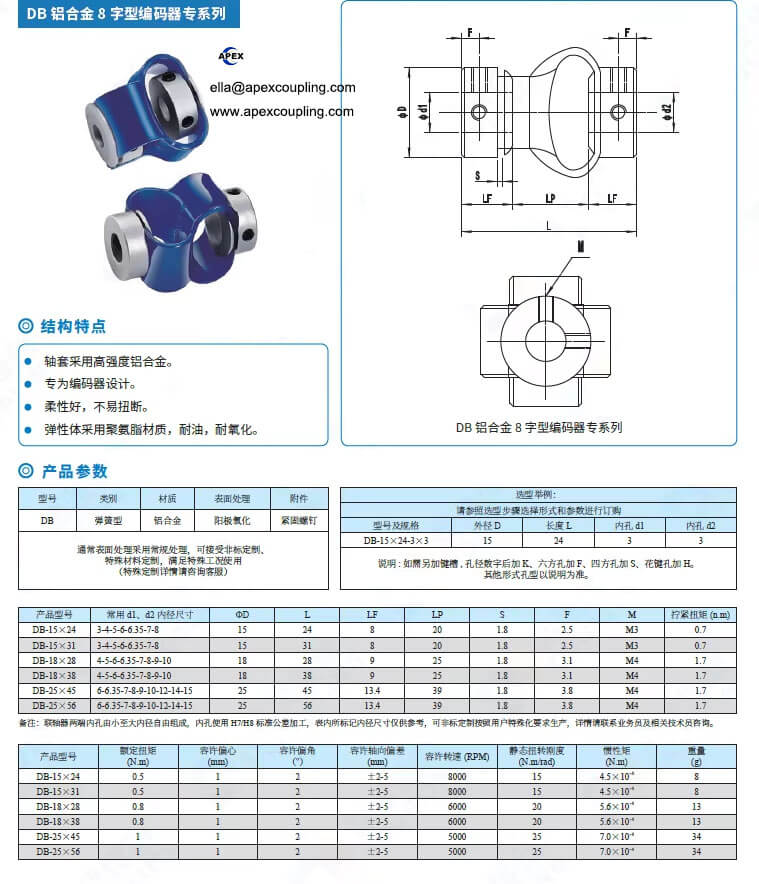
This guide explains the key requirements for encoder couplings and helps you select the right coupling for your application, using the DB 8-shaped double loop series as a practical example.
1. Why Encoders Need Specialized Couplings
Encoders require couplings that meet specific criteria:
| Requirement | Why It Matters |
|---|---|
| Zero backlash | Any rotational clearance causes position errors |
| Low inertia | Minimizes loading on the encoder – ensures accurate response |
| Misalignment compensation | Protects encoder bearings from stress and premature failure |
| Electrical isolation | Prevents ground loops that can corrupt encoder signals |
| Reliability | Long service life without maintenance – reduces downtime |
✅ The DB series is specifically engineered to meet all these requirements.
2. Types of Encoder Couplings
Several coupling types are commonly used for encoders:
| Coupling Type | Advantages | Best For |
|---|---|---|
| 8-Shaped (DB Series) | Zero backlash, high flexibility, oil/oxidation resistance, electrical isolation | General encoder applications, servo/stepper motors |
| Bellows Coupling | High torsional stiffness, zero backlash, good misalignment compensation | High-speed, high-precision encoders |
| Oldham Coupling | Large radial misalignment compensation, zero backlash | Applications with significant shaft offset |
| Jaw/Spider Coupling | Good vibration damping, cost-effective | General-purpose encoder connections |
3. Why Choose the 8-Shaped (DB) Design?
The 8-shaped double loop design offers unique advantages for encoder applications:
Exceptional flexibility – The figure-8 shape provides excellent angular, radial, and axial misalignment compensation
Zero backlash – No rotational clearance – accurate position feedback
High flexibility – Highly flexible without twisting or breaking
Oil & oxidation resistance – PU elastomer withstands harsh environments
Electrical insulation – PU elastomer prevents ground loops
Lightweight – Aluminum alloy hubs – low inertia
Easy installation – Set screw fastening – quick and secure
4. Key Selection Criteria for Encoder Couplings
When selecting an encoder coupling, consider these factors:
Step 1: Determine your shaft sizes
Measure the motor shaft diameter and encoder shaft diameter
Select a coupling with matching bore sizes (DB series: 3–13mm)
Step 2: Consider torque requirements
Calculate the torque your application requires
Select a coupling with adequate torque capacity (DB series: 0.15–1.3 N·m)
Step 3: Evaluate misalignment
Measure expected angular, radial, and axial misalignment
Ensure the coupling can accommodate your misalignment
Step 4: Check speed requirements
Verify the coupling’s maximum speed exceeds your operating speed
DB series: 3000 RPM (8000 RPM available)
Step 5: Consider environmental factors
Temperature: DB series: -20°C to +80°C
Chemical exposure: PU elastomer is oil-resistant and oxidation-resistant
5. Material Selection – Aluminum + PU Elastomer
| Component | Material | Properties |
|---|---|---|
| Hubs | High-strength aluminum alloy | Lightweight, corrosion-resistant, low inertia, anodized finish |
| Elastomer | Polyurethane (PU) | Oil-resistant, oxidation-resistant, flexible, durable, electrically insulating |
✅ The combination of aluminum hubs and PU elastomer provides the perfect balance of strength, low inertia, and long service life for encoder applications.
6. Zero Backlash – Why It Matters for Encoders
Backlash (rotational clearance) in a coupling causes:
Position errors – The encoder reports incorrect position
Reduced accuracy – Poor system performance
Control instability – Oscillations in servo systems
Reduced repeatability – Inconsistent positioning
✅ A zero backlash coupling like the DB series ensures accurate position feedback – every time.
7. Applications Where Encoder Couplings Excel
| Industry | Application | Why DB Series? |
|---|---|---|
| Encoders | Position feedback | Zero backlash, low inertia |
| Servo Motors | Precision motion control | Zero backlash, misalignment compensation |
| Stepper Motors | Accurate positioning | Zero backlash, easy installation |
| 3D Printers | Filament drive | Low inertia, flexibility |
| CNC Machines | Position feedback | Zero backlash, reliability |
| Packaging | Registration systems | Oil resistance, durability |
| Medical Devices | Precision motion | Reliability, electrical isolation |
8. Real‑World Example – Encoder Feedback Upgrade
A machine builder was experiencing position errors on a servo-driven indexing table. The encoder coupling had measurable backlash, causing the encoder to report incorrect positions – resulting in assembly misalignment and scrap.
They switched to Apex Coupling DB 8-shaped encoder coupling (aluminum hubs, PU elastomer, zero backlash, 6mm bore). Results:
Position errors eliminated – zero backlash
Encoder accuracy improved – precise position feedback
System stability increased – no oscillation
Maintenance eliminated – no lubrication required
Cost savings – reduced scrap and rework
9. Installation & Maintenance Tips
Clean shafts – Remove oil, grease, and debris
Check alignment – Even with misalignment compensation, keep within recommended limits
Tighten set screws evenly – Use a torque wrench to specification
No lubrication required – PU elastomer is self-lubricating
Inspect periodically – Check for wear or damage
Replace if damaged – PU elastomer can be replaced without replacing hubs
10. Selection Checklist
Bore size: Match motor and encoder shaft diameters – 3–13mm
Torque: Ensure coupling capacity exceeds application requirement – 0.15–1.3 N·m
Speed: Ensure max speed exceeds operating speed – 3000 RPM (8000 RPM available)
Misalignment: Check angular, radial, and axial capacity
Environment: Temperature -20°C to +80°C – oil/oxidation resistance
Backlash: Zero backlash for accurate position feedback
Material: Aluminum alloy + PU elastomer – lightweight and durable
11. Conclusion
The DB 8-shaped double loop encoder coupling from Apex Coupling offers the perfect combination of zero backlash, low inertia, high flexibility, and oil/oxidation resistance for encoder applications. With aluminum alloy hubs, PU elastomer, 3–13mm bore range, and OEM customization, it is the ideal solution for encoders, servo motors, stepper motors, and precision motion control systems.
👉 Need an encoder coupling for your application? Contact us with your bore size and torque requirements.
Inquiry now:
ella@apexcoupling.com
encoder coupling selection guide
rotary encoder coupling
zero backlash encoder coupling
figure 8 coupling for encoders
DB series encoder coupling
flexible coupling for encoders