Introduction
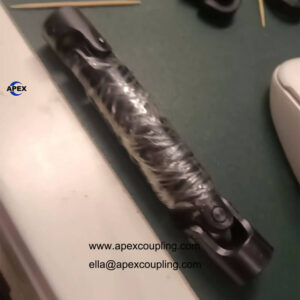
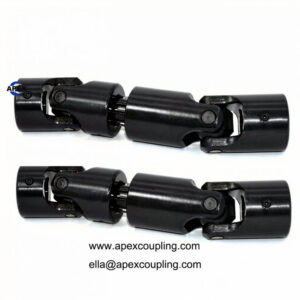
In many automated systems, the distance between the drive motor and the working spindle is not constant. For these applications, a standard fixed universal joint is insufficient. The WSP Series Telescopic Universal Joint provides the necessary “give” to accommodate changing lengths while maintaining high torque transmission.
1. The Importance of JB/T5901-1991 Standards
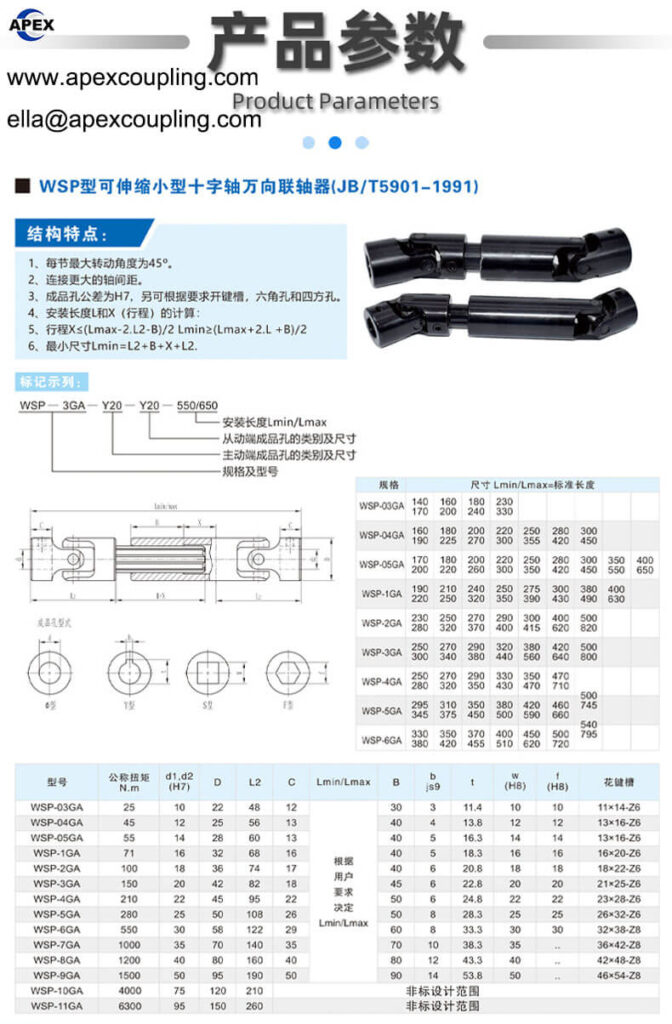
Standardization is key to reliability. Our WSP series follows the JB/T5901-1991 national standard, ensuring that every component—from the cross-pin to the spline sleeve—is interchangeable and meets rigorous load-bearing requirements.
2. Understanding the Calculation (Lmax vs. Lmin)
When designing your system, calculating the stroke (X) is critical.
Lmin: The shortest length of the assembly when fully retracted.
Lmax: The maximum safe extended length.
Using the formula $Lmin \ge (Lmax + 2 \cdot L_2 + B) / 2$, engineers can ensure that the spline maintains enough contact area to transmit full torque without stripping or failing at maximum extension.
3. Why 42CrMo is the “Gold Standard” for Splines
The sliding motion of a telescopic spline creates friction. We utilize 42CrMo alloy steel because it responds excellently to induction hardening. This creates a surface that is wear-resistant on the splines but maintains a tough, shock-absorbing core in the joint forks.
4. Versatile Bore Configurations
Every drive shaft is different. Our factory-direct service allows you to choose the exact interface you need. While H7 round bores are standard, we frequently produce Hexagonal bores for rapid-change tools and Square bores for manual drive systems.
Conclusion
The WSP Series is more than a connector; it’s a precision-engineered extension of your machine’s capability.
telescopic joint calculation, WSP coupling selection, universal joint stroke guide, industrial spline shaft benefits, JB/T5901 standard